


President Tsai Ing-wen (蔡英文), who is seeking re-election as the Democratic Progressive Party’s (DPP) presidential candidate, yesterday urged voters to “give [her] four more years,” saying “the next four years will be better.”
“Jan. 11 next year is key to protecting democracy and freedom,” Tsai said at an event in Taoyuan for independent Legislator Chao Cheng-yu (趙正宇).
Taiwan has become an aged society, she said, adding that since 2016, the government has pushed for long-term care, increasing its budget funding from NT$5 billion (US$165.5 million) to an estimated NT$40 billion next year.

Photo: Hung Mei-hsiuh, Taipei Times
The government hopes for seniors to receive the best service, whether at home, in their communities or at long-term care facilities, she said.
At another campaign event in Hsinchu, Tsai said that under the previous Chinese Nationalist Party (KMT) administration, the economy experienced negative growth.
“Now, Taiwan is first among the four [Asian] Tigers,” she said, adding that the nation’s economy has grown for 14 consecutive quarters, because many people are returning to Taiwan to invest.
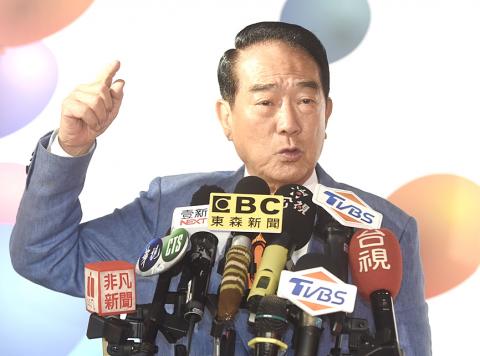
Photo: Chien Jung-fong, Taipei Times
Overseas Taiwanese businesses have pledged to invest NT$800 billion, she added.
While campaigning for DPP Legislator Lu Sun-ling (呂孫綾) in New Taipei City’s Tamsui District (淡水), Tsai said that she hoped people would vote for a candidate who can “take Taiwan forward,” instead of a “naysayer.”
Later in the evening, Tsai attended a concert in Taipei featuring heavy metal band Chthonic. The band’s lead vocalist is independent Legislator Freddy Lim (林昶佐), who is also seeking re-election.
Meanwhile, People First Party (PFP) Chairman James Soong (宋楚瑜), the party’s presidential candidate, said in a live-streamed interview yesterday that the KMT has been “controlled by a minority comprador group” when it comes to cross-strait affairs.
On the issue of pension reform, Soong said that the government would not be short of money if the DPP government could only clamp down on corruption.
Asked whether he regretted following former president Lee Teng-hui (李登輝), Soong said that in the early days, Taiwan democratized through a “peaceful revolution,” as then-president Chiang Ching-kuo (蔣經國) knew that was the trend.
Lee, who at the time served as vice president and later became Taiwan’s first directly elected president, continued what Chiang did not finish, Soong added.
Today, the PFP hosts a relay around the nation on electric scooters, with legislator-at-large nominees visiting social welfare facilities.
Soong and Hon Hai Precision Industry Co founder Terry Gou (郭台銘) would meet on the relay, Soong’s campaign spokeswoman Belle Yu (于美人) said, adding that the PFP hopes to run a “positive” campaign without manipulating other groups.
Additional reporting by Chou Hsiang-yun,
Hung Mei-hsiu and Chen Yu-fu

FUKUOKA SITUATION: Japanese media reported that the pathogen is expected to be identified by the summer, while the CDC downplayed the idea that it was hMPV A “mysterious cold-like illness” reported in Japan’s Fukuoka Prefecture does not seem to be a new disease, but Japanese authorities have been asked about the situation, the Centers for Disease Control (CDC) said yesterday. The Fukuoka Prefectural Medical Association on Wednesday told a news conference that a “mystery cold” that has become a hot topic on social media is “highly likely to be caused by some kind of viral infection,” Japan’s KBC News reported. “Many people are experiencing symptoms starting with a sore throat, followed by a runny nose, phlegm and a severe cough,” KBC News reported, citing association officials. Health authorities are

Nvidia Corp CEO Jensen Huang (黃仁勳) arrived in Taiwan yesterday ahead of upcoming AI and technology events, saying he plans to meet with clients and Taiwan Semiconductor Manufacturing Co Chairman C.C. Wei (魏哲家) during his visit. After landing at Taipei Songshan Airport, Huang posed for photos with fans and handed out Yakult drinks to reporters and supporters waiting at the scene, saying he has “a lot to do” during the trip. Asked about reports that Nvidia’s planned headquarters site in Taipei’s Beitou Shilin Technology Park could break ground on May 27, Huang said that if the company holds an event, he would

The Ministry of Finance this afternoon announced the winning numbers for the March-April uniform invoice lottery. The winning number for the NT$10 million (US$318,060) special prize is 19531471, and the winning number for the NT$2 million grand prize is 85941329. Three numbers were drawn for the NT$200,000 first prize: 07225810, 20231230 and 83518781. Those with receipts matching the last seven digits of any of the first-prize numbers will win the NT$40,000 second prize, while those matching the last six digits will win the NT$10,000 third prize. Those whose receipts match the last five digits of the first-prize numbers can claim the NT$4,000 fourth prize,
Taiwan Travelogue (臺灣漫遊錄), which earlier this week became the first Taiwanese novel to win the International Booker Prize, is to be adapted into a television series through a Taiwan-Japan coproduction, producer Chang Chen-yu (張辰漁) said yesterday. Chang, a producer at World Softest Production Film Co, wrote on Facebook that the company had been searching for projects with international appeal that retain a strong Taiwanese identity after colleagues and Japanese partners strongly recommended the novel. After reading the book, Chang said he immediately decided to pursue the screen rights. “A great story has the power to transcend time and borders, and connect countless people,”


 RSS
RSS