


Taipei prosecutors have summoned more people for questioning regarding travel agencies allegedly helping Chinese government officials pose as tourists to enter Taiwan illegally, including former Bamboo Union leader Chang An-le (張安樂), founder of the China Unification Promotion Party.
Chang, also known as the “White Wolf,” was listed as a person of interest in the case and released after questioning on Tuesday, while 11 other people have been summoned for questioning, including Chang’s son, Chang Wei (張瑋), and daughter-in-law, Wang Shu-yin (王姝茵).
Wang was listed as a suspect and released on bail of NT$250,000 (US$8,269) yesterday morning, but authorities would have to wait to talk to Chang Wei, who was not in Taiwan.
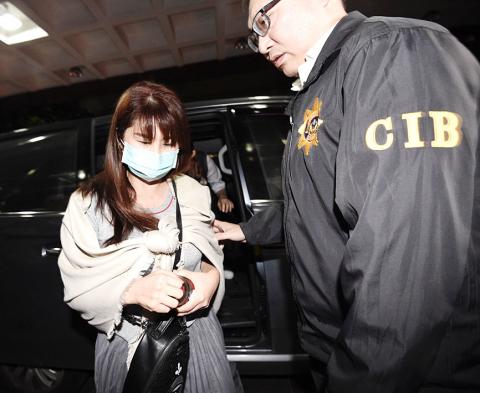
Photo: George Tsorng, Taipei Times
Chang Wei and Wang have since 2010 operated New Taipei City-based Huaxia Dadi Travel Service (華夏大地旅行社), one of six travel agencies raided on Tuesday, the second round of operations after authorities launched their investigation with raids on Wednesday last week.
The investigation has found that about 30 travel agencies allegedly created forged documents and bogus itineraries to help Chinese officials enter Taiwan illegally, colluding with Hung Ching-lin (洪慶淋), a retired journalist formerly with the Chinese-language China Times and the alleged mastermind of the operation, officials said.
As part of what prosecutors have called the most serious breach of national security in years, investigators yesterday said that from January 2017 to June, between 2,000 and 5,000 people linked to the Chinese government, including officials of the Chinese Communist Party’s United Front Work Department and suspected intelligence operatives, illegally entered Taiwan.
In addition to Wang, the other people questioned on Tuesday were released on bail of between NT$50,000 and NT$250,000, with prosecutors saying that they face charges of contravening the Act Governing Relations Between the People of the Taiwan Area and the Mainland Area (台灣地區與大陸地區人民關係條例).
After his release, Chang An-le told reporters: “My son is running a proper travel agency, which collects service fees from Chinese tourists. What is wrong with that?”
“As Taiwan’s tourism industry is stagnating, I implore President Tsai [Ing-wen (蔡英文)] to halt the prosecution against my son and other people in the case,” he said.
Hung, who was last week released on bail of NT$250,000, retired from the newspaper in 2008 and became office director of the Chinese Nationalist Party’s (KMT) caucus at the then-Taipei County Council. He has reportedly registered more than 100 nonprofit organizations and shell companies, which he allegedly used to organize purportedly short-term cross-strait exchange programs.
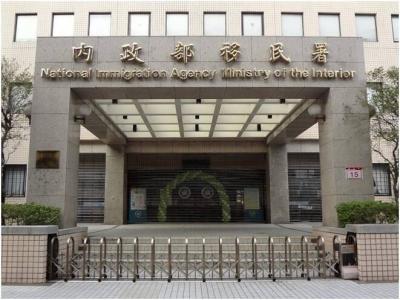
These organizations allegedly used forged documents to apply with the National Immigration Agency for entry permits for Chinese nationals to visit Taiwan on “package tours,” bypassing background checks for people associated with the Chinese government.
Prosecutors said that the operation, which Hung allegedly ran with his wife and daughter, generated more than NT$10 million in revenue by charging a NT$2,000 service fee for each Chinese “tourist.”
A small number of Taiwanese this year lost their citizenship rights after traveling in China and obtaining a one-time Chinese passport to cross the border into Russia, a source said today. The people signed up through Chinese travel agencies for tours of neighboring Russia with companies claiming they could obtain Russian visas and fast-track border clearance, the source said on condition of anonymity. The travelers were actually issued one-time-use Chinese passports, they said. Taiwanese are prohibited from holding a Chinese passport or household registration. If found to have a Chinese ID, they may lose their resident status under Article 9-1

Taiwanese were praised for their composure after a video filmed by Taiwanese tourists capturing the moment a magnitude 7.5 earthquake struck Japan’s Aomori Prefecture went viral on social media. The video shows a hotel room shaking violently amid Monday’s quake, with objects falling to the ground. Two Taiwanese began filming with their mobile phones, while two others held the sides of a TV to prevent it from falling. When the shaking stopped, the pair calmly took down the TV and laid it flat on a tatami mat, the video shows. The video also captured the group talking about the safety of their companions bathing

PROBLEMATIC APP: Citing more than 1,000 fraud cases, the government is taking the app down for a year, but opposition voices are calling it censorship Chinese Nationalist Party (KMT) Chairwoman Cheng Li-wun (鄭麗文) yesterday decried a government plan to suspend access to Chinese social media platform Xiaohongshu (小紅書) for one year as censorship, while the Presidential Office backed the plan. The Ministry of the Interior on Thursday cited security risks and accusations that the Instagram-like app, known as Rednote in English, had figured in more than 1,700 fraud cases since last year. The company, which has about 3 million users in Taiwan, has not yet responded to requests for comment. “Many people online are already asking ‘How to climb over the firewall to access Xiaohongshu,’” Cheng posted on

A classified Pentagon-produced, multiyear assessment — the Overmatch brief — highlighted unreported Chinese capabilities to destroy US military assets and identified US supply chain choke points, painting a disturbing picture of waning US military might, a New York Times editorial published on Monday said. US Secretary of Defense Pete Hegseth’s comments in November last year that “we lose every time” in Pentagon-conducted war games pitting the US against China further highlighted the uncertainty about the US’ capability to intervene in the event of a Chinese invasion of Taiwan. “It shows the Pentagon’s overreliance on expensive, vulnerable weapons as adversaries field cheap, technologically


 RSS
RSS