


The Taiwan People’s Party (TPP) and the People First Party (PFP) could still cooperate while competing in the Jan. 11 legislative elections, Taipei Mayor Ko Wen-je (柯文哲) said yesterday.
Ko, who is also TPP chairman, made the remark when asked about a rumor that his friendship with PFP Chairman James Soong (宋楚瑜), the PFP’s presidential candidate, has soured as they are both trying to solicit votes for their parties in the elections.
Under the “single-member constituency, two-vote” system, each eligible voter casts two ballots in legislative elections: one for a district candidate and the other for a party. Legislator-at-large seats are apportioned based on party ballots, but a party must have at least 5 percent of all ballots to be eligible.
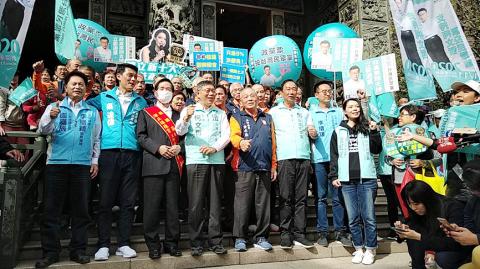
Photo: Lai Hsiao-tung, Taipei Times
Ko said that he is a follower of Scottish philosopher and political economist Adam Smith, so he believes in the idea that “individuals pursuing their own interest can benefit society more effectually,” and that people who are in a competitive relationship can still cooperate.
Remarks by TPP and PFP politicians have prompted media speculation about the status of relations between the two parties.
On Thursday, when asked to compare the TPP’s legislator-at-large nominees list with that of the PFP, Ko said that the TPP’s is “much stronger.”
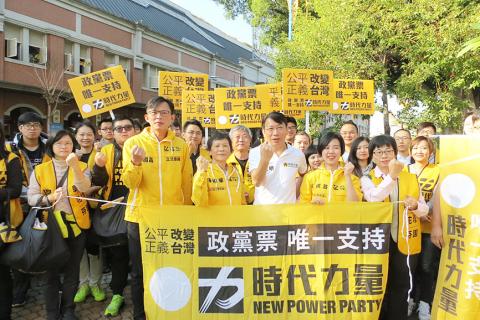
Photo: Su Chin-feng, Taipei Times
On Friday, he said in a radio interview that among the “third force” parties, the New Party and the PFP “cannot lead the way anymore” and the New Power Party (NPP) is “on its deathbed.”
The TPP is like a new company, while the PFP is like a shell company that has undergone corporate restructuring, he added.
Asked to comment in the interview on PFP legislator-at-large nominee Amanda Liu’s (劉宥彤) remark suggesting that supporters of “third force” parties should divide their votes among the TPP and PFP, Ko said: “If you ask me, of course I will say: ‘Just give all the votes to the TPP,’ but, of course, from her standpoint, she has to say that.”
Later that day, when asked to comment on Ko’s remarks, Soong said that “without the PFP’s support, could [Ko] have won re-election?”
“Taiwanese need to vote for people who are affectionate and righteous, and work seriously with responsibility, not someone who goes crazy during elections,” he said.
Soong said that he has disregarded his reputation and publicly supported Ko many times, but added: “Why is [Ko] always targeting us [the PFP]?”
Ko yesterday said that as he used to be a surgeon, he is extraordinarily calm, adding that the TPP and the PFP have a “co-opetition” relationship, meaning that they still cooperate, despite being competitors.
Separately yesterday, the NPP, which won 7 percent of overall party votes in the 2016 elections, canvassed in Taichung’s Jianguo Market (建國市場).
The NPP received more than 104,000 votes in Taichung, accounting for more than 7 percent of the city’s party votes in 2016.
NPP Chairman Hsu Yung-ming (徐永明) said that he hopes the party can obtain at least 10 percent of party votes in next month’s elections to keep NPP Legislator Huang Kuo-chang (黃國昌) in the Legislative Yuan.
There should be fair competition for party votes, he said, referring to comments by President Tsai Ing-wen (蔡英文) suggesting that voters should cast party votes for the Democratic Progressive Party (DPP), of which she is the presidential candidate, not small pan-green camp parties.
Environmentalist Chen Jiau-hua (陳椒華), who is first on the NPP’s legislator-at-large nominees list, said that the DPP’s manipulative strategy is ridiculous and urged the DPP to stop the undemocratic practice.
Additional reporting by Su Chin-feng
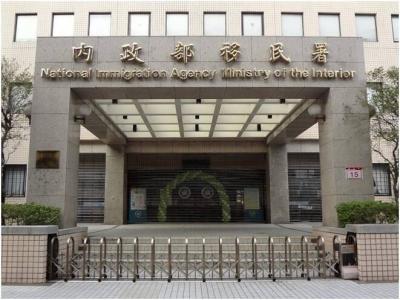
A small number of Taiwanese this year lost their citizenship rights after traveling in China and obtaining a one-time Chinese passport to cross the border into Russia, a source said today. The people signed up through Chinese travel agencies for tours of neighboring Russia with companies claiming they could obtain Russian visas and fast-track border clearance, the source said on condition of anonymity. The travelers were actually issued one-time-use Chinese passports, they said. Taiwanese are prohibited from holding a Chinese passport or household registration. If found to have a Chinese ID, they may lose their resident status under Article 9-1

Taiwanese were praised for their composure after a video filmed by Taiwanese tourists capturing the moment a magnitude 7.5 earthquake struck Japan’s Aomori Prefecture went viral on social media. The video shows a hotel room shaking violently amid Monday’s quake, with objects falling to the ground. Two Taiwanese began filming with their mobile phones, while two others held the sides of a TV to prevent it from falling. When the shaking stopped, the pair calmly took down the TV and laid it flat on a tatami mat, the video shows. The video also captured the group talking about the safety of their companions bathing

PROBLEMATIC APP: Citing more than 1,000 fraud cases, the government is taking the app down for a year, but opposition voices are calling it censorship Chinese Nationalist Party (KMT) Chairwoman Cheng Li-wun (鄭麗文) yesterday decried a government plan to suspend access to Chinese social media platform Xiaohongshu (小紅書) for one year as censorship, while the Presidential Office backed the plan. The Ministry of the Interior on Thursday cited security risks and accusations that the Instagram-like app, known as Rednote in English, had figured in more than 1,700 fraud cases since last year. The company, which has about 3 million users in Taiwan, has not yet responded to requests for comment. “Many people online are already asking ‘How to climb over the firewall to access Xiaohongshu,’” Cheng posted on

A classified Pentagon-produced, multiyear assessment — the Overmatch brief — highlighted unreported Chinese capabilities to destroy US military assets and identified US supply chain choke points, painting a disturbing picture of waning US military might, a New York Times editorial published on Monday said. US Secretary of Defense Pete Hegseth’s comments in November last year that “we lose every time” in Pentagon-conducted war games pitting the US against China further highlighted the uncertainty about the US’ capability to intervene in the event of a Chinese invasion of Taiwan. “It shows the Pentagon’s overreliance on expensive, vulnerable weapons as adversaries field cheap, technologically


 RSS
RSS