


The Taoyuan Department of Rapid Transit Systems broke ground yesterday on the Green Line of the Taoyuan Mass Rapid Transit (MRT) network, scheduled to start running in 2026 extending the Airport MRT, also known as the purple line.
According to the department, the new line would be 27.8km long, with stops at 21 stations — 10 underground and 11 elevated.
The budget for the line totals NT$98.2 billion (US$3.17 billion), with the city paying NT$39.7 billion and the central government footing the remainder, according to the department.
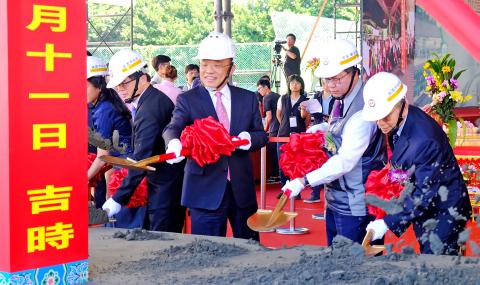
Photo: CNA
Taoyuan Mayor Cheng Wen-tsan (鄭文燦) presided over the groundbreaking ceremony, which was attended by Premier Su Tseng-chang (蘇貞昌).
Su praised Cheng for his persistence in seeking funding from the central government for the MRT system, and said that without a convenient transportation connection, it would be difficult for the city to further develop.
The department said the new line would run through Bade (八德) and Lujhu (蘆竹) districts in a north-south network and connect two stations on the Airport MRT — Kengkou (坑口, the A11 Station) and Hengshan (橫山, the A16 Station) once construction is completed.
The green line was named the “Aerotropolis line” because it would pass through the ambitious airport city project and connect to Taipei through the Airport MRT line, which connects Taipei Main Station with Taoyuan.
In addition to the Taoyuan MRT connection, the new line is also expected to link the unfinished Sanying line of the Taipei MRT to the Sansia (三峽) and Yingge (鶯歌) districts of New Taipei City.
The Sanying line, now under construction. is scheduled to start in 2023, so the green line would connect the city to Taipei and New Taipei City.
Taoyuan, home to factories and industrial parks, has in recent years attracted Taipei workers seeking more affordable housing.
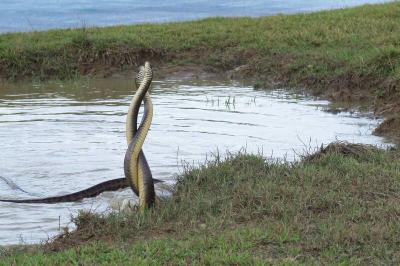
Kenting National Park service technician Yang Jien-fon (楊政峰) won a silver award in World Grand Prix Photography Awards Spring Season for his photograph of two male rat snakes intertwined in combat. Yang’s colleagues at Kenting National Park said he is a master of nature photography who has been held back by his job in civil service. The awards accept entries in all four seasons across six categories: architectural and urban photography, black-and-white and fine art photography, commercial and fashion photography, documentary and people photography, nature and experimental photography, and mobile photography. Awards are ranked according to scores and divided into platinum, gold and
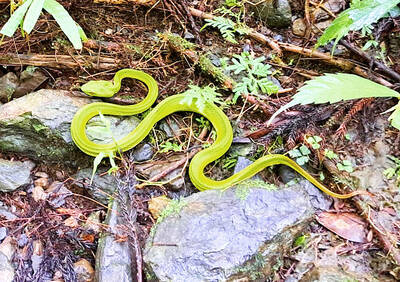
More than half of the bamboo vipers captured in Tainan in the past few years were found in the city’s Sinhua District (新化), while other districts had smaller catches or none at all. Every year, Tainan captures about 6,000 snakes which have made their way into people’s homes. Of the six major venomous snakes in Taiwan, the cobra, the many-banded krait, the brown-spotted pit viper and the bamboo viper are the most frequently captured. The high concentration of bamboo vipers captured in Sinhua District is puzzling. Tainan Agriculture Bureau Forestry and Nature Conservation Division head Chu Chien-ming (朱健明) earlier this week said that the

The Chinese Nationalist Party (KMT) caucus yesterday said it opposes the introduction of migrant workers from India until a mechanism is in place to prevent workers from absconding. Minister of Labor Hung Sun-han (洪申翰) on Thursday told the Legislative Yuan that the first group of migrant workers from India could be introduced as early as this year, as part of a government program. The caucus’ opposition to the policy is based on the assessment that “the risk is too high,” KMT caucus secretary-general Lin Pei-hsiang (林沛祥) said. Taiwan has a serious and long-standing problem of migrant workers absconding from their contracts, indicating that

SPACE VETERAN: Kjell N. Lindgren, who helps lead NASA’s human spaceflight missions, has been on two expeditions on the ISS and has spent 311 days in space Taiwan-born US astronaut Kjell N. Lindgren is to visit Taiwan to promote technological partnerships through one of the programs organized by the US for its 250th national anniversary. Lindgren would be in Taiwan from Tuesday to Saturday next week as part of the US Bureau of Educational and Cultural Affairs’ US Speaker Program, organized to celebrate the 250th anniversary of the signing of the Declaration of Independence, the American Institute in Taiwan (AIT) said in a statement yesterday. Lindgren plans to engage with key leaders across the nation “to advance cutting-edge technological partnerships and inspire the next generation of scientists and engineers,”


 RSS
RSS