


Fish tethering — live fish being bound in a “U” shape to keep them fresh — causes unnecessary pain and poses a food safety threat, animal right groups said yesterday.
Asian sea bass, also known as barramundi, make up 70 percent of farmed sea bass in Taiwan, with information from the Fisheries Agency showing that about 10.35 million of them were sold last year.
The Environment and Animal Society of Taiwan estimated that 3.45 million tethered Asian sea bass were sold last year.
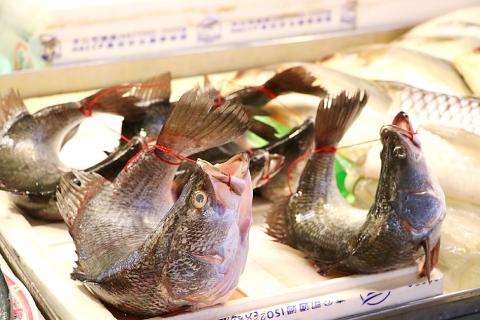
Photo courtesy of the Environment and Animal Society of Taiwan
Vendors tether the fish by puncturing the mouth and a gill and tying red string in the holes that loops around the tail, a painful process that prolongs the time they can survive out of water by eight to 12 hours before they die in terror, the group said.
Research has shown that pain causes the fish to generate additional lactic acid, which taints the meat, it said.
Fish should be “rendered unconscious or killed immediately after capture” to reduce their suffering, otherwise endocrine changes triggered by pain results in reduced meat quality, National Taiwan Ocean University associate professor of aquaculture Huang Chih-yang (黃之暘) said.
Bacteria in water sprinkled on tethered fish to help keep them alive can enter the wounds and contaminate the flesh, Huang said.
Taipei Animal Protection Office Animal Rescue Team leader Wu Ching-an (吳晉安) said that vendors who tether are not in breach of the Animal Protection Act (動物保護法), as they do not intend to torture the fish.
The authorities should extend humane slaughter rules to cover fish so that vendors would be accountable to those regulations, Wu said.
While tethered fish are a common sight at the Taipei Fish Market, the team has not received complaints, which shows that people’s awareness of animal protection needs to be enhanced, he said.
The Environment and Animal Society called on the Council of Agriculture to promulgate animal welfare regulations regarding farming, transportation, sale and slaughter of fish and to educate people on fish welfare.
Fisheries Agency Deputy Director-General Lin Kuo-ping (林國平) said tethering is traditional in Taiwan, but raising public awareness about fish welfare is a discussion worth having.
“Discussion over this issue would have to involve research and input from the government, industry and academics,” Lin said. “The Fisheries Agency will convene a meeting of experts to discuss the matter as soon as possible.”

Taiwanese can file complaints with the Tourism Administration to report travel agencies if their activities caused termination of a person’s citizenship, Mainland Affairs Council Minister Chiu Chui-cheng (邱垂正) said yesterday, after a podcaster highlighted a case in which a person’s citizenship was canceled for receiving a single-use Chinese passport to enter Russia. The council is aware of incidents in which people who signed up through Chinese travel agencies for tours of Russia were told they could obtain Russian visas and fast-track border clearance, Chiu told reporters on the sidelines of an event in Taipei. However, the travel agencies actually applied

Japanese footwear brand Onitsuka Tiger today issued a public apology and said it has suspended an employee amid allegations that the staff member discriminated against a Vietnamese customer at its Taipei 101 store. Posting on the social media platform Threads yesterday, a user said that an employee at the store said that “those shoes are very expensive” when her friend, who is a migrant worker from Vietnam, asked for assistance. The employee then ignored her until she asked again, to which she replied: "We don't have a size 37." The post had amassed nearly 26,000 likes and 916 comments as of this

New measures aimed at making Taiwan more attractive to foreign professionals came into effect this month, the National Development Council said yesterday. Among the changes, international students at Taiwanese universities would be able to work in Taiwan without a work permit in the two years after they graduate, explainer materials provided by the council said. In addition, foreign nationals who graduated from one of the world’s top 200 universities within the past five years can also apply for a two-year open work permit. Previously, those graduates would have needed to apply for a work permit using point-based criteria or have a Taiwanese company

The Shilin District Prosecutors’ Office yesterday indicted two Taiwanese and issued a wanted notice for Pete Liu (劉作虎), founder of Shenzhen-based smartphone manufacturer OnePlus Technology Co (萬普拉斯科技), for allegedly contravening the Act Governing Relations Between the People of the Taiwan Area and the Mainland Area (臺灣地區與大陸地區人民關係條例) by poaching 70 engineers in Taiwan. Liu allegedly traveled to Taiwan at the end of 2014 and met with a Taiwanese man surnamed Lin (林) to discuss establishing a mobile software research and development (R&D) team in Taiwan, prosecutors said. Without approval from the government, Lin, following Liu’s instructions, recruited more than 70 software


 RSS
RSS