


A team of oceanographers from National Taiwan University (NTU) yesterday unveiled the first observations of the Kuroshio Current’s interleaving structures made using a Seaglider, a US-made uncrewed underwater vehicle that they hope will usher in a new era for oceanography studies in Taiwan.
While layered hydrographic structures are often observed in waters with less velocity, such as in the Arctic Ocean and currents near the equator, the team is the first to document such structures in the Kuroshio east of Taiwan, NTU Institute of Oceanography director Jan Sen (詹森) told a news conference at the Ministry of Science and Technology in Taipei.
As part of its long-term observations of the Kuroshio since 2012, the team operated a Seaglider to complete 434 dives down to a depth of 1,000m from December 2016 to March 2017 and obtained high-resolution hydrographic data, Jan said.
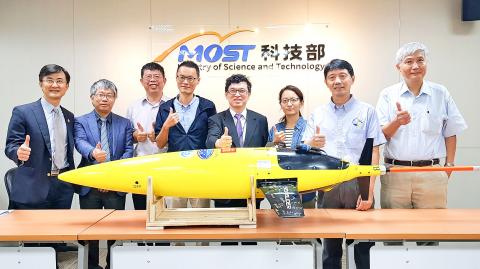
Photo: Chien Hui-ju, Taipei Times
They found that two dissimilar water masses within the 500m to 800m part of the Kuroshio do not blend quickly; rather, their contact gives rise to interleaving layers with varying salinity levels and temperatures, revolutionizing their concepts about the Kuroshio, the hydrological layers of which are not as smooth as they had presumed, he said.
The layered underwater structures would not affect rescue efforts, maritime construction or the operation of submarines, as the missions mostly occur 100m to 200m underwater, he said.
The team detailed their findings in a paper published in the journal Scientific Reports on Aug. 6.
It was the first time that Taiwanese oceanographers have made their own Seaglider observations, Jan said.
Thanks to the ministry’s funding, the institute purchased the nation’s two Seagliders for NT$6.5 million (US$209,252) each, he said, adding that he needed “export licenses” from the US Department of Commerce to import the vehicles due to the sensitive nature of the procurements.
Able to work in water for up to nine months, the energy-efficient Seagilders enabled the team to learn more about the ocean and improved global climate change projections using fewer personnel, he said, adding that team members had to constantly monitor the vehicles online.
Coupled with the institute’s buoys for monitoring typhoons and the nation’s ocean research vessels, the gliders would bring Taiwanese oceanography to a new level with increasing demand for driverless vehicles, Jan said.
Even the nation’s military cannot purchase such gliders, so it is significant that the institute has cultivated a team for operating the vehicles and managing related data, said Chiang Kuo-ping (蔣國平), convener of oceanography program under the ministry’s Department of Natural Sciences and Sustainable Development.
Chiang said that a similar vehicle once caused tension between China and the US when a Chinese naval vessel in 2016 intercepted a glider owned by a US survey ship in international waters near the Philippines, which was resolved after the Chinese government returned the glider to the US.
Data collected by the gliders are protected and regulated by the government, especially those collected within territorial waters, Jan added.
The team is also part of the global OceanGliders Boundary Ocean Observing Network set up by the Joint Technical Commission for Oceanography and Marine Meteorology, an intergovernmental body under UNESCO and the World Meteorological Organization.

Taiwanese can file complaints with the Tourism Administration to report travel agencies if their activities caused termination of a person’s citizenship, Mainland Affairs Council Minister Chiu Chui-cheng (邱垂正) said yesterday, after a podcaster highlighted a case in which a person’s citizenship was canceled for receiving a single-use Chinese passport to enter Russia. The council is aware of incidents in which people who signed up through Chinese travel agencies for tours of Russia were told they could obtain Russian visas and fast-track border clearance, Chiu told reporters on the sidelines of an event in Taipei. However, the travel agencies actually applied
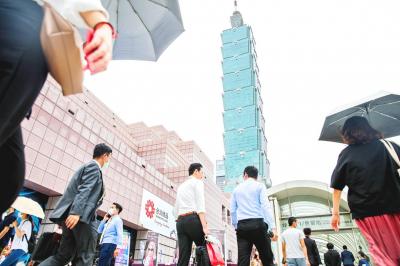
Japanese footwear brand Onitsuka Tiger today issued a public apology and said it has suspended an employee amid allegations that the staff member discriminated against a Vietnamese customer at its Taipei 101 store. Posting on the social media platform Threads yesterday, a user said that an employee at the store said that “those shoes are very expensive” when her friend, who is a migrant worker from Vietnam, asked for assistance. The employee then ignored her until she asked again, to which she replied: "We don't have a size 37." The post had amassed nearly 26,000 likes and 916 comments as of this

New measures aimed at making Taiwan more attractive to foreign professionals came into effect this month, the National Development Council said yesterday. Among the changes, international students at Taiwanese universities would be able to work in Taiwan without a work permit in the two years after they graduate, explainer materials provided by the council said. In addition, foreign nationals who graduated from one of the world’s top 200 universities within the past five years can also apply for a two-year open work permit. Previously, those graduates would have needed to apply for a work permit using point-based criteria or have a Taiwanese company
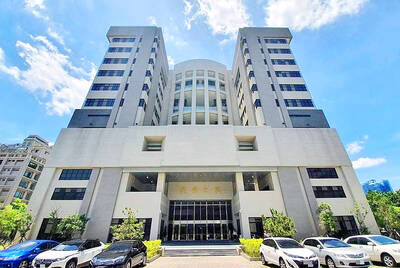
The Shilin District Prosecutors’ Office yesterday indicted two Taiwanese and issued a wanted notice for Pete Liu (劉作虎), founder of Shenzhen-based smartphone manufacturer OnePlus Technology Co (萬普拉斯科技), for allegedly contravening the Act Governing Relations Between the People of the Taiwan Area and the Mainland Area (臺灣地區與大陸地區人民關係條例) by poaching 70 engineers in Taiwan. Liu allegedly traveled to Taiwan at the end of 2014 and met with a Taiwanese man surnamed Lin (林) to discuss establishing a mobile software research and development (R&D) team in Taiwan, prosecutors said. Without approval from the government, Lin, following Liu’s instructions, recruited more than 70 software


 RSS
RSS