


A national shortage of organs and donors has continued to worsen, adding that modest increases to the numbers of organ donors are being far outstripped by a rising number of people awaiting transplants, the Taiwan Organ Registry and Sharing Center said on Thursday.
While the number of organ donors last year increased to 324 people, up from 264 people in 2015, those awaiting organ transplants rose from 8,674 to 9,576 during the same period, it said, adding that the center expects the figure to exceed 10,000 by the end of this year.
The 363 organs donated last year marked a decrease from 410 organs in 2015, the center said, even as 642 tissue and membrane donations marked an increase over 539 in 2015, which shows that tissue donations are becoming more culturally acceptable.

Photo: Lin Hui-chin, Taipei Times
The organ donation rate per 1 million people in Taiwan last year was 14.2, markedly fewer than 48 in Spain, 33.4 in Belgium, 27.3 in Italy, 17.7 in Sweden, 33.3 in the US and 24.5 in the UK, it said.
Aging populations have led to rising demand for transplants around the world, but a cultural aversion to organ donation — originating from the Chinese custom of preserving the whole body for burial — has worsened the problem in Taiwan, center chief executive Chiang Yang-jen (江仰仁) said.
A comprehensive public education effort would be needed to change the culture, he said, adding that the Ministry of Health and Welfare and the Ministry of Education should consider incorporating materials about organ donation in the elementary-school curriculum.
“However, that the elderly are increasingly willing to donate their organs is an encouraging sign that a shift in attitudes is taking place,” Chiang said.
Social worker Hsieh Shu-hao (謝書豪), who is based at Linkou Chang Gung Memorial Hospital in Taoyuan, said that he has personally witnessed family disputes sparked by organ donations.
He recalled a 20-year-old man who fell seriously ill and when his parents told the family that their child had spoken of donating his organs, his aunts were dismayed, with one saying: “I dare any of you to lay a finger on him.”
Despite complaints from the father that his wishes as a parent should take precedence over the aunts and uncles wishes, the family prevailed and no organ was donated, he said.
“While the bonds of tradition and the inability of a family to agree on a course of action play a large role in the difficulties surrounding organ donation in Taiwan, the real problem is that a lot of people simply do not have it in them to put their loved ones under the knife,” he said.
Taipei Veterans General Hospital organ donation coordinator Liao Li-feng (廖麗鳳) said that there had been a case where the family refused to donate the cornea of their deceased until their religious adviser told them that the dead need a heart to navigate the netherworld, not their eyes.
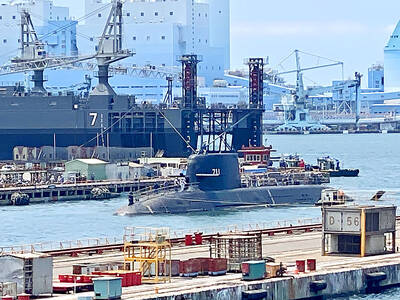
AGING: While Japan has 22 submarines, Taiwan only operates four, two of which were commissioned by the US in 1945 and 1946, and transferred to Taiwan in 1973 Taiwan would need at least 12 submarines to reach modern fleet capabilities, CSBC Corp, Taiwan chairman Chen Cheng-hung (陳政宏) said in an interview broadcast on Friday, citing a US assessment. CSBC is testing the nation’s first indigenous defense submarine, the Hai Kun (海鯤, Narwhal), which is scheduled to be delivered to the navy next month or in July. The Hai Kun has completed torpedo-firing tests and is scheduled to undergo overnight sea trials, Chen said on an SET TV military affairs program. Taiwan would require at least 12 submarines to establish a modern submarine force after assessing the nation’s operational environment and defense

A white king snake that frightened passengers and caused a stir on a Taipei MRT train on Friday evening has been claimed by its owner, who would be fined, Taipei Rapid Transit Corp (TRTC) said yesterday. A person on Threads posted that he thought he was lucky to find an empty row of seats on Friday after boarding a train on the Bannan (Blue) Line, only to spot a white snake with black stripes after sitting down. Startled, he jumped up, he wrote, describing the encounter as “terrifying.” “Taipei’s rat control plan: Release snakes on the metro,” one person wrote in reply, referring
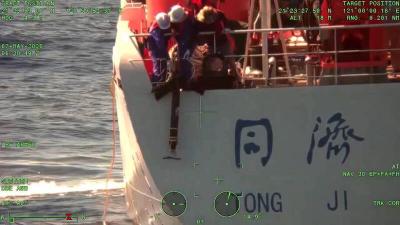
The coast guard today said that it had disrupted "illegal" operations by a Chinese research ship in waters close to the nation and driven it away, part of what Taipei sees a provocative pattern of China's stepped up maritime activities. The coast guard said that it on Thursday last week detected the Chinese ship Tongji (同濟號), which was commissioned only last year, 29 nautical miles (54km) southeast of the southern tip of Taiwan, although just outside restricted waters. The ship was observed lowering ropes into the water, suspected to be the deployment of scientific instruments for "illegal" survey operations, and the coast
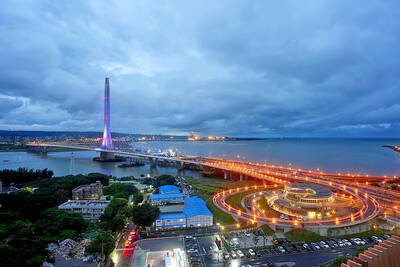
An inauguration ceremony was held yesterday for the Danjiang Bridge, the world’s longest single-mast asymmetric cable-stayed bridge, ahead of its official opening to traffic on Tuesday, marking a major milestone after nearly three decades of planning and construction. At the ceremony in New Taipei City attended by President William Lai (賴清德), Premier Cho Jung-tai (卓榮泰), Minister of Transportation and Communications Chen Shih-kai (陳世凱) and New Taipei City Mayor Hou Yu-ih (侯友宜), the bridge was hailed as both an engineering landmark and a long-awaited regional transport link connecting Tamsui (淡水) and Bali (八里)


 RSS
RSS