


Academia Sinica yesterday released a white paper urging authorities to adopt more drastic plans to curb greenhouse gas emissions and draft climate change legislation.
The drafting of the white paper, “Taiwan Deep Decarbonization Policy,” started in 2015 and took more than three years to finish, as it involves many fields, including energy-related techniques, economic development and social communication, said Wang Pao-kuan (王寶貫), director of Academia Sinica’s Research Center for Environmental Changes and lead author of the report.
Taiwan’s greenhouse gas emissions in 2015 reached 284.643 million tonnes of carbon dioxide equivalent, up from 137.854 million tonnes in 1990, the paper says.
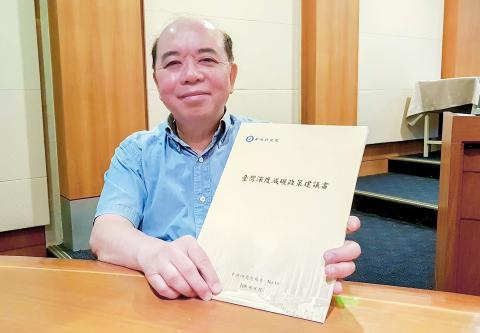
Photo: Chien Hui-ju, Taipei Times
In 2015, carbon dioxide made up about 95.21 percent of the nation’s total greenhouse gas emissions, followed by methane (1.91 percent), nitrous oxide (1.58 percent) and hydrofluorocarbons (1.3 percent), it says.
In the Germanwatch Climate Change Performance Index 2019, Taiwan placed 56th, dropping two places from last year’s report and ranking among the world’s worst performers.
With its reliance on export trade, Taiwan might face “border carbon adjustments” imposed by foreign countries if it does not take more drastic action to curb emissions, Academia Sinica said.
It said that 89.82 percent of the nation’s greenhouse gas emissions in 2015 were discharged by the energy sector, 7.79 percent by the industrial sector, 0.95 percent by the agricultural sector and 1.44 percent by the waste sector.
The government must carefully assess the pros and cons of various power sources, including nuclear energy, when planning energy reforms while paying attention to potential socioeconomic problems, it says.
It should work harder to promote energy preservation, boost energy efficiency and consider hiking electricity prices or levying a carbon tax, the paper says.
The nation needs a climate change act to integrate climate action across sectors, but before such an act is legislated, it should implement the Greenhouse Gas Reduction and Management Act (溫室氣體減量及管理法) promulgated in 2015, even though its goals are not ambitious enough, it says.
If global warming has become an accepted fact, then people need to know more about its driving mechanism, the speed of warming related to rising ocean temperatures and partial pressure of carbon dioxide in oceans, National Taiwan University’s Institute of Oceanography director Jan Sen (詹森) said separately.
Regional scientists should carry out long-term observations in the South China Sea, the East China Sea, the Kuroshio east of Taiwan and the western North Pacific to establish a seawater temperature database, Jan said, expressing the hope that the Ministry of Science and Technology or the Ocean Affairs Council would support such projects.
The Environmental Protection Administration is to hold public hearings to collect opinions on how to achieve by 2025 its goal of cutting greenhouse gas emissions by 10 percent from 2005 levels, Department of Environmental Management Deputy Director Huang Wei-ming (黃偉鳴) said, adding that it looks forward to having more collaboration with academics.

FUKUOKA SITUATION: Japanese media reported that the pathogen is expected to be identified by the summer, while the CDC downplayed the idea that it was hMPV A “mysterious cold-like illness” reported in Japan’s Fukuoka Prefecture does not seem to be a new disease, but Japanese authorities have been asked about the situation, the Centers for Disease Control (CDC) said yesterday. The Fukuoka Prefectural Medical Association on Wednesday told a news conference that a “mystery cold” that has become a hot topic on social media is “highly likely to be caused by some kind of viral infection,” Japan’s KBC News reported. “Many people are experiencing symptoms starting with a sore throat, followed by a runny nose, phlegm and a severe cough,” KBC News reported, citing association officials. Health authorities are

Nvidia Corp CEO Jensen Huang (黃仁勳) arrived in Taiwan yesterday ahead of upcoming AI and technology events, saying he plans to meet with clients and Taiwan Semiconductor Manufacturing Co Chairman C.C. Wei (魏哲家) during his visit. After landing at Taipei Songshan Airport, Huang posed for photos with fans and handed out Yakult drinks to reporters and supporters waiting at the scene, saying he has “a lot to do” during the trip. Asked about reports that Nvidia’s planned headquarters site in Taipei’s Beitou Shilin Technology Park could break ground on May 27, Huang said that if the company holds an event, he would

The Ministry of Finance this afternoon announced the winning numbers for the March-April uniform invoice lottery. The winning number for the NT$10 million (US$318,060) special prize is 19531471, and the winning number for the NT$2 million grand prize is 85941329. Three numbers were drawn for the NT$200,000 first prize: 07225810, 20231230 and 83518781. Those with receipts matching the last seven digits of any of the first-prize numbers will win the NT$40,000 second prize, while those matching the last six digits will win the NT$10,000 third prize. Those whose receipts match the last five digits of the first-prize numbers can claim the NT$4,000 fourth prize,
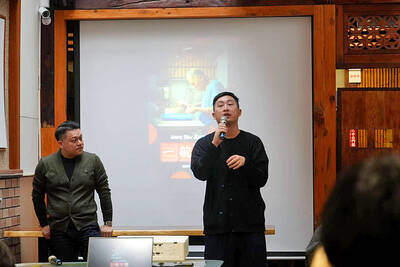
Taiwan Travelogue (臺灣漫遊錄), which earlier this week became the first Taiwanese novel to win the International Booker Prize, is to be adapted into a television series through a Taiwan-Japan coproduction, producer Chang Chen-yu (張辰漁) said yesterday. Chang, a producer at World Softest Production Film Co, wrote on Facebook that the company had been searching for projects with international appeal that retain a strong Taiwanese identity after colleagues and Japanese partners strongly recommended the novel. After reading the book, Chang said he immediately decided to pursue the screen rights. “A great story has the power to transcend time and borders, and connect countless people,”


 RSS
RSS