


Although the Ministry of Transportation and Communications announced earlier this week that it would not start fining vehicle rental businesses working with Uber for contravening the soon-to-be-amended Article 103-1 of the Transportation Management Regulations (汽車運輸業管理規則) until October, some former Uber drivers have joined the government’s diversified taxi service program to avoid penalties.
The article, dubbed the “Uber clause,” defines vehicle rental services and taxis as different businesses that are subject to separate regulations, and stipulates that rental firms must charge passengers by hourly or daily rates.
The ministry proposed amending the article after Uber was found to be using its partnerships with rental firms to offer taxi services, which the ministry said would disrupt the market.
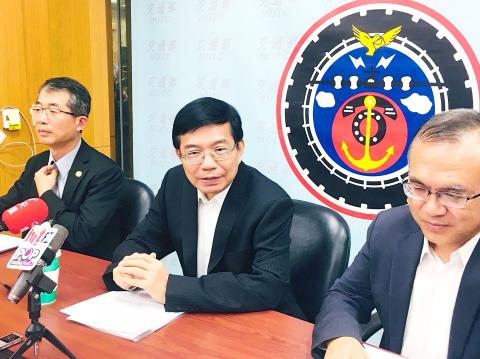
Photo: Hsiao Yu-hsin, Taipei Times
The final version of the amendment is scheduled to be approved at a weekly ministerial meeting today and should be announced early next month.
Uber should not expect the ministry to change its position on the issue, Deputy Minister of Transportation and Communications Wang Kwo-tsai (王國材) said on Tuesday, adding that the US company should apply to become a taxi operator if it wants to continue operating in Taiwan.
The ministry’s statement enraged Uber drivers, with dozens protesting outside the Executive Yuan on Wednesday.
They threatened to protest in front of the Presidential Office Building, the Legislative Yuan and the ministry if the government enforces the regulations.
Two former Uber drivers, surnamed Tsai (蔡) and Tseng (曾), joined the diversified taxi service program provided by Taiwan Taxi a month ago.
They told the Taipei Times that the main reason for the switch was because the government would soon enforce the amendment.
“I think Uber’s chance of survival is getting lower... It will have a difficult time continuing operations here in the future,” Tseng said.
“The only difference between an Uber driver and a diversified taxi driver is that the latter also needs a taxi business registration certificate, in addition to a license to operate commercial vehicles,” Tsai said.
“Taiwan Taxi is a well-known taxi brand. I have not had much of a problem adjusting to the program,” he said, adding that he now earns about as much as he did when he was an Uber driver.
Joining the diversified taxi program has helped him earn a more stable income, Tsai said, adding that Uber receives 28 percent of fares, while drivers in the diversified taxi service program only need to give the online platform operator 15 percent, he said.
Asked why so many Uber drivers refuse to comply with the law, Tsai said that they are resisting change because they are not familiar with the details of the program.
“If you are an Uber driver, you hardly have time to catch a breath because you keep receiving assignments once you are online. You can at least take a break if you are a diversified taxi driver,” Tseng said.
The biggest obstacles for Uber drivers to become diversified taxi drivers is that they have to obtain a taxi business registration certificate by passing a test and must first resolve issues with car loan contracts, he said.
Uber on Wednesday said it would keep its operations in Taiwan unchanged from June to September, but would also begin to re-evaluate its presence in this market.
However, it would not consider the ministry’s suggestion that it transform into a taxi operator for the time being, as the ministry has provided it with limited information, Uber Asia-Pacific director of public policy and government relations Emily Potvin told the Taipei Times from Singapore.
“The ministry asked us to join the diversified taxi program, but it failed to give us full information about the mechanism, such as how many licenses we need to gain, how many fees the drivers have to pay and if the rates would be fixed or not,” Potvin said.
Uber cannot decide on whether to comply with the new rules or assess the new rules’ effects on its operations, Potvin said.
“We are willing to make a compromise and still willing to move forward, but we need clarity for those regulations first,” Potvin said.
Uber Taiwan has sent many questioning letters to the ministry about its amendment to the regulations, but has not received a response, she said.
The regulator should explain the new regulations and mechanism clearly, so that Uber can assess how to adapt or whether to launch a new business model in Taiwan, she said.
Additional reporting by Kao Shih-ching

Taiwanese can file complaints with the Tourism Administration to report travel agencies if their activities caused termination of a person’s citizenship, Mainland Affairs Council Minister Chiu Chui-cheng (邱垂正) said yesterday, after a podcaster highlighted a case in which a person’s citizenship was canceled for receiving a single-use Chinese passport to enter Russia. The council is aware of incidents in which people who signed up through Chinese travel agencies for tours of Russia were told they could obtain Russian visas and fast-track border clearance, Chiu told reporters on the sidelines of an event in Taipei. However, the travel agencies actually applied
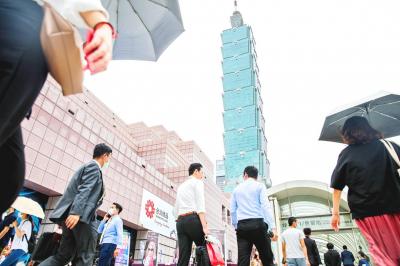
Japanese footwear brand Onitsuka Tiger today issued a public apology and said it has suspended an employee amid allegations that the staff member discriminated against a Vietnamese customer at its Taipei 101 store. Posting on the social media platform Threads yesterday, a user said that an employee at the store said that “those shoes are very expensive” when her friend, who is a migrant worker from Vietnam, asked for assistance. The employee then ignored her until she asked again, to which she replied: "We don't have a size 37." The post had amassed nearly 26,000 likes and 916 comments as of this

New measures aimed at making Taiwan more attractive to foreign professionals came into effect this month, the National Development Council said yesterday. Among the changes, international students at Taiwanese universities would be able to work in Taiwan without a work permit in the two years after they graduate, explainer materials provided by the council said. In addition, foreign nationals who graduated from one of the world’s top 200 universities within the past five years can also apply for a two-year open work permit. Previously, those graduates would have needed to apply for a work permit using point-based criteria or have a Taiwanese company

The Shilin District Prosecutors’ Office yesterday indicted two Taiwanese and issued a wanted notice for Pete Liu (劉作虎), founder of Shenzhen-based smartphone manufacturer OnePlus Technology Co (萬普拉斯科技), for allegedly contravening the Act Governing Relations Between the People of the Taiwan Area and the Mainland Area (臺灣地區與大陸地區人民關係條例) by poaching 70 engineers in Taiwan. Liu allegedly traveled to Taiwan at the end of 2014 and met with a Taiwanese man surnamed Lin (林) to discuss establishing a mobile software research and development (R&D) team in Taiwan, prosecutors said. Without approval from the government, Lin, following Liu’s instructions, recruited more than 70 software


 RSS
RSS