


The Taoyuan Flight Attendants’ Union yesterday announced that it would hold a vote next month to decide when and where it would hold a strike against EVA Air Corp.
The union and the company have since April 2017 held more than 20 rounds of talks, with the union walking away from the table late last year due to a lack of progress, prompting mediation intervention by the Taoyuan City Government.
A breakdown in government-led negotiations on Wednesday marked the third time the parties failed to find a solution on the issues of flight adjustments, hourly rates and labor representation on the company’s board.
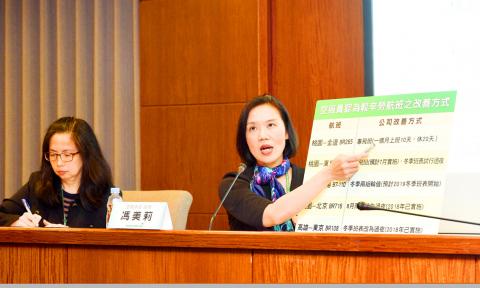
Photo: Peter Lo, Taipei Times
The union demanded an increase in the hourly overseas allowance rate from NT$90 to NT$150; a change in the Taoyuan-Tokyo and Taoyuan-Beijing routes to allow for employees to rest overnight; additional rest hours for long flights; and the ability for union members to nominate labor representatives to the board.
The union said that it was willing to enter into negotiations with the company should it offer sincere alternatives, and called on authorities to help spread notice of the planned strike.
“We do not wish to inconvenience the public should the strike be approved by union members,” it said.
Deputy Minister of Transportation and Communications Wang Kwo-tsai (王國材) said that the Ministry of Labor and the Taoyuan Department of Labor were overseeing the talks.
The Ministry of Transportation and Communications hopes that both parties could find common ground for dialogue on the basis of upholding the rights of workers and travelers, Wang said, adding that his ministry would work with the Ministry of Labor and the department to bring both parties back to the table.
EVA said that it hopes the union would continue to negotiate, as it is willing to adjust its proposals.
If the union goes ahead with the strike, it would be a lose-lose situation for all concerned, it added.
The airline on Wednesday had urged the union to continue talks, but it decided to proceed with the strike, EVA said, adding that it had proposed solutions to the union’s requests, but was unfortunately refused.
It said that it proposed allowing flight attendants to stay overnight in certain months during bad weather conditions and to adopt fixed schedules, which would increase attendants’ leave without a reduction in wages.
Although the airline declined to increase the per diem rate to US$5 per hour to match China Airlines, it proposed distributing a monthly bonus of between NT$1,500 and NT$2,500 to each flight attendant, it said.
If the union launches the strike, EVA would strive to reduce the effects on customers, it added.
Additional reporting by Wei Chin-yun
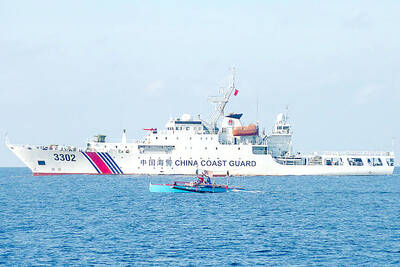
EXPANSIONIST: China deploys an average of 40 to 50 warships and coast guard vessels daily in the South China Sea, despite pledges not to militarize the region, an official said China is attempting to expand its influence across the First Island Chain and increase pressure on Japan by sending coast guard vessels into waters off of Taiwan under the pretext of maritime negotiations with Japan and the Philippines, a national security official said yesterday. China’s recent actions in the waters east of Taiwan and Japan and the Philippines’ exclusive economic zones (EEZ) are attempts to establish dominance in First Island Chain waters, said the official who declined to be named, adding that this is “expansion disguised as law enforcement.” Framing China’s actions solely as a cross-strait issue is a serious misjudgment that
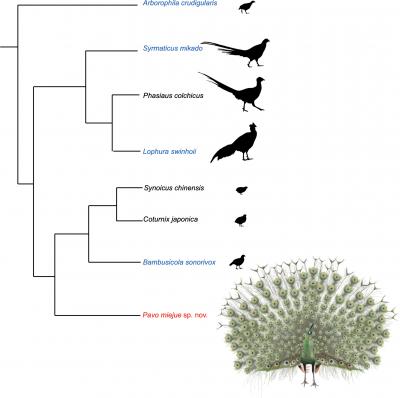
Through analyzing fossil evidence, a research team at National Taiwan University (NTU) discovered the largest endemic bird to have lived in Taiwan, naming it Pavo miejue, or extinct peafowl (滅絕孔雀). The Mikado pheasant, which is printed on the back of the NT$1,000 bank note, was previously believed to be the biggest endemic bird to Taiwan. The research team’s findings suggest that Pavo miejue lived during the Pleistocene epoch tens of thousands of years ago. It is the first endemic extinct bird species discovered and formally named in Taiwan. The study was coauthored by NTU Institute of Ecology and Evolutionary Biology professor Tsai Cheng-hsiu (蔡政修),
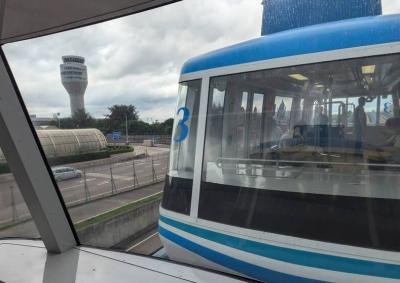
Taiwan Taoyuan International Airport is to suspend its automated Skytrain service connecting Terminal 1 and Terminal 2 starting on July 1 to facilitate connection works for the upcoming Terminal 3, the airport operator said today. Passengers and staff who need to travel between the two terminals after the suspension can instead use the Taoyuan MRT or the airport's 24-hour shuttle bus service, Taoyuan International Airport Corp said. The Taoyuan MRT Airport Line directly links the two terminals, while the shuttle buses are to operate around the clock, the company added. The Skytrain provides free transportation between the airport’s two terminals for travelers and
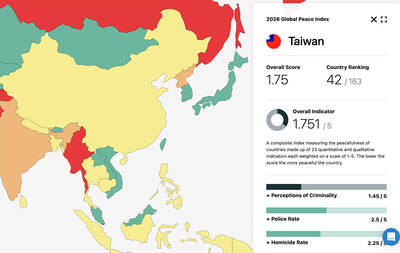
Taiwan ranked 42nd in terms of peacefulness among 163 countries, down five places from last year, according to this year’s Global Peace Index. With an overall score of 1.751, Taiwan dropped from 37th last year, the report published by the global Institute for Economics and Peace showed. The overall score measures a country’s level of peacefulness using 23 quantitative and qualitative indicators across three domains — ongoing domestic and international conflict, societal safety and security, and militarization. While Taiwan ranked 42nd worldwide, it was listed in ninth place among the 19 Asian-Pacific countries in the report, after New Zealand, Singapore, Japan, Malaysia,


 RSS
RSS