


A crowdfunding campaign to buy full-page ads in the Washington Times and The Hill urging members of the US House of Representatives to cosponsor and support House Resolution No. 248 has met its US$19,235 goal in two days.
The campaign, launched on Tuesday by six Taiwanese living in the US, including Formosan Association for Public Affairs policy coordinator Dee Wu (吳迪), garnered contributions from 350 donors.
The proposed resolution — titled “Expressing the sense of the House of Representatives that the United States One-China Policy does not commit it to the People’s Republic of China’s One-China Principle, and for other purposes” — was introduced on March 21 in the lower house by US Representative Steve Chabot.
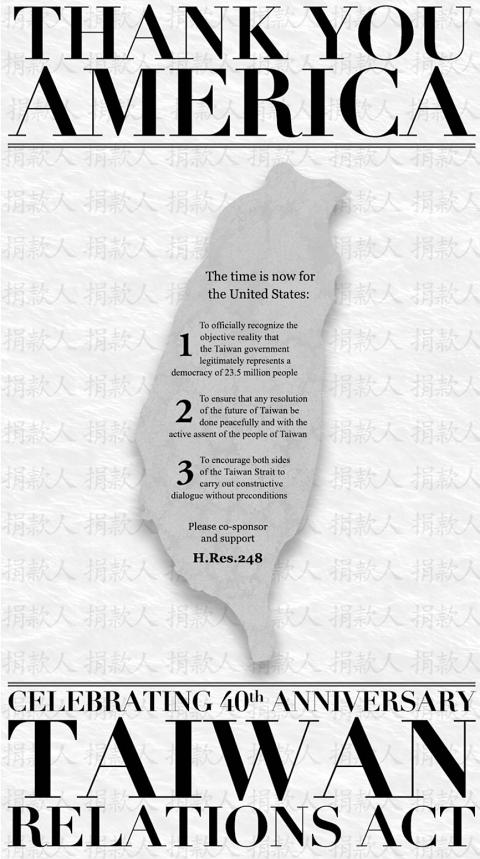
Photo courtesy of Dee Wu
In the summary of the GoFundMe campaign, the initiators said they wanted to do something for Taiwan even though they were in the US.
They said that they first selected the Washington Times because of the relatively low cost of placing an ad in the newspaper and because, as a conservative paper, it would boost their chances of the ad being seen by US President Donald Trump’s Republican administration.
After raising US$5,000 on Tuesday for a full-page ad in the Washington Times, they extended the crowdfunding campaign to raise an additional US$14,235 for a full-page ad in The Hill.
Although its circulation is not large, The Hill is found in every US congressional office and would increase the ad’s chances of being seen by Democratic representatives, the campaign starters said, adding that they hope to garner bipartisan support for the resolution.
Wu, who is the son of Minister of Foreign Affairs Joseph Wu (吳釗燮), said he was surprised that the campaign, which they promoted through Facebook and online bulletin board Professional Technology Temple (PTT), was able to raise nearly US$20,000 in two days.
He thanked the campaign supporters and said he hoped the ad would encourage more discussion and generate greater visibility for Taiwan in the international community.
The ad, which would include the names of donors who contributed more than US$100, is expected to appear in the two newspapers on Wednesday next week — the 40th anniversary of the enactment of the Taiwan Relations Act.

Considering that most countries issue more than five denominations of banknotes, the central bank has decided to redesign all five denominations, the bank said as it prepares for the first major overhaul of the banknotes in more than 24 years. Central bank Governor Yang Chin-lung (楊金龍) is expected to report to the Legislative Yuan today on the bank’s operations and the redesign’s progress. The bank in a report sent to the legislature ahead of today’s meeting said it had commissioned a survey on the public’s preferences. Survey results showed that NT$100 and NT$1,000 banknotes are the most commonly used, while NT$200 and NT$2,000

The Centers for Disease Control (CDC) yesterday reported the first case of a new COVID-19 subvariant — BA.3.2 — in a 10-year-old Singaporean girl who had a fever upon arrival in Taiwan and tested positive for the disease. The girl left Taiwan on March 20 and the case did not have a direct impact on the local community, it said. The WHO added the BA.3.2 strain to its list of Variants Under Monitoring in December last year, but this was the first imported case of the COVID-19 variant in Taiwan, CDC Deputy Director-General Lin Ming-cheng (林明誠) said. The girl arrived in Taiwan on

South Korea is planning to revise its controversial electronic arrival card, a step Taiwanese officials said prompted them to hold off on planned retaliatory measures, a South Korean media report said yesterday. A Yonhap News Agency report said that the South Korean Ministry of Foreign Affairs is planning to remove the “previous departure place” and “next destination” fields from its e-arrival card system. The plan, reached after interagency consultations, is under review and aims to simplify entry procedures and align the electronic form with the paper version, a South Korean ministry official said. The fields — which appeared only on the electronic form

The Ministry of Foreign Affairs (MOFA) is suspending retaliation measures against South Korea that were set to take effect tomorrow, after Seoul said it is updating its e-arrival system, MOFA said today. The measures were to be a new round of retaliation after Taiwan on March 1 changed South Korea's designation on government-issued alien resident certificates held by South Korean nationals to "South Korea” from the "Republic of Korea," the country’s official name. The move came after months of protests to Seoul over its listing of Taiwan as "China (Taiwan)" in dropdown menus on its new online immigration entry system. MOFA last week


 RSS
RSS