


The Supreme Court yesterday rejected appeals by defendants in the Weiguan Jinlong building case in which more than 100 people died after the housing complex collapsed during the 2016 Tainan earthquake.
The court also upheld the sentences for the five defendants of five years in prison and a fine of NT$90,000 each.
The five are Weiguan Corp owner Lin Ming-hui (林明輝); architects Chang Kuei-pao (張魁寶) and Cheng Chin-kuei (鄭進貴); Weiguan design department’s Hung Hsien-han (洪仙汗); and structural engineer Cheng Tung-hsu (鄭東旭).
The Weiguan Jinlong housing complex in Tainan collapsed during a magnitude 6.6 quake on Feb. 6, 2016, resulting in the death of 115 people, while 104 sustained injuries and more than 200 people were rendered homeless.
It was one of the worst man-made disasters in the nation’s history.
Yesterday’s ruling was final and cannot be appealed.
Victims and their families had asked for more severe punishment as the disaster resulted in more than 100 deaths.
However, the charges of “homicide through professional negligence” carried a maximum prison term of five years only.
Following the High Court’s ruling in July last year, all the defendants, except for Lin, filed appeals to either overturn the guilty conviction or receive a lighter sentence.
The four defendants argued that they were not responsible for the disaster because they merely followed Lin’s instructions and that the structural failure was due to alterations to the original architectural plan.
Chang also argued that the construction of the building started in 1992, and as such, had exceeded the 20-year period as statute of limitations for criminal prosecution.
Investigators found that the building was poorly designed and built, and that inferior materials were used to save costs.
They said that Lin had ordered Hung to minimize costs during the design and planning stages, and to use fewer than the required number of reinforcements for beam column joints and to reduce the size of some pillars to further cut costs.
The combination of negligence and cost-cutting led to the collapse of the building, investigators said, citing flaws and load-bearing calculation errors in the original design and later alterations that contributed to the building’s structural weaknesses.
The two architects had helped the company acquire construction certification and other documents without properly supervising the construction work, the investigators added.

LOUD AND PROUD Taiwan might have taken a drubbing against Australia and Japan, but you might not know it from the enthusiasm and numbers of the fans Taiwan might not be expected to win the World Baseball Classic (WBC) but their fans are making their presence felt in Tokyo, with tens of thousands decked out in the team’s blue, blowing horns and singing songs. Taiwanese fans have packed out the Tokyo Dome for all three of their games so far and even threatened to drown out home team supporters when their team played Japan on Friday. They blew trumpets, chanted for their favorite players and had their own cheerleading squad who dance on a stage during the game. The team struggled to match that exuberance on the field, with
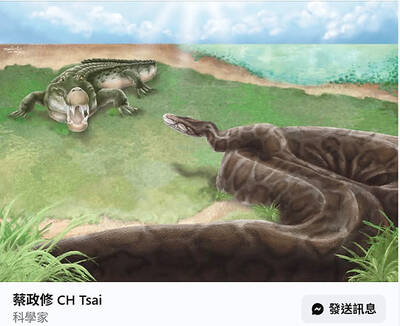
Taiwanese paleontologists have discovered fossil evidence that pythons up to 4m long inhabited Taiwan during the Pleistocene epoch, reporting their findings in the international scientific journal Historical Biology. National Taiwan University (NTU) Institute of Ecology and Evolutionary Biology associate professor Tsai Cheng-hsiu (蔡政修) led the team that discovered the largest snake fossil ever found in Taiwan. The single trunk vertebra was discovered in Tainan at the Chiting Formation, dated to between 400,000 and 800,000 years ago in the Middle Pleistocene, the paper said. The area also produced Taiwan’s first avian fossil, as well as crocodile, mammoth, saber-toothed cat and rhinoceros fossils, it said. Discoveries

Taiwanese paleontologists have discovered fossil evidence that pythons up to 4m long inhabited Taiwan during the Pleistocene epoch, reporting their findings in the international scientific journal Historical Biology. National Taiwan University (NTU) Institute of Ecology and Evolutionary Biology associate professor Tsai Cheng-hsiu (蔡政修) led the team that discovered the largest snake fossil ever found in Taiwan. A single trunk vertebra was discovered in Tainan at the Chiting Formation, dated to between 800,000 to 400,000 years ago in the Middle Pleistocene, the paper said. The area also produced Taiwan’s first avian fossil, as well as crocodile, mammoth, sabre-toothed cat and rhinoceros fossils, it said. Discoveries
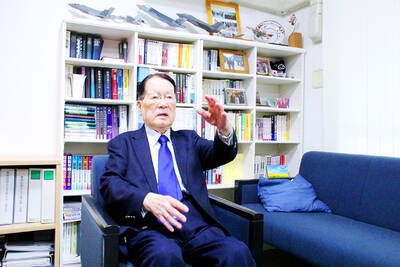
Whether Japan would help defend Taiwan in case of a cross-strait conflict would depend on the US and the extent to which Japan would be allowed to act under the US-Japan Security Treaty, former Japanese minister of defense Satoshi Morimoto said. As China has not given up on the idea of invading Taiwan by force, to what extent Japan could support US military action would hinge on Washington’s intention and its negotiation with Tokyo, Morimoto said in an interview with the Liberty Times (sister paper of the Taipei Times) yesterday. There has to be sufficient mutual recognition of how Japan could provide


 RSS
RSS