


Iconic democracy pioneer and Christian minister the Reverend Kao Chun-ming (高俊明), 89, passed away yesterday at 5:25pm, the Presbyterian Church in Taiwan said.
Kao, a life-long Taiwan independence advocate, was known for helping Shih Ming-te (施明德) give the authorities the slip, after Shih became a fugitive because of his involvement in the 1979 Kaohsiung Incident during the White Terror era.
Arrested in April 1980, Kao was sentenced to seven years in prison, but later served as an adviser to former president Chen Shui-bian (陳水扁).
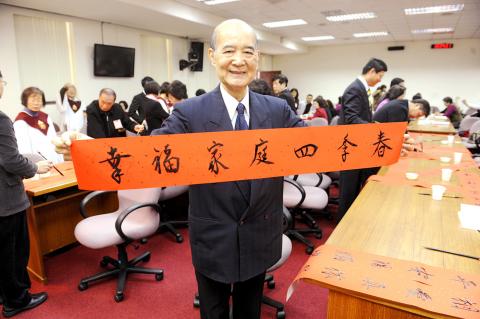
Photo: George Tsorng, Taipei Times
Presidential Office spokesperson Xavier Chang (張惇涵) said in a statement yesterday President Tsai Ing-wen (蔡英文) mourned Kao’s death and that the nation had lost a great man.
“Kao was a guiding light for Taiwanese democracy and his courage will be remembered forever, as the bush that burned and was not consumed,” Chang said.
Kao was born in 1929. His grandfather Kao Chang (高長) was the nation’s first Presbyterian convert and a follower of medical doctor and missionary James L. Maxwell Sr.
In an interview with the Chinese Christian Tribune, Kao Chun-ming said he was a willful child who hated going to church and studying.
He came to appreciate his circumstances and the importance of intellectual pursuits only after attending night school in Japan, where students from less fortunate backgrounds worked to earn a living by day and studied by night, Kao Chun-ming said.
Witnessing the carnage after the allied forces bombed Japan in World War II, he experienced a spiritual awakening and decided to attend a seminary, Kao Chun-ming said.
Kao Chun-ming served as the principle of Yushan Theological College and Seminiary from 1957 to 1970.
In 2012, then-Tainan mayor William Lai (賴清德) visited him at his residence and presented him with a commendation that honored him as a “Taiwanese of high character.”
Last month, Kao Chun-ming cosigned a public letter asking Tsai not to seek re-election next year, citing the electoral drubbing that the Democratic Progressive Party received in November last year.

NATIONAL SECURITY: Authorities are working to confirm the identities of the military personnel involved and investigating possible illegal conduct and regulatory violations Authorities are probing possible national security implications after Kinmen police and immigration officers on Sunday found a Chinese woman allegedly posing as a tourist while engaging in prostitution involving more than 10 military personnel. The woman, surnamed Chen (陳), has since been deported, authorities said, adding that investigators are still working to confirm the identities of those implicated, as the records only listed code names and aliases. The case stemmed from a report received by the Kinmen District Prosecutors’ Office on Friday last week from the Jinhu Precinct of the Kinmen County Police Bureau. On Sunday, police, along with the National Immigration

GLOBALGIVING: ‘ Caving to external pressure is not acceptable for an organization that has cultivated justice reform and human rights for 30 years,’ one NGO said A slew of non-government organizations (NGOs) have withdrawn from the GlobalGiving fundraising platform after it announced it would use “Chinese Taipei” instead of “Taiwan” from next month. The Taiwan Good Rice Association wrote on Facebook on Friday that it was informed on April 28 via a teleconference call of the change, which was made because the platform wanted to operate in China. Taiwan Good Rice is to terminate all cooperative relationships with GlobalGiving in response to the platform’s “unilateral and non-negotiable” decision to remove references to Taiwan, the NGO said. “Taiwan is in the official name of Taiwan Good Rice Association and the

HEAVY WEATHER: Typhoon Jangmi is due to crash straight into the Ryukyus as airlines look to shift flights to larger aircraft or cancel flights to Okinawa entirely Taiwan’s international air carriers announced flight adjustments over the weekend as Typhoon Jangmi is forecast to hit the Ryukyu Islands today and tomorrow. The Central Weather Administration (CWA) upgraded Jangmi from a tropical storm to a typhoon at 8am yesterday, with the eye located 580km south of Naha city. It was moving north at 19kph. Today, China Airlines’ CI-120, CI-121, CI-122 and CI-123 flights between Taoyuan and Naha, Okinawa, have been canceled as well as CI-132 and CI-133 between Kaohsiung and Naha. EVA Air’s BR-112, BR-113, BR-186 and BR-185 flights between Taoyuan and Naha are also canceled. Low-cost carrier Tigerair Taiwan canceled IT-230,

Chinese Nationalist Party (KMT) Chairwoman Cheng Li-wun (鄭麗文) yesterday briefed her party’s Central Standing Committee regarding her scheduled visit to the US between Monday next week and June 16, saying that her purpose would be to persuade the US that the Republic of China (ROC) Constitution was a “one China” constitution that would foster stable and peaceful cross-strait relations. The ROC Constitution is the most important defense for all Taiwanese citizens, as it upholds our democracy and has contributed to our robust economy, which aligns with international and US interests, she said. “We would not be troublemakers and drag the US under,”


 RSS
RSS