


Farmers who raise black pigs in Pingtung County have formed a self-help group as fears about the effects of African swine fever have resulted in sales coming to a standstill and increased scrutiny of farms that use food waste as feed.
Unlike their lighter-skinned counterparts, black pigs are raised in two stages, Pingtung hog farmers said on Wednesday.
Upstream farmers raise sows and piglets, then one to two months after the piglets have stopped nursing, they are sent to downstream farmers, who raise them until they are mature, they said.
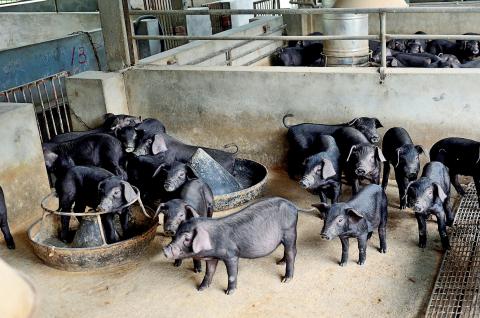
Photo: Chiu Chih-jou, Taipei Times
This partnership between upstream and downstream farmers has existed for more than a decade, but since the government started subsidizing farmers who switch from using food waste as pig feed or give up farming altogether, downstream farmers have stopped placing orders, said Chiu Hsiu-chin (邱秀琴), a black pig farmer in Pingtung.
In the past, all piglets would be sold by the time they reached 50 jin (30kg), but now piglets weighing 70 jin (42kg) are still being kept in upstream farms, she said.
Upstream farms mainly use commercial feed, she said, adding that food waste is only fed to pigs in downstream farms as they are older.
Upstream farms have not received any subsidies and sales are slowing, she said, adding that the black pig industry is suffering even though African swine fever has not entered Taiwan proper.
Black pig farmers used to be called the “pride of Taiwan,” but people now say feeding food waste to pigs is unhygienic, said Chen Chin-chu (陳金助), a black pig farmer in Neipu Township (內埔).
All pig farmers — whether they raise lighter-skinned or black pigs — stand with the government when it comes to preventing African swine fever, but the government’s policy should not be imposed in a blanket fashion, Chen said.
There are unique aspects to the black pig industry and the use of food scraps as feed should not be stigmatized, Chen added.
Aside from food waste, black pigs in Pingtung are also fed distillers grains, soybean meal and other agricultural byproducts, black pig farmer Hsieh Hsu-chung (謝旭忠) said.
If pigs are no longer fed food scraps, the unique flavor of Taiwanese black pigs might also disappear, Hsieh said.
The practice of using food scraps as feed in Taiwan is rooted in history, self-help group member Tseng Jen-te (曾仁德) said, adding that this has helped resolve environmental problems associated with food waste.
If a complete ban is placed on the use of food scraps as feed, the increased cost of handling food waste would be passed on to consumers, black pig farmer Chung Wen-feng (鍾文丰) said.
Equipment to heat food waste is available, Chung said, adding that government policies should consider all of the different aspects of the situation.
About 12 percent of domestically raised pigs are fed food waste, according to data from the Council of Agriculture.

Taiwanese can file complaints with the Tourism Administration to report travel agencies if their activities caused termination of a person’s citizenship, Mainland Affairs Council Minister Chiu Chui-cheng (邱垂正) said yesterday, after a podcaster highlighted a case in which a person’s citizenship was canceled for receiving a single-use Chinese passport to enter Russia. The council is aware of incidents in which people who signed up through Chinese travel agencies for tours of Russia were told they could obtain Russian visas and fast-track border clearance, Chiu told reporters on the sidelines of an event in Taipei. However, the travel agencies actually applied
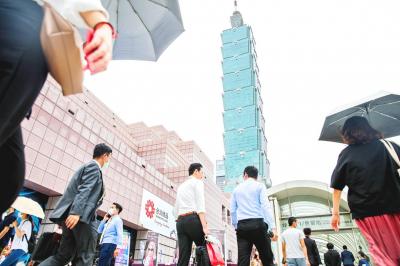
Japanese footwear brand Onitsuka Tiger today issued a public apology and said it has suspended an employee amid allegations that the staff member discriminated against a Vietnamese customer at its Taipei 101 store. Posting on the social media platform Threads yesterday, a user said that an employee at the store said that “those shoes are very expensive” when her friend, who is a migrant worker from Vietnam, asked for assistance. The employee then ignored her until she asked again, to which she replied: "We don't have a size 37." The post had amassed nearly 26,000 likes and 916 comments as of this

New measures aimed at making Taiwan more attractive to foreign professionals came into effect this month, the National Development Council said yesterday. Among the changes, international students at Taiwanese universities would be able to work in Taiwan without a work permit in the two years after they graduate, explainer materials provided by the council said. In addition, foreign nationals who graduated from one of the world’s top 200 universities within the past five years can also apply for a two-year open work permit. Previously, those graduates would have needed to apply for a work permit using point-based criteria or have a Taiwanese company

The Shilin District Prosecutors’ Office yesterday indicted two Taiwanese and issued a wanted notice for Pete Liu (劉作虎), founder of Shenzhen-based smartphone manufacturer OnePlus Technology Co (萬普拉斯科技), for allegedly contravening the Act Governing Relations Between the People of the Taiwan Area and the Mainland Area (臺灣地區與大陸地區人民關係條例) by poaching 70 engineers in Taiwan. Liu allegedly traveled to Taiwan at the end of 2014 and met with a Taiwanese man surnamed Lin (林) to discuss establishing a mobile software research and development (R&D) team in Taiwan, prosecutors said. Without approval from the government, Lin, following Liu’s instructions, recruited more than 70 software


 RSS
RSS