


The red pigment prodigiosin could have cosmetic benefits, such as reducing dark spots and lightening a person’s complexion, Tatung University biological engineering professor Will Chen (陳志成) said this week.
About a decade ago, his research team added prodigiosin to fish feed to enhance the red coloring of a tropical species, Chen said.
About three months later, the doctoral candidates in charge of the fish reported that the experiment had failed, because the fish turned bone-white, he said.
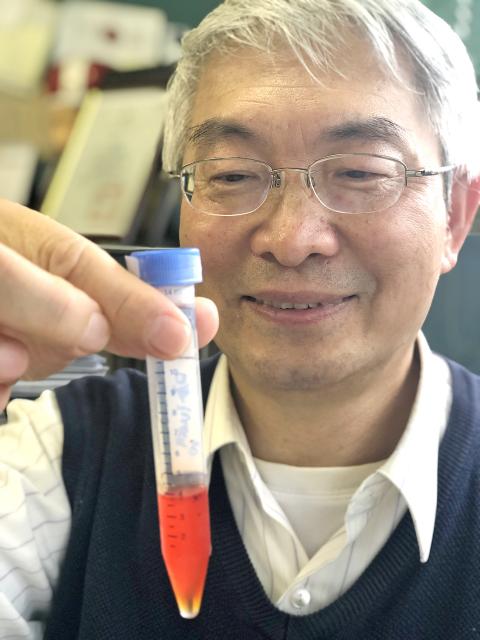
Photo provided by Tatung University
The unexpected result triggered a series of new inquires, eventually leading to the discovery that prodogiosin could potentially counter the effect of melanin on skin tissue, which leads to dark spots and tanning, he said.
Prodigiosin is a naturally occurring carotenoid produced by several types of microbes — including the halophiles from which the team extracted the substance, he said, adding that prodigiosin is two to seven times more effective as an anti-oxidant than other carotenoids.
The Dead Sea is rich with salt-eating halophiles that produce prodigiosin, which could explain the reported cosmetic effects of the salt lake’s mud, he said.
Cell tissue research and early clinical trials at Tri-Service General Hospital found that using prodigosin might reverse melanin-induced pigmentation, he said, adding that the university team was working on applying the discovery to cosmetic medicine.
In other news, a new mosquito trap designed by the National Health Research Institutes (NHRI) quickly identifies whether a mosquito could spread dengue fever and can determine high-risk locations.
Traditional traps are designed to kill mosquitoes, not to identify their species, but the newly developed “smart multimembrane mosquito trapping device” catches them alive and uses special technology to identify them, NHRI researcher Liao Lun-de (廖倫德) said yesterday.
As soon as a mosquito flies into the trap, the device takes 0.07 seconds to photographically determine with more than 90 percent accuracy whether it is the Aedes aegypti or Aedes albopictus species, which spread dengue fever and the Zika virus, Liao said.
The data can be transmitted to the NHRI and help in identifying neighborhoods at high risk for dengue fever, Liao added.
With enough data points, an early-warning system could be developed, allowing authorities to take preventive measures, Liao said.
Because the mosquitoes are captured alive, their blood can be tested to identify what they have bitten and whether they are carrying a virus, the researcher said.
It took the NHRI 18 months to design the trap, which combines photoelectric sensing and artificial intelligence technology, Liao said, adding that each device costs NT$2,000 to NT$4,000.

Taiwanese can file complaints with the Tourism Administration to report travel agencies if their activities caused termination of a person’s citizenship, Mainland Affairs Council Minister Chiu Chui-cheng (邱垂正) said yesterday, after a podcaster highlighted a case in which a person’s citizenship was canceled for receiving a single-use Chinese passport to enter Russia. The council is aware of incidents in which people who signed up through Chinese travel agencies for tours of Russia were told they could obtain Russian visas and fast-track border clearance, Chiu told reporters on the sidelines of an event in Taipei. However, the travel agencies actually applied
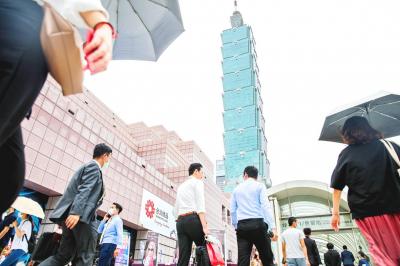
Japanese footwear brand Onitsuka Tiger today issued a public apology and said it has suspended an employee amid allegations that the staff member discriminated against a Vietnamese customer at its Taipei 101 store. Posting on the social media platform Threads yesterday, a user said that an employee at the store said that “those shoes are very expensive” when her friend, who is a migrant worker from Vietnam, asked for assistance. The employee then ignored her until she asked again, to which she replied: "We don't have a size 37." The post had amassed nearly 26,000 likes and 916 comments as of this

New measures aimed at making Taiwan more attractive to foreign professionals came into effect this month, the National Development Council said yesterday. Among the changes, international students at Taiwanese universities would be able to work in Taiwan without a work permit in the two years after they graduate, explainer materials provided by the council said. In addition, foreign nationals who graduated from one of the world’s top 200 universities within the past five years can also apply for a two-year open work permit. Previously, those graduates would have needed to apply for a work permit using point-based criteria or have a Taiwanese company
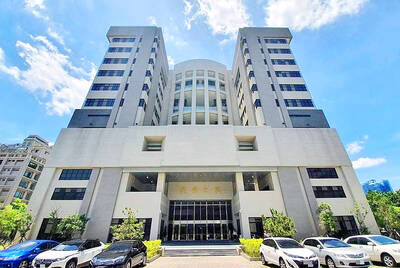
The Shilin District Prosecutors’ Office yesterday indicted two Taiwanese and issued a wanted notice for Pete Liu (劉作虎), founder of Shenzhen-based smartphone manufacturer OnePlus Technology Co (萬普拉斯科技), for allegedly contravening the Act Governing Relations Between the People of the Taiwan Area and the Mainland Area (臺灣地區與大陸地區人民關係條例) by poaching 70 engineers in Taiwan. Liu allegedly traveled to Taiwan at the end of 2014 and met with a Taiwanese man surnamed Lin (林) to discuss establishing a mobile software research and development (R&D) team in Taiwan, prosecutors said. Without approval from the government, Lin, following Liu’s instructions, recruited more than 70 software


 RSS
RSS