


The Executive Yuan yesterday approved draft amendments to the Statute for Investment by Foreign Nationals (外國人投資條例) and the Statute for Investment by Overseas Chinese (華僑回國投資條例) that would relax regulations on foreign and overseas investments.
The amendments would allow ordinary mergers, divisions and start-ups to be reported after the fact, Investment Commission Executive Secretary Emile Chang (張銘斌) said, adding that only more complex mergers and acquisitions would still require advance approval.
Of the 3,500 applications that the commission receives annually, 3,000 could be reported afterward, while only 500 would need preapproval, he said, adding that the new rules would simplify the process for foreign and overseas investments.
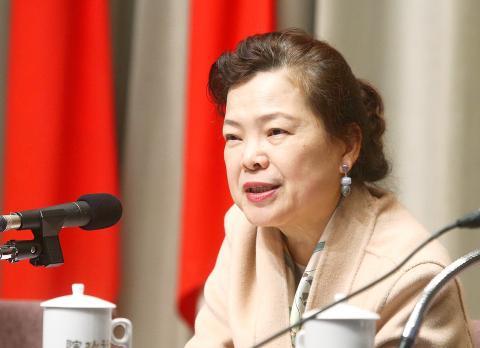
Photo: CNA
The exemption from advance application would apply to all cases except for those in which the investment exceeds a certain sum or involves a substantial percentage of shares; the investment is restricted; or the investor is a foreign government or in a region facing UN sanctions, he said.
The threshold would be US$1 million, but the Ministry of Economic Affairs still needs to discuss the issue with the central bank and other agencies, Vice Minister of Economic Affairs Wang Mei-hua (王美花) said.
Chinese investments would still be governed by the Act Governing Relations Between the People of the Taiwan Area and the Mainland Area (臺灣地區與大陸地區人民關係條例), she said.
Under current regulations, even if Chinese funds account for less than 30 percent of an investment, it would still require regulation if it can be determined that the funds have the ability to control the company making the investment, Chang said.
The draft amendments would also improve the transparency and predictability of reviews of foreign investments, the ministry said.
The competent authority would be required to request supplementary documentation within five days in case investors fail to submit complete documentation, it said.
The competent authority would also be required to approve or reject an application within a month, except in cases that involve other authorities, in which case the agencies would be given two months to reach a decision, it said.
The ministry is to announce clear criteria for approving or rejecting investment proposals, or restricting investments, to improve review efficiency, it said.
The draft amendments would also introduce new fines and penalties on unlawful investments, the ministry added.

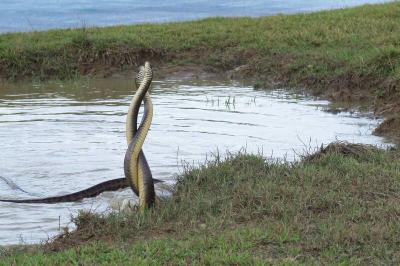
Kenting National Park service technician Yang Jien-fon (楊政峰) won a silver award in World Grand Prix Photography Awards Spring Season for his photograph of two male rat snakes intertwined in combat. Yang’s colleagues at Kenting National Park said he is a master of nature photography who has been held back by his job in civil service. The awards accept entries in all four seasons across six categories: architectural and urban photography, black-and-white and fine art photography, commercial and fashion photography, documentary and people photography, nature and experimental photography, and mobile photography. Awards are ranked according to scores and divided into platinum, gold and

More than half of the bamboo vipers captured in Tainan in the past few years were found in the city’s Sinhua District (新化), while other districts had smaller catches or none at all. Every year, Tainan captures about 6,000 snakes which have made their way into people’s homes. Of the six major venomous snakes in Taiwan, the cobra, the many-banded krait, the brown-spotted pit viper and the bamboo viper are the most frequently captured. The high concentration of bamboo vipers captured in Sinhua District is puzzling. Tainan Agriculture Bureau Forestry and Nature Conservation Division head Chu Chien-ming (朱健明) earlier this week said that the
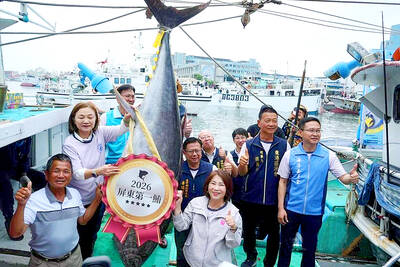
The first bluefin tuna of the season, brought to shore in Pingtung County and weighing 190kg, was yesterday auctioned for NT$10,600 (US$333.5) per kilogram, setting a record high for the local market. The auction was held at the fish market in Donggang Fishing Harbor, where the Siaoliouciou Island-registered fishing vessel Fu Yu Ching No. 2 delivered the “Pingtung First Tuna” it had caught for bidding. Bidding was intense, and the tuna was ultimately jointly purchased by a local restaurant and a local company for NT$10,600 per kilogram — NT$300 ,more than last year — for a total of NT$2.014 million. The 67-year-old skipper
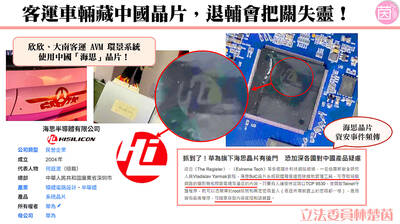
BREACH OF CONTRACT: The bus operators would seek compensation and have demanded that the manufacturer replace the chips with ones that meet regulations Two bus operators found to be using buses with China-made chips are to demand that the original manufacturers replace the systems and provide compensation for breach of contract, the Veterans Affairs Council said yesterday. Democratic Progressive Party Legislator Michelle Lin (林楚茵) yesterday said that Da Nan Bus Co and Shin-Shin Bus Co Ltd have fielded a total of 82 buses that are using Chinese chips. The bus models were made by Tron-E, while the systems provider was CYE Electronics, Lin said. Lin alleged that the buses were using chips manufactured by Huawei subsidiary HiSilicon Co, which presents a national security risk if the


 RSS
RSS