


While the amount of plastic bags found in local waters has significantly decreased, plastic straws are becoming a greater contributor to marine debris, the Taipei-based Society of Wilderness environmental group said on Monday.
Since 2004, the group has participated in the International Coastal Cleanup, with cleanups taking place nationwide in September each year, society executive director Liu Yueh-mei (劉月梅) said.
This year, plastic bottles (46,976), bottle caps (43,733) and plastic straws (36,660) were the most common types of marine debris volunteers found, she said.
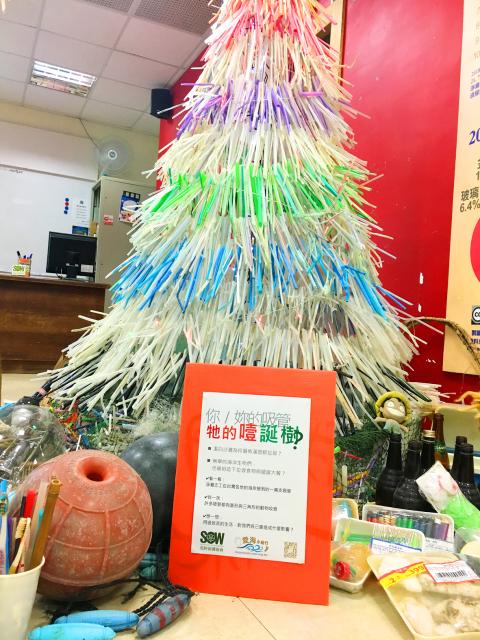
Photo: Hsiao Yu-hsin, Taipei Times
They also collected 16,364 plastic bags, which made up 5.7 percent of all items collected, Liu said, adding that this percentage has drastically fallen over the past decade.
In 2008, plastic bags made up 27.5 percent of marine debris collected at the nationwide cleanups, she said.
This year saw the least amount of plastic bags in the event’s 14-year history, group member Hu Chieh-shen (胡介申) said.
Hu said that he believes the trend could be attributed to the introduction of a government policy in 2002 requiring supermarkets, convenience stores and other major establishments to charge customers for plastic bags.
The trend became even more obvious after the government expanded the policy to include seven additional retail categories this year, he added.
Meanwhile, plastic straws are making up a greater proportion of marine debris each year, Hu said, adding that this year there were 12.8 plastic straws for every 100 items.
Liu said she believes that if the number of plastic straws circulating in the nation was similarly reduced at source, they would show up in smaller numbers in the ocean.
The society’s findings serve as a huge encouragement for the Environmental Protection Administration (EPA), Department of Waste Management Director-General Lai Ying-ying (賴瑩瑩) said.
They also show the public that government restrictions aimed at reducing the amount of plastic are effective at limiting the use of plastics, she said.
After it established a platform to manage marine debris with local environmental groups last year, the agency has made the reduction of marine debris most commonly found at beach cleanups a long-term goal, she added.
The agency’s bans on single-use tableware, plastic straws and other items would be carried out in three phases, Lai said.
Before 2020, there would be a “restriction” on the use of such items, while an “expanded restriction” would be implemented after 2020, she said, but did not provide a clear timetable for when the complete bans would be issued.
The society said that it has used more than 10,000 plastic straws collected in the beach cleanups to build a Christmas tree it is calling yedanshu (噎誕樹) — replacing the Chinese character ye (耶) in Christmas tree (yedanshu, 耶誕樹) with ye (噎, choke).
An excessive amount of marine debris “chokes” the ocean, it said, adding that it hopes to raise awareness of the importance of protecting the environment as people celebrate Christmas.

SECURITY: Starlink owner Elon Musk has taken pro-Beijing positions, and allowing pro-China companies to control Taiwan’s critical infrastructure is risky, a legislator said Starlink was reluctant to offer services in Taiwan because of the nation’s extremely high penetration rates in 4G and 5G services, the Ministry of Digital Affairs said yesterday. The ministry made the comments at a meeting of the legislature’s Transportation Committee, which reviewed amendments to Article 36 of the Telecommunications Management Act (電信管理法). Article 36 bans foreigners from holding more than 49 percent of shares in public telecommunications networks, while shares foreigners directly and indirectly hold are also capped at 60 percent of the total, unless specified otherwise by law. The amendments, sponsored by Chinese Nationalist Party (KMT) Legislator Ko

The military has spotted two Chinese warships operating in waters near Penghu County in the Taiwan Strait and sent its own naval and air forces to monitor the vessels, the Ministry of National Defense (MND) said. Beijing sends warships and warplanes into the waters and skies around Taiwan on an almost daily basis, drawing condemnation from Taipei. While the ministry offers daily updates on the locations of Chinese military aircraft, it only rarely gives details of where Chinese warships are operating, generally only when it detects aircraft carriers, as happened last week. A Chinese destroyer and a frigate entered waters to the southwest

The eastern extension of the Taipei MRT Red Line could begin operations as early as late June, the Taipei Department of Rapid Transit Systems said yesterday. Taipei Rapid Transit Corp said it is considering offering one month of free rides on the new section to mark its opening. Construction progress on the 1.4km extension, which is to run from the current terminal Xiangshan Station to a new eastern terminal, Guangci/Fengtian Temple Station, was 90.6 percent complete by the end of last month, the department said in a report to the Taipei City Council's Transportation Committee. While construction began in October 2016 with an

NON-RED SUPPLY: Boosting the nation’s drone industry is becoming increasingly urgent as China’s UAV dominance could become an issue in a crisis, an analyst said Taiwan’s drone exports to Europe grew 41.7-fold from 2024 to last year, with demand from Ukraine’s fight against Russian aggression the most likely driver of growth, a study showed. The Institute for Democracy, Society and Emerging Technology (DSET) in a statement on Wednesday said it found that many of Taiwan’s uncrewed aerial vehicle (UAV) sales were from Poland and the Czech Republic. These countries likely transferred the drones to Ukraine to aid it in its fight against the Russian invasion that started in 2022, it said. Despite the gains, Taiwan is not the dominant drone exporter to these markets, ranking second and fourth


 RSS
RSS