


New Power Party (NPP) Legislator Huang Kuo-chang (黃國昌) yesterday asked Premier William Lai (賴清德) to remove Minister of Transportation and Communications Wu Hong-mo (吳宏謀) from his post, after Wu was stumped by some elementary questions regarding the Puyuma Express train derailment on Oct. 21.
Wu on Monday also passed on erroneous information regarding the Puyuma Express’ automatic train protection (ATP) device to the media.
During a question-and-answer session with Lai and Wu at the Legislative Yuan in Taipei, Huang asked Wu to clarify remarks he made on Monday at a news conference that it would be time-consuming to send the ATP device back to Japan to be checked and that the Taiwan Railways Administration (TRA) would instead ask the Chungshan Institute of Science and Technology to improve on the exisiting ATP.
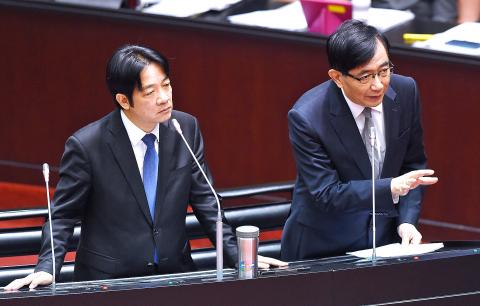
Photo: Liao Chen-huei, Taipei Times
Wu initially told Huang that the ministry would investigate whether the derailed train had been equipped with an ATP and if it had, whether the device was functioning properly.
Citing the TRA’s latest inspections, which were published on Monday, Huang said that the Puyuma Express train was equipped with an ATP and it was working normally.
Asked by Huang which country manufactured the ATPs on all trains including the Puyuma Express, Wu said it was Japan.
However, Huang said that the ATP installed on the Puyuma Express, as well as those on other trains, were made by Canadian firm Bombardier Inc and installed in 2007.
Huang then asked Wu whether it was the ATP, the remote surveillance system or the connection between the two that was problematic and might have led to the derailment.
He asked why the TRA on Monday told a news conference that its own tests had confirmed that the ATP on the Puyuma Express can connect to the surveillance system, but continued to disconnect during testing.
The TRA needed to put the quality of connections between the ATP and the surveillance system through further testing to see if the signal is stable, Wu said.
Noting that all trains in the nation are connected to the same remote surveillance system, Huang said that if it is unsafe to link Puyuma Express trains to the system, it would also be pointless to link other trains.
Huang said the maintenance of the surveillance system was contracted to Mercuries Data Systems — a Taiwanese company — and asked Wu whether he knew the reason why limited tendering rather than open bidding had been used in allocating the contract, to which Wu replied that the process would be investigated.
Visibly angered by Wu’s response, Huang told Lai: “Premier, I know you back this minister, but I will offer you a sincere piece of advice: Just fire him.”
“The minister’s understanding of the accident after more than a week has proved to be poorer than a legislator who only has the power of investigation,” Huang said.
Citing a 2012 report on the TRA’s “mid-term and long-term operating strategy,” which was compiled by Sinotech Engineering Consultants Ltd, Huang said the ATPs were the most problematic component in the TRA’s operations, as on average there are 133 malfunctions per month.
Asked by Huang what he thought of the rate of malfunction, Lai answered: “Very high.”
Asked whether improvements needed to be made, Lai said: “It is imperative to improve the ATPs to ensure safety.”

Considering that most countries issue more than five denominations of banknotes, the central bank has decided to redesign all five denominations, the bank said as it prepares for the first major overhaul of the banknotes in more than 24 years. Central bank Governor Yang Chin-lung (楊金龍) is expected to report to the Legislative Yuan today on the bank’s operations and the redesign’s progress. The bank in a report sent to the legislature ahead of today’s meeting said it had commissioned a survey on the public’s preferences. Survey results showed that NT$100 and NT$1,000 banknotes are the most commonly used, while NT$200 and NT$2,000

The Centers for Disease Control (CDC) yesterday reported the first case of a new COVID-19 subvariant — BA.3.2 — in a 10-year-old Singaporean girl who had a fever upon arrival in Taiwan and tested positive for the disease. The girl left Taiwan on March 20 and the case did not have a direct impact on the local community, it said. The WHO added the BA.3.2 strain to its list of Variants Under Monitoring in December last year, but this was the first imported case of the COVID-19 variant in Taiwan, CDC Deputy Director-General Lin Ming-cheng (林明誠) said. The girl arrived in Taiwan on

South Korea is planning to revise its controversial electronic arrival card, a step Taiwanese officials said prompted them to hold off on planned retaliatory measures, a South Korean media report said yesterday. A Yonhap News Agency report said that the South Korean Ministry of Foreign Affairs is planning to remove the “previous departure place” and “next destination” fields from its e-arrival card system. The plan, reached after interagency consultations, is under review and aims to simplify entry procedures and align the electronic form with the paper version, a South Korean ministry official said. The fields — which appeared only on the electronic form

The Ministry of Foreign Affairs (MOFA) is suspending retaliation measures against South Korea that were set to take effect tomorrow, after Seoul said it is updating its e-arrival system, MOFA said today. The measures were to be a new round of retaliation after Taiwan on March 1 changed South Korea's designation on government-issued alien resident certificates held by South Korean nationals to "South Korea” from the "Republic of Korea," the country’s official name. The move came after months of protests to Seoul over its listing of Taiwan as "China (Taiwan)" in dropdown menus on its new online immigration entry system. MOFA last week


 RSS
RSS