


While the Taiwan Railways Administration (TRA) yesterday attributed Sunday’s deadly train derailment to the driver, the Executive Yuan said that an investigation has not turned up evidence that the accident was due to human error.
The driver operating the Puyuma Express train that derailed in Yilan County turned off the automatic train protection (ATP) system without informing the dispatch and distribution office, the TRA said.
TRA operations were under scrutiny yesterday at the legislature’s Transportation Committee in the wake of the accident that killed 18 passengers and injured 190 people.
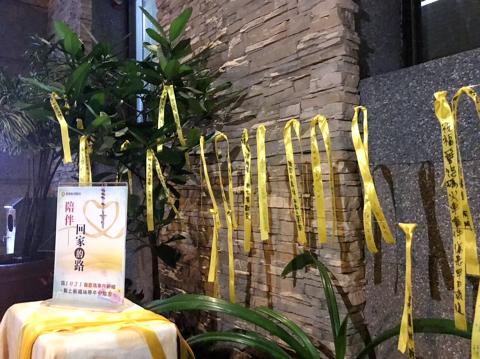
Photo copied by Chiang Chih-hsiung, Taipei Times
Lawmakers were particularly concerned about why the ATP system, which should be activated when a driver exceeds the speed limit, was turned off by the driver, surnamed Yu (尤).
Yu was supposed to operate the train at 75kph with a functioning ATP when he was driving through a curve near the Sinma Train Station (新馬), Deputy Minister of Transportation and Communications Wang Kwo-tsai (王國材) said.
However, Yu was found to have driven through the section at 140kph with a turned-off ATP, he said.
TRA Director-General Jason Lu (鹿潔身) said that the ATP was already turned off after the train passed through Dasi Train Station (大溪).
Although Yu did tell the agency that he was having problems with the air compressors, the train was operating at normal speed and he had no problem pulling in at Yilan and Luodong (羅東) stations.
However, the train began accelerating to 140kph after it passed Luodong Station, Lu said.
Train communication records also showed that Yu did not tell the dispatch and distribution office that he had turned off the ATP, Lu said.
Standard operating procedures state that drivers can turn off the ATPs only when they are out of order, Lu said.
If the driver wants to turn off a malfunctioning ATP, they must inform the dispatch and distribution office and must try to turn it on again when the train reaches the next station.
Should the driver fail to reactivate the ATP, the TRA will either have to change trains or send an assistant to help the driver handle any possible problem along the route.
Although the TRA acquired a remote surveillance system in 2010 to monitor if ATPs on trains are working properly, Lu said that this not apply to Puyuma Express trains.
“The surveillance system cannot tell if the ATPs were shut down because they were out of order or were turned off by drivers, which has caused troubles for dispatch and distribution officers,” Lu said. “When the Puyuma Express was launched in 2012, we decided not to use the surveillance system on Puyuma Express trains. We are asking the manufacturers to enhance the functions of the remote surveillance system.”
TRA Deputy Director-General Du Wei (杜微) said that You reported problems with the air-conditioning system in addition to the air compressors, but the communications records did not show that he had told the dispatch and distribution office about shutting down the ATP.
The TRA reiterated that the ATP on the derailed Puyuma Express train was working normally before it was turned off.
Local media reported that You told prosecutors that he had turned off the ATP when the train reached Dasi Train Station and that he did not try to reactivate it at the next stop.
However, You said that he had told the dispatch and distribution office about turning off the ATP.
The TRA resumed two-way operation at the section between Dongshan Train Station (冬山) and Sinma at 5:54am yesterday.
The speed limit at this section has been lowered from 75kph to 40 kph for now, it said.
Meanwhile, the Executive Yuan task force established to investigate the train accident yesterday dismissed media reports that human error was the main cause of the tragedy.
The task force is still going through evidence and examining the train and its records and has yet to reach a conclusion, task force spokesman, Bureau of High Speed Rail Director-General Allen Hu (胡湘麟), said in a press release.
“We have not yet made the conclusion or the assumption that the primary cause of the accident is human negligence,” Hu said, urging the media to stop speculating.
The task force is trying to ascertain why the train’s ATP was turned off and why it was traveling at a high speed, while gathering information about railroads, the train’s maintenance, travel and communication records, as well as images taken at the scene of the accident, Hu said.
A team of experts will process the evidence and find out the real cause of the accident, so that the TRA can make necessary improvement to avoid similar occurrences in the future, Hu said.
Additional reporting by CNA

The military has spotted two Chinese warships operating in waters near Penghu County in the Taiwan Strait and sent its own naval and air forces to monitor the vessels, the Ministry of National Defense (MND) said. Beijing sends warships and warplanes into the waters and skies around Taiwan on an almost daily basis, drawing condemnation from Taipei. While the ministry offers daily updates on the locations of Chinese military aircraft, it only rarely gives details of where Chinese warships are operating, generally only when it detects aircraft carriers, as happened last week. A Chinese destroyer and a frigate entered waters to the southwest

The eastern extension of the Taipei MRT Red Line could begin operations as early as late June, the Taipei Department of Rapid Transit Systems said yesterday. Taipei Rapid Transit Corp said it is considering offering one month of free rides on the new section to mark its opening. Construction progress on the 1.4km extension, which is to run from the current terminal Xiangshan Station to a new eastern terminal, Guangci/Fengtian Temple Station, was 90.6 percent complete by the end of last month, the department said in a report to the Taipei City Council's Transportation Committee. While construction began in October 2016 with an
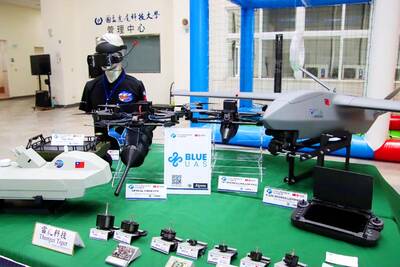
NON-RED SUPPLY: Boosting the nation’s drone industry is becoming increasingly urgent as China’s UAV dominance could become an issue in a crisis, an analyst said Taiwan’s drone exports to Europe grew 41.7-fold from 2024 to last year, with demand from Ukraine’s fight against Russian aggression the most likely driver of growth, a study showed. The Institute for Democracy, Society and Emerging Technology (DSET) in a statement on Wednesday said it found that many of Taiwan’s uncrewed aerial vehicle (UAV) sales were from Poland and the Czech Republic. These countries likely transferred the drones to Ukraine to aid it in its fight against the Russian invasion that started in 2022, it said. Despite the gains, Taiwan is not the dominant drone exporter to these markets, ranking second and fourth

Japanese Prime Minister Sanae Takaichi’s comment last year on Tokyo’s potential reaction to a Taiwan-China conflict has forced Beijing to rewrite its invasion plans, a retired Japanese general said. Takaichi told the Diet on Nov. 7 last year that a Chinese naval blockade or military attack on Taiwan could constitute a “survival-threatening situation” for Japan, potentially allowing Tokyo to exercise its right to collective self-defense. Former Japan Ground Self-Defense Force general Kiyofumi Ogawa said in a recent speech that the remark has been interpreted as meaning Japan could intervene in the early stages of a Taiwan Strait conflict, undermining China’s previous assumptions


 RSS
RSS