


Escalating tensions between the US and China over trade, the South China Sea and recent arms sales are pushing Taiwan back into the US foreign policy spotlight, attracting Beijing’s ire.
After a precedent-shattering telephone call with Donald Trump when he was president-elect, President Tsai Ing-wen (蔡英文) has found an increasingly receptive audience in the US during the recent disputes.
She has been aided in that by the presence of long-standing allies in the White House, the US Department of State and the Pentagon, including US National Security Adviser John Bolton.
“The Republic of China has more high-level friends in this administration than it’s had for many, many years,” said Nicholas Eberstadt, who focuses on Asian security issues at the American Enterprise Institute. “It’s also apparent that the administration has an approach that is going to contest China on many different fronts.”
While it is not clear how far the Trump administration is willing to boost Taiwan, it is seen as an increasingly valuable point of leverage over Beijing, which considers Taiwan’s fate a “core interest” — more important than nearly any other issue.
A faction in Bolton’s National Security Council (NSC) is seeking a more aggressive posture, including by sending more warships through the Taiwan Strait, while Trump and US Vice President Mike Pence have advocated proceeding with caution, according to one current and one former administration official.
An NSC spokesperson said the US president did not need to give further authorization for the US Navy to sail or operate wherever international law allows.
Decades have passed since the fate of Taiwan was considered so important that it featured in the 1960 US presidential debate.
The US broke diplomatic ties with Taiwan and officially recognized the government in Beijing in 1979, but the brewing confrontations over trade and security have created a new opportunity for Taiwan to push back against China’s bid to steadily erode its influence overseas.
Taiwan’s importance to Beijing was why Trump set off a shock wave in China when, as president-elect, he took a call from Tsai. The move raised questions about the US’ continuing commitment to its “one China” policy, which underpinned the restoration of ties between the two powers.
The move prompted then-US president Barack Obama to offer a rare rebuke of the president-elect.
“If you’re going to upend this understanding, you have to have thought through what the consequences are,” Obama said.
While Trump has since affirmed US support for “one China,” his administration has followed its predecessors and gone ahead with weapons sales to Taiwan and made clear that the island’s fate would feature in a broader realignment toward greater confrontation with leaders in Beijing.
In an Oct. 4 speech in Washington, Pence assailed China for a series of moves chipping away at Taiwan’s diplomatic presence overseas and its ramping up of pressure on private companies to refer to Taiwan as a province of China rather than what he called a “distinct geographic entity.”
“America will always believe Taiwan’s embrace of democracy shows a better path for all the Chinese people,” Pence said.
The speech followed sharp condemnation from the US after China persuaded three Latin American and Caribbean countries to switch their allegiances and establish diplomatic ties with China.
Chinese Minister of Foreign Affairs Wang Yi (王毅) delivered an unusually sharp rebuke during US Secretary of State Michael Pompeo’s visit to Beijing on Tuesday last week.
Wang urged the US to stop its “incorrect actions which harm China’s core interests.”
While he did not specify what he meant, there were many potential culprits: Pence’s speech, the announcements of US$1.4 billion in arms sales to Taiwan last year and another US$330 million proposed last month.
Taiwan is no longer seen as a bulwark of resistance against a communist threat, and the economic relationship between China and the US, the world’s two biggest economies, is too important to risk war, several analysts said.
“Although Washington’s rhetoric is loud and its provocative movements are frequent, as a researcher who followed the issue for years, I don’t worry that much about a fundamental change in status quo,” said Zhu Feng (朱峰), dean of Nanjing University’s Institute of International Relations. “If the Trump administration abandons the ’one China’ policy and fully supports Tsai Ing-wen militarily, that will be doomsday for US-China relations.”

The military has spotted two Chinese warships operating in waters near Penghu County in the Taiwan Strait and sent its own naval and air forces to monitor the vessels, the Ministry of National Defense (MND) said. Beijing sends warships and warplanes into the waters and skies around Taiwan on an almost daily basis, drawing condemnation from Taipei. While the ministry offers daily updates on the locations of Chinese military aircraft, it only rarely gives details of where Chinese warships are operating, generally only when it detects aircraft carriers, as happened last week. A Chinese destroyer and a frigate entered waters to the southwest
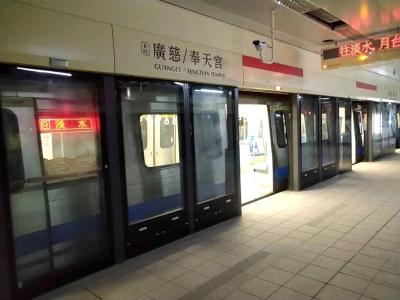
The eastern extension of the Taipei MRT Red Line could begin operations as early as late June, the Taipei Department of Rapid Transit Systems said yesterday. Taipei Rapid Transit Corp said it is considering offering one month of free rides on the new section to mark its opening. Construction progress on the 1.4km extension, which is to run from the current terminal Xiangshan Station to a new eastern terminal, Guangci/Fengtian Temple Station, was 90.6 percent complete by the end of last month, the department said in a report to the Taipei City Council's Transportation Committee. While construction began in October 2016 with an
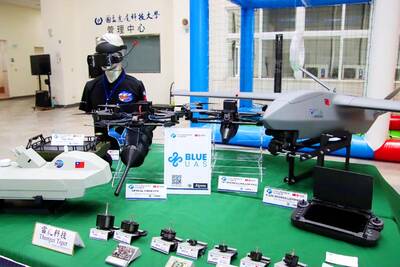
NON-RED SUPPLY: Boosting the nation’s drone industry is becoming increasingly urgent as China’s UAV dominance could become an issue in a crisis, an analyst said Taiwan’s drone exports to Europe grew 41.7-fold from 2024 to last year, with demand from Ukraine’s fight against Russian aggression the most likely driver of growth, a study showed. The Institute for Democracy, Society and Emerging Technology (DSET) in a statement on Wednesday said it found that many of Taiwan’s uncrewed aerial vehicle (UAV) sales were from Poland and the Czech Republic. These countries likely transferred the drones to Ukraine to aid it in its fight against the Russian invasion that started in 2022, it said. Despite the gains, Taiwan is not the dominant drone exporter to these markets, ranking second and fourth
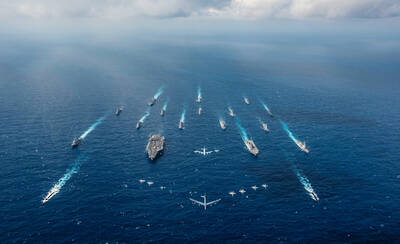
Japanese Prime Minister Sanae Takaichi’s comment last year on Tokyo’s potential reaction to a Taiwan-China conflict has forced Beijing to rewrite its invasion plans, a retired Japanese general said. Takaichi told the Diet on Nov. 7 last year that a Chinese naval blockade or military attack on Taiwan could constitute a “survival-threatening situation” for Japan, potentially allowing Tokyo to exercise its right to collective self-defense. Former Japan Ground Self-Defense Force general Kiyofumi Ogawa said in a recent speech that the remark has been interpreted as meaning Japan could intervene in the early stages of a Taiwan Strait conflict, undermining China’s previous assumptions


 RSS
RSS