


Taiwan would always be used as a pawn in confrontations between the US and China, and the conflicts are likely to escalate from a trade war to military confrontations, foreign affairs experts said yesterday at a National Policy Foundation seminar in Taipei.
The seminar at the Chinese Nationalist Party (KMT) think tank, which also examined President Tsai Ing-wen’s (蔡英文) foreign policy, drew several officials from the former KMT administration, including National Security Bureau director-general Tsai Der-sheng (蔡得勝), minister of foreign affairs Francisco Ou (歐鴻鍊), deputy minister of foreign affairs Bruce Linghu (令狐榮達) and National Security Council adviser Chiu Kun-shuan (邱坤玄), as well as former KMT legislator Lin Yu-fang (林郁方).
Taiwan should not bet on any side to win in Sino-US conflicts, Tsai Der-sheng said, adding that it should seek to strengthen its economic power amid the trade disputes between the two nations.
Commenting on a Sept. 25 article in Foreign Policy by Tanner Greer, which argued that Taiwan could win a war with China even without US assistance, Tsai Der-sheng said that in a conflict involving China’s southeastern provinces, the rest of China would continue to operate normally and offer logistic support, but Taiwan would not have the same option given its small size.
Lin said that many independence advocates take delight in the estranged relations between the US and China, thinking that the situation would make Taiwan safer because of the increase in US military assistance, but the opposite is true.
A conflict would mean the end of the “status quo” in the Taiwan Strait, Lin said.
Some Democratic Progressive Party (DPP) lawmakers have said that Taiwan would benefit from the Sino-US trade war because companies would place orders with Taiwanese suppliers rather than with those in China, but some Taiwanese businesspeople might decide to establish factories in the US, as Hong Hai Precision Industry Co has done, or have the products made in Southeast Asian factories, Lin said.
The government’s pursuit of closer ties with the US, combined with deteriorating relations between the US and China, does not help Taiwan make substantial progress in foreign policy, he said.
Taiwan has lost five allies since Tsai Ing-wen took office, and it cannot attend the World Health Assembly, or meetings of the International Civil Aeronautics Organization and other international organizations because Chinese obstructionism, he said.
No nation is exempt from the damage caused by Trump’s “America first” policy, adding that China might be the hardest hit, Lin said.
One of the side effects of the trade war is that Taiwan has now been asked to buy US$1.42 billion of US soybeans, he said.
Taiwan is a victim, not a beneficiary, of worsening Sino-US relations, he added.
Chiu said that Taiwan should seek a “dynamic equilibrium” in its relations with China as well as with the US, rather than fighting with one and relying heavily on the other.
Regardless of the nation Taiwan chooses to associate with, relations should be built on the basis of cooperation and competition, he said.
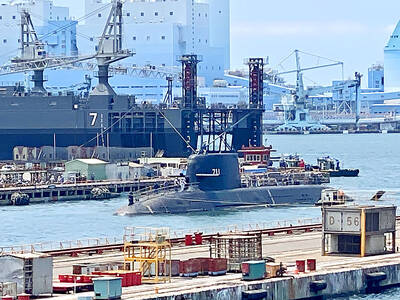
AGING: While Japan has 22 submarines, Taiwan only operates four, two of which were commissioned by the US in 1945 and 1946, and transferred to Taiwan in 1973 Taiwan would need at least 12 submarines to reach modern fleet capabilities, CSBC Corp, Taiwan chairman Chen Cheng-hung (陳政宏) said in an interview broadcast on Friday, citing a US assessment. CSBC is testing the nation’s first indigenous defense submarine, the Hai Kun (海鯤, Narwhal), which is scheduled to be delivered to the navy next month or in July. The Hai Kun has completed torpedo-firing tests and is scheduled to undergo overnight sea trials, Chen said on an SET TV military affairs program. Taiwan would require at least 12 submarines to establish a modern submarine force after assessing the nation’s operational environment and defense
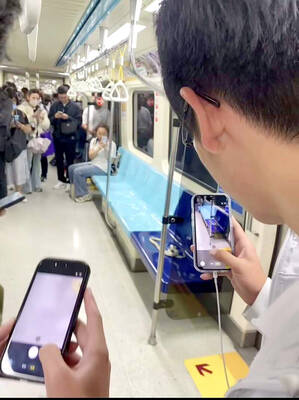
A white king snake that frightened passengers and caused a stir on a Taipei MRT train on Friday evening has been claimed by its owner, who would be fined, Taipei Rapid Transit Corp (TRTC) said yesterday. A person on Threads posted that he thought he was lucky to find an empty row of seats on Friday after boarding a train on the Bannan (Blue) Line, only to spot a white snake with black stripes after sitting down. Startled, he jumped up, he wrote, describing the encounter as “terrifying.” “Taipei’s rat control plan: Release snakes on the metro,” one person wrote in reply, referring
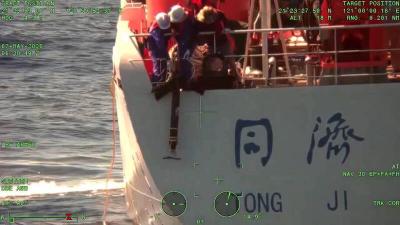
The coast guard today said that it had disrupted "illegal" operations by a Chinese research ship in waters close to the nation and driven it away, part of what Taipei sees a provocative pattern of China's stepped up maritime activities. The coast guard said that it on Thursday last week detected the Chinese ship Tongji (同濟號), which was commissioned only last year, 29 nautical miles (54km) southeast of the southern tip of Taiwan, although just outside restricted waters. The ship was observed lowering ropes into the water, suspected to be the deployment of scientific instruments for "illegal" survey operations, and the coast
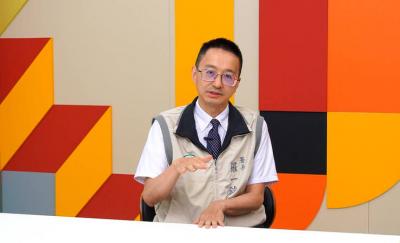
Taiwan’s two cases of hantavirus so far this year are on par with previous years’ case numbers, and the government is coordinating rat extermination work, so there should not be any outbreaks, Centers for Disease Control (CDC) Director-General Philip Lo (羅一鈞) said today in an interview with the Liberty Times (the Taipei Times’ sister newspaper). An increase in rat sightings in Taipei and New Taipei City has raised concerns about the spread of hantavirus, as rats can carry the disease. In January, a man in his 70s who lived in Taipei’s Daan District (大安) tested positive posthumously for hantavirus, Taiwan’s


 RSS
RSS