


CPC Corp, Taiwan’s (CPC) third liquefied natural gas (LNG) terminal project yesterday passed its environmental impact assessment (EIA) review, drawing ire from environmentalists who said they were “disappointed and furious.”
The EIA grand assembly’s decision overturned a decision made by an EIA committee in July, which rejected the project due to its potential impact on algal reef and endangered species on the planned site — Guantang Industrial Park (觀塘工業區) on the coast of Datan Borough (大潭) in Taoyuan’s Guanyin District (觀音).
Two previous assembly meetings failed to convene due to the absence of Environmental Protection Administration (EPA) Deputy Minister Chan Shun-kuei (詹順貴) and five EIA members, but yesterday’s meeting pushed through with another EPA deputy minister, Chang Tzi-chin (張子敬), attending in Chan’s place.
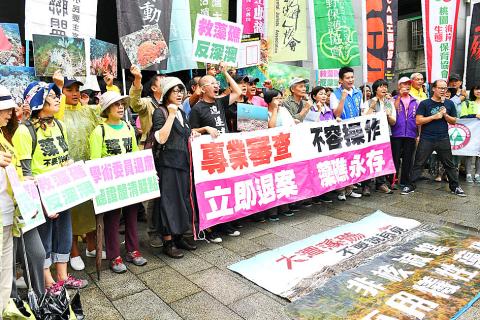
Photo: CNA
With EPA Minister Lee Ying-yuan (李應元) presiding, the project passed by 7-2.
Although it was a secret ballot, the seven were believed to be six government representatives and one academic, while two other committee members cast invalid votes.
Soon after the meeting closed, the EPA called a news conference at 4pm.
The agency reiterated that CPC has reduced the development area from 232 to 23 hectares and proposed plans to mitigate the project’s potential ecological impact.
Premier William Lai (賴清德) did not exert any pressure on the EIA assembly, but only asked that the company persuade assembly members with a convincing report, Lee said.
EPA Department of Comprehensive Planning Director-General Liu Tsung-yung (劉宗勇) said that CPC is required to build the terminal’s wave breakers 20m to 30m away from the coastline to minimize their impact on coastal species, in line with a proposal made yesterday by EIA committee member Ma Hsiao-kan (馬小康).
Committee member and coral expert Jeng Ming-shiou (鄭明修), who was again absent at yesterday’s meeting, said he was disappointed, but that he would continue to supervise other development projects to address the concerns of environmental groups.
Many environmental and labor rights groups protested outside the EPA building before and throughout the meeting.
After the project was passed, they turned to petition President Tsai Ing-wen (蔡英文) outside the Presidential Office Building.
“We feel disappointed, regretful and furious” about the result, Taoyuan Local Union director Pan Chong-cheng (潘忠政) said, but added that it was expected, as it had the premier’s support.
The groups said they wanted to remind Tsai of her 2013 promise to protect the algal reefs on Datan’s coast and would push through with a planned rally on Ketagalan Boulevard on Nov. 3, Pan said.
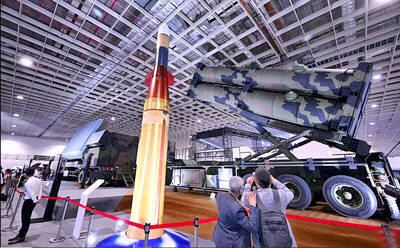
Taiwan is to commence mass production of the Tien Kung (天弓, “Sky Bow”) III, IV and V missiles by the second quarter of this year if the legislature approves the government’s NT$1.25 trillion (US$39.78 billion) special defense budget, an official said yesterday. Commenting on condition of anonymity, a defense official with knowledge of the matter said that the advanced systems are expected to provide crucial capabilities against ballistic and cruise missiles for the proposed “T-Dome,” an advanced, multi-layered air defense network. The Tien Kung III is an air defense missile with a maximum interception altitude of 35km. The Tien Kung IV and V
The disruption of 941 flights in and out of Taiwan due to China’s large-scale military exercises was no accident, but rather the result of a “quasi-blockade” used to simulate creating the air and sea routes needed for an amphibious landing, a military expert said. The disruptions occurred on Tuesday and lasted about 10 hours as China conducted live-fire drills in the Taiwan Strait. The Civil Aviation Administration (CAA) said the exercises affected 857 international flights and 84 domestic flights, affecting more than 100,000 travelers. Su Tzu-yun (蘇紫雲), a research fellow at the government-sponsored Institute for National Defense and Security Research, said the air
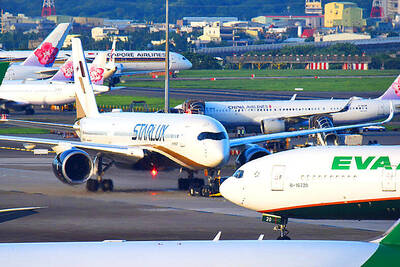
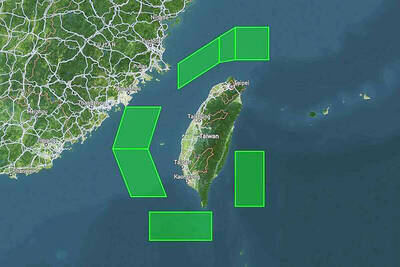
Trips for more than 100,000 international and domestic air travelers could be disrupted as China launches a military exercise around Taiwan today, Taiwan’s Civil Aviation Administration (CAA) said yesterday. The exercise could affect nearly 900 flights scheduled to enter the Taipei Flight Information Region (FIR) during the exercise window, it added. A notice issued by the Chinese Civil Aviation Administration showed there would be seven temporary zones around the Taiwan Strait which would be used for live-fire exercises, lasting from 8am to 6pm today. All aircraft are prohibited from entering during exercise, it says. Taipei FIR has 14 international air routes and
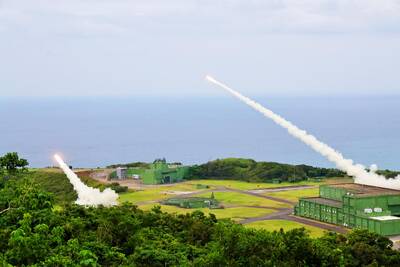
Taiwan lacks effective and cost-efficient armaments to intercept rockets, making the planned “T-Dome” interception system necessary, two experts said on Tuesday. The concerns were raised after China’s military fired two waves of rockets during live-fire drills around Taiwan on Tuesday, part of two-day exercises code-named “Justice Mission 2025.” The first wave involved 17 rockets launched at 9am from Pingtan in China’s Fujian Province, according to Lieutenant General Hsieh Jih-sheng (謝日升) of the Office of the Deputy Chief of the General Staff for Intelligence at the Ministry of National Defense. Those rockets landed 70 nautical miles (129.6km) northeast of Keelung without flying over Taiwan,


 RSS
RSS