


The Chinese military is posing a growing threat to Taiwan because of its improved military capabilities, the Heritage Foundation said in an annual report analyzing the US’ military strength.
The 2019 Index of US Military Strength, published by the Washington-based think tank on Thursday, warned of China’s growing military might in its chapter highlighting threats to the US’ vital interests.
It described China’s longstanding threat to end Taiwan’s de facto independence and ultimately to bring it under Beijing’s authority — if necessary, by force — as posing a danger to a major US security partner and to the US’ interest in peace and stability in the Western Pacific.
The 494-page report described Taiwan as an “essential part of the People’s Liberation Army’s (PLA) ‘new historic missions,’ shaping PLA acquisitions and military planning.”
That is because for Chinese leadership, the failure to effect unification, whether peacefully or through the use of force, would reflect fundamental political weakness in the People’s Republic of China (PRC), the report said.
“Two decades of double-digit increases in China’s announced defense budget have produced a significantly more modern PLA, much of which remains focused on a Taiwan contingency,” it said.
The Chinese have more than 1,000 ballistic missiles, a modernized air force, and growing numbers of modern surface combatants and diesel-electric submarines capable of mounting a blockade, the report said.
Tensions across the Taiwan Strait have risen since May 2016 when the Democratic Progressive Party won both the presidential and legislative elections in Taiwan, with Beijing ramping up efforts to suppress Taiwan in the international arena.
Over the past year in particular, China has sought to intimidate Taiwan with a growing number of military exercises, including live-fire drills and bomber flights around the island, the report said.
“In the absence of a strong American presence, [Beijing] might be willing to go farther than this,” it said.
The report also said that Chinese efforts to reclaim Taiwan are not limited to overt military actions.
The PRC employs political warfare methods called the “three warfares” — legal warfare, public opinion warfare and psychological warfare — to undermine both Taiwan’s will to resist and the US’ willingness to support Taiwan, it said.
The Chinese goal is to “win without fighting”; to take Taiwan without firing a shot or with only minimal resistance before the US can organize an effective response, the report said.
It concluded that the Chinese threat to Taiwan is a longstanding one, and that China’s ability to take military action against Taiwan, albeit at high economic and political cost, is improving.
The report singled out China and Russia as the most worrisome threats to US interests over the past year, “both because of the ongoing modernization and expansion of their offensive military capabilities and because of the more enduring effect they are having within their respective regions.”
Citing a warning from Admiral Harry Harris, the outgoing head of the US Pacific Command, the report said that the US is in danger of losing the next arms race with China, because of China’s heavy investment in new military technologies, including hypersonic missiles, artificial intelligence, and advanced space and cyber capabilities.
The Heritage Foundation has published the Index of US Military Strength annually since 2015. It gauges the ability of the US military to perform its missions in today’s world and assesses how it has changed from the preceding year.
It is the only non-governmental annual assessment of US military strength.
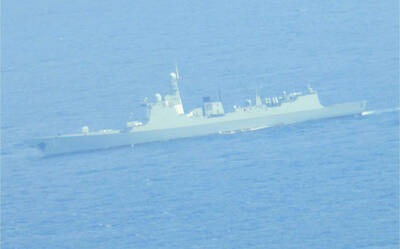
The military has spotted two Chinese warships operating in waters near Penghu County in the Taiwan Strait and sent its own naval and air forces to monitor the vessels, the Ministry of National Defense (MND) said. Beijing sends warships and warplanes into the waters and skies around Taiwan on an almost daily basis, drawing condemnation from Taipei. While the ministry offers daily updates on the locations of Chinese military aircraft, it only rarely gives details of where Chinese warships are operating, generally only when it detects aircraft carriers, as happened last week. A Chinese destroyer and a frigate entered waters to the southwest

A magnitude 6.1 earthquake struck off the coast of Yilan County at 8:39pm tonight, the Central Weather Administration (CWA) said, with no immediate reports of damage or injuries. The epicenter was 38.7km east-northeast of Yilan County Hall at a focal depth of 98.3km, the CWA’s Seismological Center said. The quake’s maximum intensity, which gauges the actual physical effect of a seismic event, was a level 4 on Taiwan’s 7-tier intensity scale, the center said. That intensity level was recorded in Yilan County’s Nanao Township (南澳), Hsinchu County’s Guansi Township (關西), Nantou County’s Hehuanshan (合歡山) and Hualien County’s Yanliao (鹽寮). An intensity of 3 was
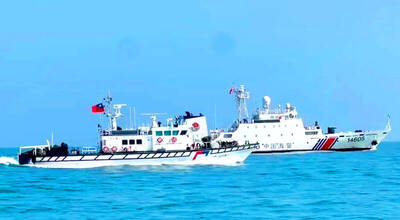
Instead of focusing solely on the threat of a full-scale military invasion, the US and its allies must prepare for a potential Chinese “quarantine” of Taiwan enforced through customs inspections, Stanford University Hoover fellow Eyck Freymann said in a Foreign Affairs article published on Wednesday. China could use various “gray zone” tactics in “reconfiguring the regional and ultimately the global economic order without a war,” said Freymann, who is also a nonresident research fellow at the US Naval War College. China might seize control of Taiwan’s links to the outside world by requiring all flights and ships entering or leaving Taiwan
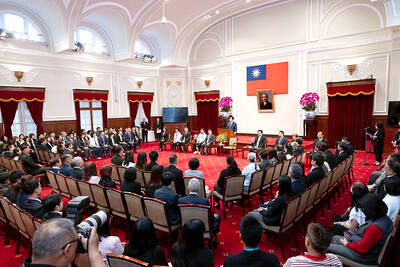
The next minimum wage hike is expected to exceed NT$30,000, President William Lai (賴清德) said yesterday during an award ceremony honoring “model workers,” including migrant workers, at the Presidential Office ahead of Workers’ Day today. Lai said he wished to thank the awardees on behalf of the nation and extend his most sincere respect for their hard work, on which Taiwan’s prosperity has been built. Lai specifically thanked 10 migrant workers selected for the award, saying that although they left their home countries to further their own goals, their efforts have benefited Taiwan as well. The nation’s industrial sector and small businesses lay


 RSS
RSS