


Taipei Mayor Ko Wen-je (柯文哲) yesterday rejected US author Ethan Gutmann’s accusation on Tuesday that he is a “liar” and that he was involved in live organ harvesting in China, vowing to file a lawsuit against Gutmann if he does not apologize.
Gutmann, interviewed Ko for his 2014 book The Slaughter: Mass Killings, Organ Harvesting, and China’s Secret Solution to tts Dissident Problem, and wrote that Ko was aware that many of the organs transplanted in China came from Falun Gong (法輪功) members.
Gutmann on Tuesday told a news conference in Taipei that Ko was a potential broker for Taiwanese patients wanting to receive organ transplants in China, and that Ko, having taught extracorporeal membrane oxygenation (ECMO) techniques to doctors in China, created a “perverse incentive” for the Chinese doctors to harvest live organs.
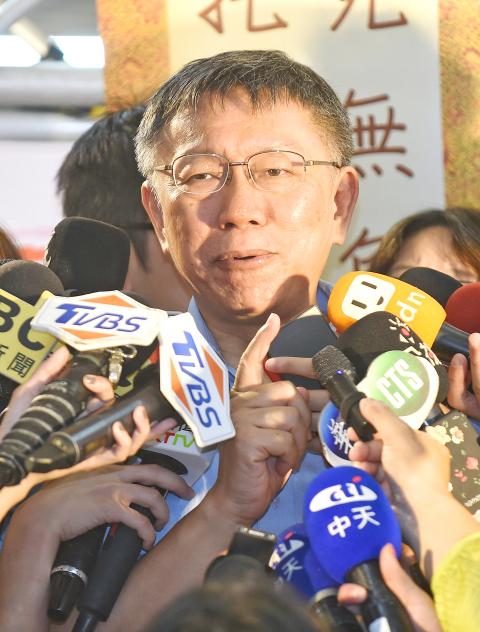
Photo: Liu Hsin-de, Taipei Times
“I have lived in the US before, so I know that calling a person a liar in the US is a serious accusation, so I am very upset that Gutmann used the term to describe me in public,” Ko said yesterday morning. “I urge him to apologize or present evidence within 24 hours to explain why he made the accusation.”
Ko’s election campaign office said the deadline was 9:49pm yesterday, as Ko first posted the remark on Facebook at 9:49pm on Tuesday.
“If you [Gutmann] do not apologize, I will sue you. And I assure you that I will file a lawsuit, even if it is a cross-border lawsuit,” he said.
“Let me get this straight, I, Ko Wen-je, have never took patients to the Mainland to mediate for organ transplants,” Ko said, adding that while all election campaigns are characterized by attacks, they do not have to be so “dirty.”
Citing the Yu Chang Biologics Co (now known as TaiMed) controversy against then-presidential candidate Tsai Ing-wen (蔡英文) in 2012, and allegations in 2014 that he transferred donations made to the National Taiwan University Hospital (NTUH) into his personal account, he said the first case damaged half of Taiwan’s biotechnology industry and the latter caused many difficulties for the clinical medicine research community.
“Now ‘the Gutmann case’ is affecting the nation’s transplant and intensive care communities,” he said.
The ECMO system is used for temporarily supporting the functions of the heart and lungs, before they recover or the patient receives an organ transplant, Ko said.
Taiwan’s ECMO techniques received the National Quality Award, and the Extracorporeal Life Support Organization also gave NTUH’s ECMO team — which Ko led for many years — a “Center of Excellence” award, he said.
Ko went to China to teach ECMO techniques because they can save lives, he said, adding that he has taught them in Singapore, Malaysia, Hong Kong, Italy, Japan and the US.
The ECMO system is an expensive high-end technology that is seldom used for organ transplants, and using the ECMO or conducting an organ transplant are both very complicated operations that cannot be completed by a physician alone, he said, adding that most doctors in the field know these facts too.
“The transplantation process includes preoperative evaluation, operation, postoperative care and follow-ups, but I was in charge of the intensive care unit [ICU], so my patients were mostly in a poor physical condition prior to their operations or had suffered postoperative complications,” Ko said, “Most of them could not even leave the ICU, so how could I possibly take them to China for a transplant?”
He said he does not have control over how other people make use of the ECMO techniques, just like people cannot blame the atomic bomb on Albert Einstein, adding that he gave ECMO lectures to more than 400 people in China, so it was impossible for him to know everyone.
Ko said it is a widely known fact that some Taiwanese doctors take patients to China for organ transplants, but that does not mean he did.
The organ transplant registration system in Taiwan was designed by him, so it is easy to identify the preoperative care patients whose organs do not have a source, none of whom were treated by him, Ko said.
“I think the people who are intentionally using these controversies ... for electoral gains are detestable,” he said.

SECURITY: Starlink owner Elon Musk has taken pro-Beijing positions, and allowing pro-China companies to control Taiwan’s critical infrastructure is risky, a legislator said Starlink was reluctant to offer services in Taiwan because of the nation’s extremely high penetration rates in 4G and 5G services, the Ministry of Digital Affairs said yesterday. The ministry made the comments at a meeting of the legislature’s Transportation Committee, which reviewed amendments to Article 36 of the Telecommunications Management Act (電信管理法). Article 36 bans foreigners from holding more than 49 percent of shares in public telecommunications networks, while shares foreigners directly and indirectly hold are also capped at 60 percent of the total, unless specified otherwise by law. The amendments, sponsored by Chinese Nationalist Party (KMT) Legislator Ko
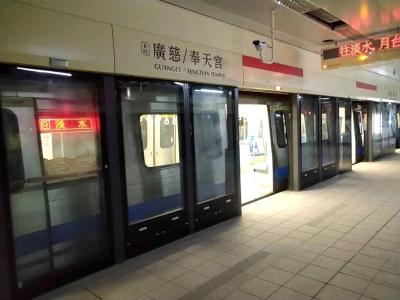
The eastern extension of the Taipei MRT Red Line could begin operations as early as late June, the Taipei Department of Rapid Transit Systems said yesterday. Taipei Rapid Transit Corp said it is considering offering one month of free rides on the new section to mark its opening. Construction progress on the 1.4km extension, which is to run from the current terminal Xiangshan Station to a new eastern terminal, Guangci/Fengtian Temple Station, was 90.6 percent complete by the end of last month, the department said in a report to the Taipei City Council's Transportation Committee. While construction began in October 2016 with an
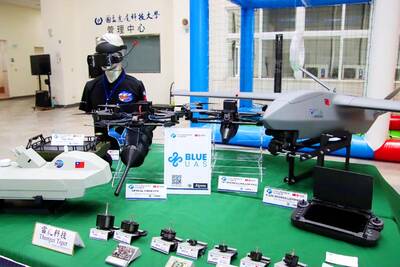
NON-RED SUPPLY: Boosting the nation’s drone industry is becoming increasingly urgent as China’s UAV dominance could become an issue in a crisis, an analyst said Taiwan’s drone exports to Europe grew 41.7-fold from 2024 to last year, with demand from Ukraine’s fight against Russian aggression the most likely driver of growth, a study showed. The Institute for Democracy, Society and Emerging Technology (DSET) in a statement on Wednesday said it found that many of Taiwan’s uncrewed aerial vehicle (UAV) sales were from Poland and the Czech Republic. These countries likely transferred the drones to Ukraine to aid it in its fight against the Russian invasion that started in 2022, it said. Despite the gains, Taiwan is not the dominant drone exporter to these markets, ranking second and fourth
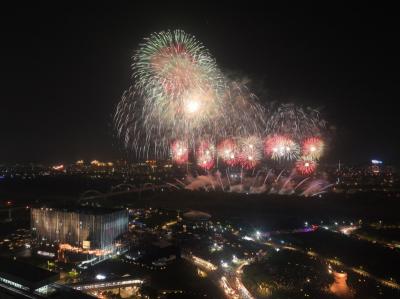
The New Taipei City Art Museum this weekend plans to celebrate its first anniversary with a two-day extravaganza featuring live concerts and a large-scale synchronized fireworks and drone display, the New Taipei City Cultural Affairs Department said. The two-day celebrations are to take place in the museum’s outdoor park, with markets and live performances by singers including Ann Bai (白安), Bii (畢書盡) and the Cosmos People (宇宙人), the department said. The highlight on both evenings would be the "Echoes of Light" show, an aerial spectacle combining fireworks and drone performances designed around the concept of "dual stages in the sky," it


 RSS
RSS