


China Unification Promotion Party (CUPP) member Chen Chih-chiang (陳志強) yesterday said that Taiwanese-Australian model and actress Hannah Quinlivan (昆凌) supported Taiwanese independence, after uncovering an interview she did five years ago.
In a post on Sina Weibo, Chen shared a photograph of Quinlivan during the 2013 interview, in which she said she represented two nationalities — Taiwan and Australia.
She was visiting her family in Australia at the time.

Photo: Hu Shun-hsiang, Taipei Times
In his post, Chen called on Quinlivan’s husband, Taiwanese singer Jay Chou (周杰倫), to “educate” her.
In a separate post yesterday, Chen tagged a Sina Weibo account shared by two Chinese Ministry of Public Security offices, asking whether Quinlivan’s comments are against the law.
“If [the comments] have violated the law, I choose to forgive her ignorance,” Chen wrote.
In response to requests for comment, Quinlivan’s agent said that she does not understand the question and is not interested in politics.
Quinlivan is only focused on the work she enjoys and on her family, her agent added.
The news comes after Taiwanese actress Vivian Sung (宋芸樺) on Thursday posted an apology on Sina Weibo after a video surfaced of her calling Taiwan her favorite country in a 2015 interview.
“I am a Chinese girl born in the 1990s. Taiwan is my hometown, China is my home country,” Sung wrote.
Sung’s apology received a backlash from Taiwanese and appears to have failed to please Chinese.

LOUD AND PROUD Taiwan might have taken a drubbing against Australia and Japan, but you might not know it from the enthusiasm and numbers of the fans Taiwan might not be expected to win the World Baseball Classic (WBC) but their fans are making their presence felt in Tokyo, with tens of thousands decked out in the team’s blue, blowing horns and singing songs. Taiwanese fans have packed out the Tokyo Dome for all three of their games so far and even threatened to drown out home team supporters when their team played Japan on Friday. They blew trumpets, chanted for their favorite players and had their own cheerleading squad who dance on a stage during the game. The team struggled to match that exuberance on the field, with
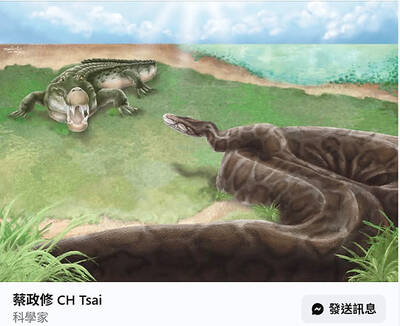
Taiwanese paleontologists have discovered fossil evidence that pythons up to 4m long inhabited Taiwan during the Pleistocene epoch, reporting their findings in the international scientific journal Historical Biology. National Taiwan University (NTU) Institute of Ecology and Evolutionary Biology associate professor Tsai Cheng-hsiu (蔡政修) led the team that discovered the largest snake fossil ever found in Taiwan. The single trunk vertebra was discovered in Tainan at the Chiting Formation, dated to between 400,000 and 800,000 years ago in the Middle Pleistocene, the paper said. The area also produced Taiwan’s first avian fossil, as well as crocodile, mammoth, saber-toothed cat and rhinoceros fossils, it said. Discoveries

Taiwanese paleontologists have discovered fossil evidence that pythons up to 4m long inhabited Taiwan during the Pleistocene epoch, reporting their findings in the international scientific journal Historical Biology. National Taiwan University (NTU) Institute of Ecology and Evolutionary Biology associate professor Tsai Cheng-hsiu (蔡政修) led the team that discovered the largest snake fossil ever found in Taiwan. A single trunk vertebra was discovered in Tainan at the Chiting Formation, dated to between 800,000 to 400,000 years ago in the Middle Pleistocene, the paper said. The area also produced Taiwan’s first avian fossil, as well as crocodile, mammoth, sabre-toothed cat and rhinoceros fossils, it said. Discoveries
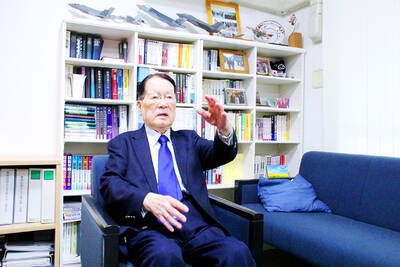
Whether Japan would help defend Taiwan in case of a cross-strait conflict would depend on the US and the extent to which Japan would be allowed to act under the US-Japan Security Treaty, former Japanese minister of defense Satoshi Morimoto said. As China has not given up on the idea of invading Taiwan by force, to what extent Japan could support US military action would hinge on Washington’s intention and its negotiation with Tokyo, Morimoto said in an interview with the Liberty Times (sister paper of the Taipei Times) yesterday. There has to be sufficient mutual recognition of how Japan could provide


 RSS
RSS