


Academia Sinica academician and NTU president-elect Kuan Chung-ming (管中閔) yesterday reiterated that he will not back down from what he called a fight for National Taiwan University’s (NTU) autonomy against government intervention, in a speech at an annual gala held by the Southern California National Taiwan University Alumni Association in Los Angeles.
Kuan was on Jan. 5 elected NTU president, but the Ministry of Education in April refused to appoint him amid allegations of plagiarism and a conflict of interest, as well as a flawed selection process.
Since then, three administrative appeals have been filed — by NTU students, by the university and by Kuan himself — requesting that the ministry honor the election results and appoint him.
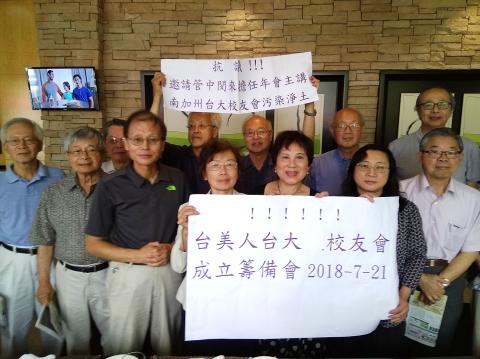
Photo: CNA
When asked by the audience about his plans to tackle the controversy, Kuan said that he had considered giving up, but former NTU president Chen Wei-jao (陳維昭) changed his mind by telling him that the fight is less about who should be president and more about the university’s autonomy.
“I will stand in solidarity with NTU in its fight for university autonomy and insist on not backing down,” he said.
Anyone who supports him is supporting NTU and academic freedom, Kuan said, adding that he hopes to fight the establishment with the power of the public.
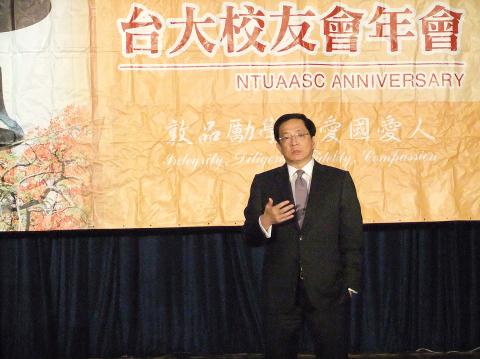
Photo: CNA
Meanwhile, several members of the association at a news conference announced the founding of a separate alumni association in Los Angeles.
The new association was founded because the original association insisted on inviting Kuan as the keynote speaker at the gala, despite opposition from fellow members, former association council member Lin Mei-li (林美里) said.
More than 200 alumni issued a joint statement criticizing the association’s decision to invite Kuan, who said before his speech that the opposition prompted him to scrap about half of his speech.
On Saturday, the Action Alliance for University Autonomy — which consists of 4,000 NTU students and faculty members — issued a joint statement with 13 other groups from universities nationwide, demanding that new Minister of Education Yeh Jiunn-rong (葉俊榮) respect the law.
“We are extremely disappointed that Yeh has continued to criticize the election process and request a new vote,” they said, adding that the government should admit its mistake and complete the procedures for the NTU presidential election in accordance with the law.
On Monday last week, when Yeh was inaugurated, a group of students that had filed an administrative appeal applied for a provisional injunction, requesting that the Taipei High Administrative Court order the ministry to temporarily appoint Kuan as NTU president until a ruling is made.
Yeh has said that resolving the standoff is a priority.
Before Yeh took office, the controversy led to the resignations of former education ministers Pan Wen-chung (潘文忠) in April and Wu Maw-kuen (吳茂昆) in May.

NATIONAL SECURITY: Authorities are working to confirm the identities of the military personnel involved and investigating possible illegal conduct and regulatory violations Authorities are probing possible national security implications after Kinmen police and immigration officers on Sunday found a Chinese woman allegedly posing as a tourist while engaging in prostitution involving more than 10 military personnel. The woman, surnamed Chen (陳), has since been deported, authorities said, adding that investigators are still working to confirm the identities of those implicated, as the records only listed code names and aliases. The case stemmed from a report received by the Kinmen District Prosecutors’ Office on Friday last week from the Jinhu Precinct of the Kinmen County Police Bureau. On Sunday, police, along with the National Immigration

GLOBALGIVING: ‘ Caving to external pressure is not acceptable for an organization that has cultivated justice reform and human rights for 30 years,’ one NGO said A slew of non-government organizations (NGOs) have withdrawn from the GlobalGiving fundraising platform after it announced it would use “Chinese Taipei” instead of “Taiwan” from next month. The Taiwan Good Rice Association wrote on Facebook on Friday that it was informed on April 28 via a teleconference call of the change, which was made because the platform wanted to operate in China. Taiwan Good Rice is to terminate all cooperative relationships with GlobalGiving in response to the platform’s “unilateral and non-negotiable” decision to remove references to Taiwan, the NGO said. “Taiwan is in the official name of Taiwan Good Rice Association and the

HEAVY WEATHER: Typhoon Jangmi is due to crash straight into the Ryukyus as airlines look to shift flights to larger aircraft or cancel flights to Okinawa entirely Taiwan’s international air carriers announced flight adjustments over the weekend as Typhoon Jangmi is forecast to hit the Ryukyu Islands today and tomorrow. The Central Weather Administration (CWA) upgraded Jangmi from a tropical storm to a typhoon at 8am yesterday, with the eye located 580km south of Naha city. It was moving north at 19kph. Today, China Airlines’ CI-120, CI-121, CI-122 and CI-123 flights between Taoyuan and Naha, Okinawa, have been canceled as well as CI-132 and CI-133 between Kaohsiung and Naha. EVA Air’s BR-112, BR-113, BR-186 and BR-185 flights between Taoyuan and Naha are also canceled. Low-cost carrier Tigerair Taiwan canceled IT-230,
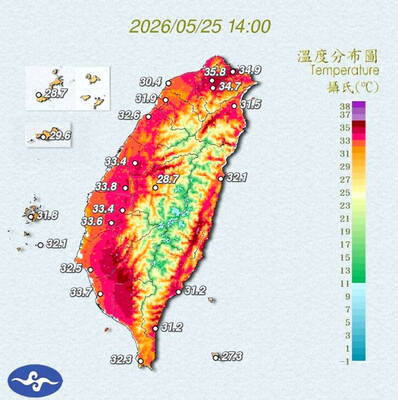
STAY COOL: The HPA recommended that people stay hydrated, use air-conditioning or fans while indoors, wear loose-fitting clothes and walk in the shade while outdoors Employers must implement measures such as installing cooling equipment, and providing drinking water and rest breaks for outdoor workers starting from Monday next week, the Taipei Department of Labor said on Sunday. Employers who fail to comply could face fines of NT$30,000 to NT$300,000 under the Occupational Safety and Health Act (職業安全衛生法), the department said. Businesses in Taipei employing fewer than 100 workers, as well as registered self-employed workers with labor insurance coverage, could receive on-site assessments and guidance from occupational safety consultants to help them apply for central government subsidies to implement or improve heat-protection measures, it said. Under the Ministry of


 RSS
RSS