


New Minister of Education Yeh Jiunn-rong (葉俊榮) yesterday said he would communicate with National Taiwan University (NTU) within the next two months with the goal to resolve the controversy surrounding the school’s presidential election.
Yeh yesterday took office as the education minister at a handover ceremony in Taipei that was presided over by Minister Without Portfolio Lin Wan-yi (林萬億).
At the ceremony, Yeh said his priorities are to resolve the NTU controversy and finish curriculum guidelines for the 12-year education system, which is to be implemented next year.
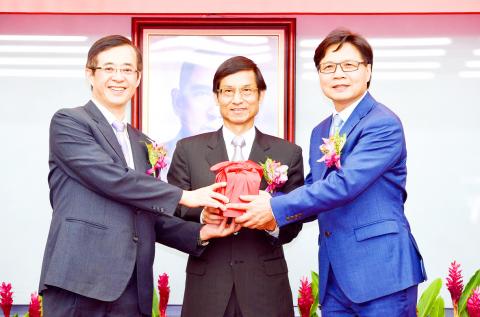
Photo: Peter Lo, Taipei Times
The ministry on April 27 decided not to appoint NTU’s elected candidate, Kuan Chung-ming (管中閔), as the school’s new president on the grounds that there had been a conflict of interest in the election process, instructing the university to hold a new election.
Since then, three administrative appeals have been filed — by NTU students, by the university and by Kuan himself — requesting that the ministry honor the election results and appoint Kuan.
A standoff has existed between the ministry and NTU since the university last month refused to hold another presidential election, he said.
While respecting their decision to file an administrative appeal, Yeh said that such cases typically drag on for years, adding that the university being without a formal president long-term would be damaging to its development.
“I hope that we can find another way to resolve the problem. I will communicate with the university, understanding their needs and the context,” he said.
By being open to dialogue, he hopes to build mutual trust with the school, Yeh added.
The ministry would not leave the nation’s leading university stranded, he said, adding that the university has “many top faculty members and students, and we should ensure that the school continues to be successful.”
“However, this window of communication will not last forever,” he said. “It is important to offer an opportunity, but this will be the only opportunity.”
“The next two months are the best time to resolve this and we must work hard and take advantage of the opportunity,” he added.
Regarding the new curriculum, the ministry plans to complete it before the beginning of the new academic year, he said.
While many had questioned Yeh’s lack of experience in elementary and secondary education, he said he would do his best to learn more about the subject.
“I will work hard on that,” he said. “No matter how much I already know, I will always try to learn more.”
Yeh was earlier this year accused of teaching illegally at China’s Zhejiang University from Dec. 19, 2011, to Jan. 15, 2012, while he worked at NTU.
However, he says he did not break any law, adding that it was a short-term academic exchange for which he was not paid.
When asked whether he received any subsidies for the trip, Yeh said that although he was not paid a salary, he had received subsidies to cover lodging and transportation.
Before taking office, Yeh was the minister of the interior. He was also a professor at National Taiwan University and a minister without portfolio for the Executive Yuan.

NATIONAL SECURITY: Authorities are working to confirm the identities of the military personnel involved and investigating possible illegal conduct and regulatory violations Authorities are probing possible national security implications after Kinmen police and immigration officers on Sunday found a Chinese woman allegedly posing as a tourist while engaging in prostitution involving more than 10 military personnel. The woman, surnamed Chen (陳), has since been deported, authorities said, adding that investigators are still working to confirm the identities of those implicated, as the records only listed code names and aliases. The case stemmed from a report received by the Kinmen District Prosecutors’ Office on Friday last week from the Jinhu Precinct of the Kinmen County Police Bureau. On Sunday, police, along with the National Immigration

GLOBALGIVING: ‘ Caving to external pressure is not acceptable for an organization that has cultivated justice reform and human rights for 30 years,’ one NGO said A slew of non-government organizations (NGOs) have withdrawn from the GlobalGiving fundraising platform after it announced it would use “Chinese Taipei” instead of “Taiwan” from next month. The Taiwan Good Rice Association wrote on Facebook on Friday that it was informed on April 28 via a teleconference call of the change, which was made because the platform wanted to operate in China. Taiwan Good Rice is to terminate all cooperative relationships with GlobalGiving in response to the platform’s “unilateral and non-negotiable” decision to remove references to Taiwan, the NGO said. “Taiwan is in the official name of Taiwan Good Rice Association and the

HEAVY WEATHER: Typhoon Jangmi is due to crash straight into the Ryukyus as airlines look to shift flights to larger aircraft or cancel flights to Okinawa entirely Taiwan’s international air carriers announced flight adjustments over the weekend as Typhoon Jangmi is forecast to hit the Ryukyu Islands today and tomorrow. The Central Weather Administration (CWA) upgraded Jangmi from a tropical storm to a typhoon at 8am yesterday, with the eye located 580km south of Naha city. It was moving north at 19kph. Today, China Airlines’ CI-120, CI-121, CI-122 and CI-123 flights between Taoyuan and Naha, Okinawa, have been canceled as well as CI-132 and CI-133 between Kaohsiung and Naha. EVA Air’s BR-112, BR-113, BR-186 and BR-185 flights between Taoyuan and Naha are also canceled. Low-cost carrier Tigerair Taiwan canceled IT-230,

Chinese Nationalist Party (KMT) Chairwoman Cheng Li-wun (鄭麗文) yesterday briefed her party’s Central Standing Committee regarding her scheduled visit to the US between Monday next week and June 16, saying that her purpose would be to persuade the US that the Republic of China (ROC) Constitution was a “one China” constitution that would foster stable and peaceful cross-strait relations. The ROC Constitution is the most important defense for all Taiwanese citizens, as it upholds our democracy and has contributed to our robust economy, which aligns with international and US interests, she said. “We would not be troublemakers and drag the US under,”


 RSS
RSS