


President Tsai Ing-wen (蔡英文) yesterday vowed to promote international exchange and foreign relations based on respect for human rights as she presided over the opening of the National Human Rights Museum at White Terror Memorial Park on Green Island.
The opening of the museum yesterday marked the 67th anniversary since political prisoners were first incarcerated on Green Island on May 17, 1951.
Accompanied by Minister of Culture Cheng Li-chiun (鄭麗君), Tsai inspected a wall inscribed with names of political prisoners and later watched performances by the Shin Sing Elementary School choir from Taitung County and members of the Tsai Jui-yueh Culture Foundation.
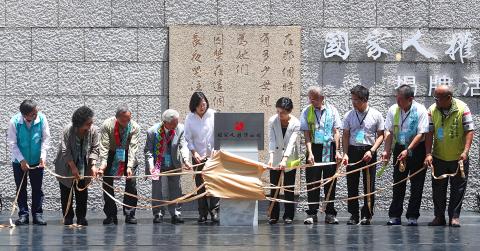
Photo: CNA
More than 80 people, including former political prisoners and relatives of those who have passed, attended the event.
“The opening of this museum gives people a better understanding of how much the older generation endured during the White Terror era,” Tsai said in her speech.
“Through this museum, we hope the younger generation will understand the importance of freedom and continue to strive for human rights from the lessons learned through history,” she said.
Tsai also expressed hope that the museum — which occupies the site of a former prison for political detainees — would help promote human rights education within government agencies and serve as a platform to show the rest of the world that Taiwan is not afraid to reflect on its history.
The transitional justice promotion committee, which is to be officially established on Sunday, will work with local governments to launch a human rights education network, with projects designed to breathe new life into sites across the nation that bore witness to human rights violations, Cheng said.
The 228 Incident refers to a brutal crackdown by the then-Chinese Nationalist Party (KMT) government headed by Chiang Kai-shek (蔣介石) after an anti-government uprising in 1947. The crackdown, which continued into May that year, left about 18,000 to 28,000 people dead, according to government figures.
The period immediately following the 228 Incident — during which political dissidents were suppressed, imprisoned and killed — is known as the White Terror era. It lasted until the lifting of martial law in 1987.

NATIONAL SECURITY: Authorities are working to confirm the identities of the military personnel involved and investigating possible illegal conduct and regulatory violations Authorities are probing possible national security implications after Kinmen police and immigration officers on Sunday found a Chinese woman allegedly posing as a tourist while engaging in prostitution involving more than 10 military personnel. The woman, surnamed Chen (陳), has since been deported, authorities said, adding that investigators are still working to confirm the identities of those implicated, as the records only listed code names and aliases. The case stemmed from a report received by the Kinmen District Prosecutors’ Office on Friday last week from the Jinhu Precinct of the Kinmen County Police Bureau. On Sunday, police, along with the National Immigration

GLOBALGIVING: ‘ Caving to external pressure is not acceptable for an organization that has cultivated justice reform and human rights for 30 years,’ one NGO said A slew of non-government organizations (NGOs) have withdrawn from the GlobalGiving fundraising platform after it announced it would use “Chinese Taipei” instead of “Taiwan” from next month. The Taiwan Good Rice Association wrote on Facebook on Friday that it was informed on April 28 via a teleconference call of the change, which was made because the platform wanted to operate in China. Taiwan Good Rice is to terminate all cooperative relationships with GlobalGiving in response to the platform’s “unilateral and non-negotiable” decision to remove references to Taiwan, the NGO said. “Taiwan is in the official name of Taiwan Good Rice Association and the

HEAVY WEATHER: Typhoon Jangmi is due to crash straight into the Ryukyus as airlines look to shift flights to larger aircraft or cancel flights to Okinawa entirely Taiwan’s international air carriers announced flight adjustments over the weekend as Typhoon Jangmi is forecast to hit the Ryukyu Islands today and tomorrow. The Central Weather Administration (CWA) upgraded Jangmi from a tropical storm to a typhoon at 8am yesterday, with the eye located 580km south of Naha city. It was moving north at 19kph. Today, China Airlines’ CI-120, CI-121, CI-122 and CI-123 flights between Taoyuan and Naha, Okinawa, have been canceled as well as CI-132 and CI-133 between Kaohsiung and Naha. EVA Air’s BR-112, BR-113, BR-186 and BR-185 flights between Taoyuan and Naha are also canceled. Low-cost carrier Tigerair Taiwan canceled IT-230,

Chinese Nationalist Party (KMT) Chairwoman Cheng Li-wun (鄭麗文) yesterday briefed her party’s Central Standing Committee regarding her scheduled visit to the US between Monday next week and June 16, saying that her purpose would be to persuade the US that the Republic of China (ROC) Constitution was a “one China” constitution that would foster stable and peaceful cross-strait relations. The ROC Constitution is the most important defense for all Taiwanese citizens, as it upholds our democracy and has contributed to our robust economy, which aligns with international and US interests, she said. “We would not be troublemakers and drag the US under,”


 RSS
RSS