


Criticizing National Taiwan University for failing to resolve the controversy over its president-elect Kuan Chung-ming (管中閔), the National Taiwan University Student Association yesterday said it would propose a motion to review the school’s regulations at next month’s council meeting.
The Ministry of Education on April 27 said that Kuan was unqualified for the post because he had violated regulations by illegally serving as an independent director and a member of the salary and auditing committees at Taiwan Mobile, and that his election had been flawed due to a conflict of interest in the process.
A provisional school affairs meeting on Saturday decided that the university should urge the ministry to approve Kuan’s selection and that the school would take legal action if the ministry refused.
A motion proposed at that meeting by student association president Lin Yen-ting (林彥廷) calling for an overhaul of the legal and administrative disputes throughout the election process and increased percentage of student representatives on the election committee and university council was vetoed in a 66-52 vote.
By refusing to investigate the controversy surrounding Kuan or to review its regulations, the university is allowing the boundaries defining academic misconduct to blur, the association said yesterday.
“To resolve the controversy, the university must examine all related facts and have a sufficient legal basis. To better implement university autonomy, it must take on a more active and responsible role and overhaul its regulations,” the group said in a statement.
The association would propose a motion to review the university’s regulations at the next council meeting, scheduled for June 9, the group said.
In related news, former vice president Annette Lu (呂秀蓮) and former premier Simon Chang (張善政), both graduates of the university, yesterday issued a joint statement calling on the ministry to appoint Kuan.
“As alumni, we are urging the ministry to appoint Kuan as the university’s president based on Article 9 of the University Act (大學法) following the university council’s meeting on Saturday,” they said.
Their statement was not aimed at expressing support for any individual, they simply believe controversies should be resolved by adhering to the law, they said.
“We have respectively been the vice-president and premier for different ruling parties. We understand a transparent and fair environment is essential for high-quality public policies and that the basic principles of democracy and law that separate right from wrong must not be compromised,” they said.
According to Article 9, the ministry must appoint the president selected by public universities, Lu said in a separate statement.
If interested parties believe such an election was flawed, they can file for an administrative remedy after the appointment has been made, she added.
Lu was vice president during the first Democratic Progressive Party administration of then-president Chen Shui-bian (陳水扁), while Chang was premier for a little more than three months during the second term of then-president Ma Ying-jeou (馬英九) of the Chinese Nationalist Party (KMT).
Additional reporting by CNA and staff writer
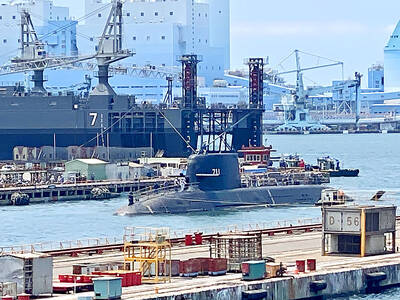
AGING: While Japan has 22 submarines, Taiwan only operates four, two of which were commissioned by the US in 1945 and 1946, and transferred to Taiwan in 1973 Taiwan would need at least 12 submarines to reach modern fleet capabilities, CSBC Corp, Taiwan chairman Chen Cheng-hung (陳政宏) said in an interview broadcast on Friday, citing a US assessment. CSBC is testing the nation’s first indigenous defense submarine, the Hai Kun (海鯤, Narwhal), which is scheduled to be delivered to the navy next month or in July. The Hai Kun has completed torpedo-firing tests and is scheduled to undergo overnight sea trials, Chen said on an SET TV military affairs program. Taiwan would require at least 12 submarines to establish a modern submarine force after assessing the nation’s operational environment and defense

Yangmingshan National Park authorities yesterday urged visitors to respect public spaces and obey the law after a couple was caught on a camera livestream having sex at the park’s Qingtiangang (擎天崗) earlier in the day. The Shilin Police Precinct in Taipei said it has identified a suspect and his vehicle registration number, and would summon him for questioning. The case would be handled in accordance with public indecency charges, it added. The couple entered the park at about 11pm on Thursday and began fooling around by 1am yesterday, the police said, adding that the two were unaware of the park’s all-day live
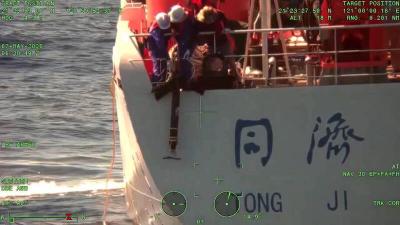
The coast guard today said that it had disrupted "illegal" operations by a Chinese research ship in waters close to the nation and driven it away, part of what Taipei sees a provocative pattern of China's stepped up maritime activities. The coast guard said that it on Thursday last week detected the Chinese ship Tongji (同濟號), which was commissioned only last year, 29 nautical miles (54km) southeast of the southern tip of Taiwan, although just outside restricted waters. The ship was observed lowering ropes into the water, suspected to be the deployment of scientific instruments for "illegal" survey operations, and the coast

A former soldier and an active-duty army officer were yesterday indicted for allegedly selling classified military training materials to a Chinese intelligence operative for a total of NT$79,440. The Taipei District Prosecutors’ Office indicted Chen Tai-yin (陳泰尹) and Lee Chun-ta (李俊達) for contravening the National Security Act (國家安全法) and the Anti-Corruption Act (貪污治罪條例). Chen left the military in September 2013 after serving alongside then-staff sergeant Lee, now an army lieutenant, at the 21st Artillery Command of the army’s Sixth Corps from 2011 to 2013, according to the indictment. Chen met a Chinese intelligence operative identified as “Wang” (王) through a friend in November


 RSS
RSS