


Newly inaugurated Minister of Education Wu Maw-kuen (吳茂昆) must disprove an allegation that he breached regulations by founding a company in the US to apply for biotech patents while serving as National Dong Hwa University’s president in an attempt to profit from the school’s intellectual property, the Chinese Nationalist Party (KMT) caucus said yesterday.
During a meeting of the Legislative Yuan’s Education and Culture Committee on Monday, Wu sought to disavow his alleged involvement in Spiranthes Biotech, which he allegedly established in August 2015, when he was president of the university, KMT Legislator Ko Chih-en (柯志恩) told a news conference in Taipei.
Wu denied founding the company and presented information from the California state government’s Web site on registered businesses, which listed James Ouyang (歐陽彥堂) as the firm’s owner, Ko said.

Photo: Cheng Shu-ting, Taipei Times
However, Wu only disclosed half of the information from the Web site, she said.
Data from the Web site, which she paid US$27 to see, showed that Wu’s name appeared on a list of the firm’s “managers or members” as a manager and agent for the company, Ko said.
She accused Wu of applying for a technology patent in China in September 2015 using the company’s name without informing the university.
“As students wanted to obtain patents in China and to reduce patent application fees, James Ouyang proposed applying for a Patent Cooperation Treaty patent in the US, which would automatically grant applicants patent rights in Japan, China and the EU,” Wu said in a statement.
“However, as Taiwan is not a member of international organizations, Taiwanese must apply through China, which is something I could not accept. That is why we decided to found a company in the US, the sole purpose of which is to apply for patents,” he said, adding that he planned to give the patent rights to the university after obtaining them.
Wu has applied for five patents in four nations in the company’s name, and in all of the applications he specified that the university should have the priority claim for any patent awarded, Taipei city councilor aspirant Yu Shu-hui (游淑惠) of the KMT said.
However, Wu did not obtain the university’s approval before applying for the patents, nor did he sign a contract or agreement with the school to warrant a subsequent transfer of intellectual property rights, which could have easily been arranged, as he was president and allegedly one of the company’s managers at the time, Yu said.
University secretary-general Ku Chih-hsiung (古智雄) said school staff were unaware of the US company or its attempts to apply for patents in China until they saw it on the news.
The university still owns the rights to the technology, he said.
Prosecutors and investigators should inquire into the firm’s background to determine whether it was founded to help the university obtain patents or to steal its intellectual property, he said.
If Wu cannot prove that he is not a manager or agent of Spiranthes Biotech, he would be in breach of the Civil Servant Work Act (公務員服務法), which prohibits civil servants from engaging in most commercial activities, KMT Legislator Alicia Wang (王育敏) said.
Control Yuan member Kao Feng-hsien (高鳳仙) yesterday said she would investigate the matter to clarify if Wu has breached that act or the Act on the Recusal of Public Servants Due to Conflict of Interest (公職人員利益衝突迴避法).

Actor Darren Wang (王大陸) was sentenced to six months in prison, commutable to a fine, by the New Taipei District Court today for contravening the Personal Data Protection Act (個人資料保護法) in a case linked to an alleged draft-dodging scheme. Wang allegedly paid NT$3.6 million (US$114,380) to an illegal group to help him evade mandatory military service through falsified medical documents, prosecutors said. He transferred the funds to Chen Chih-ming (陳志明), the alleged mastermind of a draft-evasion ring, although he lost contact with him as he was already in detention on fraud charges, they said. Chen is accused of helping a

UNREASONABLE SURVEILLANCE: A camera targeted on an road by a neighbor captured a man’s habitual unsignaled turn into home, netting him dozens of tickets The Taichung High Administrative Court has canceled all 45 tickets given to a man for failing to use a turn signal while driving, as it considered long-term surveillance of his privacy more problematic than the traffic violations. The man, surnamed Tseng (曾), lives in Changhua County and was reported 45 times within a month for failing to signal while driving when he turned into the alley where his residence is. The reports were filed by his neighbor, who set up security cameras that constantly monitored not only the alley but also the door and yard of Tseng’s house. The surveillance occurred from July

SECURITY: Starlink owner Elon Musk has taken pro-Beijing positions, and allowing pro-China companies to control Taiwan’s critical infrastructure is risky, a legislator said Starlink was reluctant to offer services in Taiwan because of the nation’s extremely high penetration rates in 4G and 5G services, the Ministry of Digital Affairs said yesterday. The ministry made the comments at a meeting of the legislature’s Transportation Committee, which reviewed amendments to Article 36 of the Telecommunications Management Act (電信管理法). Article 36 bans foreigners from holding more than 49 percent of shares in public telecommunications networks, while shares foreigners directly and indirectly hold are also capped at 60 percent of the total, unless specified otherwise by law. The amendments, sponsored by Chinese Nationalist Party (KMT) Legislator Ko
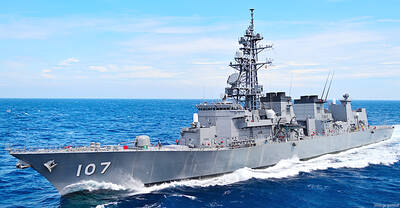
A Japan Self-Defense Forces vessel entered the Taiwan Strait yesterday, Japanese media reported. After passing through the Taiwan Strait, the Ikazuchi was to proceed to the South China Sea to take part in a joint military exercise with the US and the Philippines, the reports said. Japan Self-Defense Force vessels were first reported to have passed through the strait in September, 2024, with two further transits taking place in February and June last year, the Asahi Shimbun reported. Yesterday’s transit also marked the first time since Japanese Prime Minister Sanae Takaichi took office that a Japanese warship has been sent through the Taiwan


 RSS
RSS