


Anna Chennault (陳香梅), the Chinese journalist who married the legendary leader of the World War II Flying Tigers squadron and, after his death, became a Republican power broker in Washington, has died at the age of 94.
A doyenne of Washington society in the 1960s, she charmed politicians and diplomats while running her late husband’s cargo airline, becoming embroiled in an election scandal known as the Anna Chennault Affair and funneling large sums of Chinese Nationalist Party (KMT) money to US Republicans.
Chennault, died in Washington on Friday last week, three months after she had a stroke, her daughter Cynthia Chennault told the Washington Post.
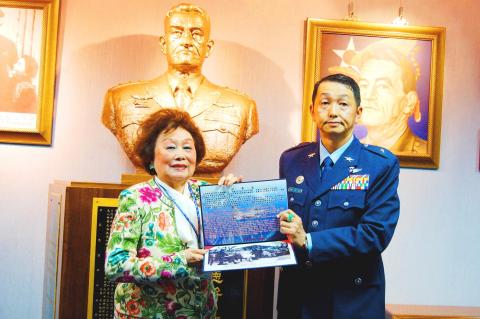
Photo: Hua Meng-ching, Taipei Times
Born in Beijing on June 23, 1923, Anna Chennault was raised in a well-off family of diplomats and editors who fled China as Japanese invaders approached in 1937.
She studied journalism at Hong Kong’s Lingnan University and became a reporter for the Republic of China’s Central News Agency.
Covering the rise of Mao Zedong’s (毛澤東) communists after the war, she met and married US lieutenant general Claire Chennault, whose swashbuckling Flying Tigers operated out of then-Burma in the early 1940s in support of Chiang Kai-shek (蔣介石) against the Japanese.
After the communists took power in China in 1949, the couple started two Taipei-based airlines, Civil Air Transport and Flying Tiger Line, which helped relocate Chiang’s KMT to Taiwan. Both continued to operate for years, with Flying Tiger as a pioneering global cargo carrier and Civil Air Transport becoming a CIA front.
When Claire Chennault died in 1957, Anna Chennault moved to Washington, where she learned the ropes of lobbying and became a power broker in her own right, frequently representing the then-KMT government.
Adamantly opposed to the Beijing regime, Anna Chennault became a public advocate for Asia’s anti-communist autocrats, strongly backing the Vietnam War.
That put her at the center of a US election scandal. In the 1968 US presidential election, Anna Chennault was vice chair of the US Republican National Finance Committee, raising huge sums for then-Republican presidential candidate Richard Nixon.
During the campaign, Nixon used Anna Chennault to set up a back channel to the South Vietnamese government, scheming to block any efforts by then-US president Lyndon Johnson to enter peace talks with North Vietnam.
Nixon wanted to make sure that Johnson’s launch of peace talks would not propel his Democratic election rival, then-US vice president Hubert Humphrey, into office.
The gambit worked, but Johnson was infuriated when FBI wiretaps exposed Anna Chennault’s dealing, and she was castigated by the media.
Anna Chennault later expressed disappointment that she was not named by Nixon to an official position, but she continued to wield influence — and money — across Washington for years.
However, after Nixon undertook his historical opening to China, Anna Chennault herself joined in, helping the administration of then-US president Ronald Reagan in the 1980s as a “shuttle diplomat” with the government of then-Chinese leader Deng Xiaoping (鄧小平).
The Ministry of Foreign Affairs yesterday said in a statement that she would be remembered for her many contributions to the nation.
Anna Chennault worked as a war correspondent who was dedicated to developing US-China relations and facilitating cooperation between the two nations, it said.
She made outstanding achievements in several fields, and was deeply revered in Taiwan and the US, the ministry said, adding that it had sent its condolences to her family through the nation’s representative office in the US.
Minister of Foreign Affairs Joseph Wu (吳釗燮) frequently collaborated with Anna Chennault during his tenure as representative to the US, and she was often invited to attend official events at the nation’s Twin Oaks estate in Washington, the ministry said.
Anna Chennault was good friends with Wu and his wife, who are deeply saddened by her passing, the statement said.

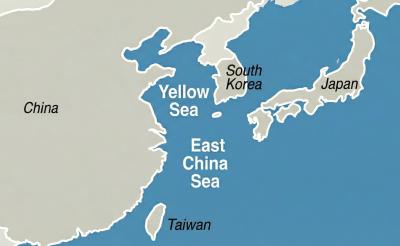
China has reserved offshore airspace in the Yellow Sea and East China Sea from March 27 to May 6, issuing alerts usually used to warn of military exercises, although no such exercises have been announced, the Wall Street Journal (WSJ) reported yesterday. Reserving such a large area for 40 days without explanation is an “unusual step,” as military exercises normally only last a few days, the paper said. These alerts, known as Notice to Air Missions (Notams), “are intended to inform pilots and aviation authorities of temporary airspace hazards or restrictions,” the article said. The airspace reserved in the alert is
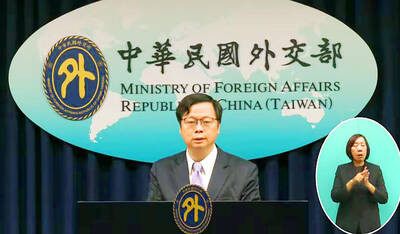
NAMING SPAT: The foreign ministry called on Denmark to propose an acceptable solution to the erroneous nationality used for Taiwanese on residence permits Taiwan has revoked some privileges for Danish diplomatic staff over a Danish permit that lists “Taiwan” as “China,” Eric Huang (黃鈞耀), head of the Ministry of Foreign Affairs’ Department of European Affairs, told a news conference in Taipei yesterday. Reporters asked Huang whether the Danish government had responded to the ministry’s request that it correct the nationality on Danish residence permits of Taiwanese, which has been listed as “China” since 2024. Taiwan’s representative office in Denmark continues to communicate with the Danish government, and the ministry has revoked some privileges previously granted to Danish representatives in Taiwan and would continue to review

More than 6,000 Taiwanese students have participated in exchange programs in China over the past two years, despite the Mainland Affairs Council’s (MAC) “orange light” travel advisory, government records showed. The MAC’s publicly available registry showed that Taiwanese college and university students who went on exchange programs across the Strait numbered 3,592 and 2,966 people respectively. The National Immigration Agency data revealed that 2,296 and 2,551 Chinese students visited Taiwan for study in the same two years. A review of the Web sites of publicly-run universities and colleges showed that Taiwanese higher education institutions continued to recruit students for Chinese educational programs without

A bipartisan group of US senators has introduced a bill to enhance cooperation with Taiwan on drone development and to reduce reliance on supply chains linked to China. The proposed Blue Skies for Taiwan Act of 2026 was introduced by Republican US senators Ted Cruz and John Curtis, and Democratic US senators Jeff Merkley and Andy Kim. The legislation seeks to ease constraints on Taiwan-US cooperation in uncrewed aerial systems (UAS), including dependence on China-sourced components, limited access to capital and regulatory barriers under US export controls, a news release issued by Cruz on Wednesday said. The bill would establish a "Blue UAS


 RSS
RSS