


Describing herself as someone who is not afraid to make tough decisions, Tang Prize winner Gro Harlem Brundtland on Monday recounted how she battled opposition from China and other countries to send WHO experts to Taiwan to help during the SARS epidemic in 2003.
The WHO’s constitution entrusts its director-general with the responsibility to take action on behalf of global health, so when SARS broke out in southern China in late 2002, she had a chance to argue that “we need every country to be on board in each local area” to deal with a global threat, she said.
The three-time Norwegian prime minister, who served as WHO director-general from 1998 to 2003, was talking about her long career at a forum at Academia Sinica as part of Gro Harlem Brundtland Week of Women in Sustainable Development, hosted by National Cheng Kung University.
The WHO faced some challenges in its dealings on the Taiwan issue because it is a UN organization and has to follow the UN’s principles related to participation and rights, Brundtland said.
“I had the responsibility to work with the health authorities of Taiwan to help prevent spreading in Taiwan or from Taiwan or into Taiwan. In that way, the governments that were most against Taiwan becoming part of the UN system had to shut up,” she said.
Some of those governments that were most opposed to working with Taiwan were responsible for the outbreak happening in the first place, she added.
As a result, the WHO was able to cooperate with all of its collaborating centers on critical health issues even though the political question remained, Brundtland said.
Her personality probably had something to do with it, she said, adding: “I was not afraid to make tough decisions on behalf of the WHO. I am not afraid generally.”
Brundtland recounted the story after Academia Sinica’s Research Center for Environmental Change Director Wang Pao-kuan (王寶貫) told the forum that Vice President Chen Chien-jen (陳建仁), who was Department of Health minister during the SARS epidemic, had told him that it was Brundtland’s decision that led the WHO to eventually send its experts to help Taiwan.
Her experiences as prime minister made her believe in “the necessity of the international system,” because the world needs organizations to take action when government after government is not doing anything or not doing enough in a global crisis, Brundtland said.
National Cheng Kung University president Jenny Su (蘇慧貞) yesterday presented Brundtland with an honorary doctorate in recognition of her ideas and spirit, marking the end of this year’s Gro Harlem Brundtland Week of Women in Sustainable Development.
The week is funded by some of the research money Brundtland received as part of the Tang Prize.

Fast food chain McDonald's is to raise prices by up to NT$5 on some products at its restaurants across Taiwan, starting on Wednesday next week, the company announced today. The prices of all extra value meals and sharing boxes are to increase by NT$5, while breakfast combos and creamy corn soup would go up by NT$3, the company said in a statement. The price of the main items of those meals, if ordered individually, would remain the same. Meanwhile, the price of a medium-sized lemon iced tea and hot cappuccino would rise by NT$3, extra dipping sauces for chicken nuggets would go up
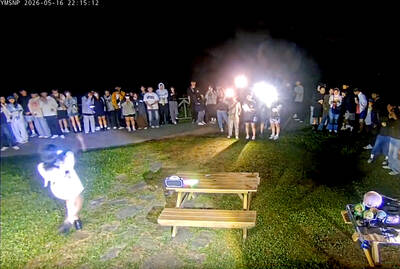
Yangmingshan National Park’s Qingtiangang (擎天崗) nature area has gone viral after a park livestream camera observed a couple in the throes of intimate congress, which was broadcast live on YouTube, drawing large late-night crowds and sparking a backlash over noise, bright lights and disruption to wildlife habitat. The area’s livestream footage appeared to show a couple engaging in sexual activity on a picnic table in the park on Friday last week, with the uncensored footage streamed publicly online. The footage quickly spread across social media, prompting a tide of visitors to travel to the site to “check in” and recreate the

Minister of Digital Affairs Lin Yi-ching (林宜敬) yesterday cited regulatory issues and national security concerns as an expert said that Taiwan is among the few Asian regions without Starlink. Lin made the remarks on Facebook after funP Innovation Group chief executive officer Nathan Chiu (邱繼弘) on Friday said Taiwan and four other countries in Asia — China, North Korea, Afghanistan and Syria — have no access to Starlink. Starlink has become available in 166 countries worldwide, including Ukraine, Malaysia, the Philippines and Vietnam, in the six years since it became commercial, he said. While China and North Korea block Starlink, Syria is not
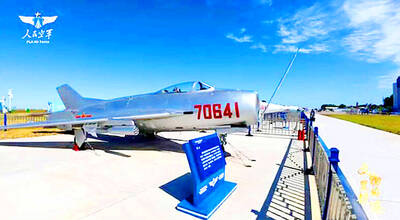
GROUNDED: A KMT lawmaker proposed eliminating drone development programs and freezing funding for counterdrone systems, despite China’s adoption of the technology China has deployed attack drones at air bases near the Taiwan Strait in a strategy aimed at overwhelming Taiwan’s air defense systems through saturation attacks, the Mainland Affairs Council (MAC) said. The council’s latest quarterly report on China said that satellite imagery and open-source intelligence indicate that the Chinese People’s Liberation Army (PLA) had converted retired J-6 fighter jets into J-6W drones, which the PLA has stationed at six air bases near Taiwan, five in China’s Fujian Province and one in Guangdong Province. The report cited J. Michael Dahm, a senior fellow at the US-based Mitchell Institute, as saying that China has


 RSS
RSS