


In the face of a rising China, a “social resistance” has emerged in Taiwan against Chinese President Xi Jinping’s (習近平) “Chinese dream” of bringing about national rejuvenation, Academia Sinica Institute of Sociology associate research fellow Wu Chieh-min (吳介民) said.
Social resistance is a “collective” phenomenon in Taiwanese society and the embodiment of people’s desire and pursuit of a Taiwan-centered identity, Wu said.
The “Chinese dream” Xi aims to achieve and has defined as the “great rejuvenation of the Chinese nation” is also referred to as the “Chinese empire” in the academic community, Wu told a forum hosted by the Taiwan Research Fund on Wednesday.
Taiwanese have put up “social resistance” because Xi has tried to forcefully engage Taiwan in his plan to build a Chinese empire regardless of what Taiwanese think, Wu said.
Wu, who leads a research team at the institute that studies the influence China exerts over Taiwan on various fronts — which it calls “China factors” — said his team has conducted surveys on how people see Taiwan’s future and their preferences.
In last year’s survey, 40 percent of respondents said they favored independence, 17 percent said they wanted unification with China and 43 percent chose a middle-ground position, Wu said.
When asked to forecast Taiwan’s future, 48 percent said they believed Taiwan would be unified by China and 37 percent believed Taiwan could become an independent nation, but only 16 percent said that Taiwan would manage to maintain the “status quo,” Wu said.
The gap between the public’s wishes and expectations showed that most people in Taiwan are anxious about “Taiwan being forced into unification with China,” he said.
Such anxiety is “not necessarily a bad thing” for Taiwan, because it could generate momentum toward democratization and heighten people’s vigilance with regard to China’s attempts to bring Taiwan into its fold on China’s terms, Wu said.
However, it could also influence elections, Wu said.
The survey over the past years also found a significant increase in the percentage of people aged 20 to 34 who supported independence, peaking at 55 percent in 2015, up from 44 percent in 2011, Wu said.
However, the percentage fell to 52 percent in 2016 and was only 43 percent last year, Wu said.
He said his team is still working on identifying possible contributing causes that might have weakened support for independence among younger people.
Further study is necessary to find out whether there is any link between decreased support for independence and the incentives China has rolled out to attract young Taiwanese and Beijing pressuring Taiwan by showcasing its military strength, Wu said.

Trips for more than 100,000 international and domestic air travelers could be disrupted as China launches a military exercise around Taiwan today, Taiwan’s Civil Aviation Administration (CAA) said yesterday. The exercise could affect nearly 900 flights scheduled to enter the Taipei Flight Information Region (FIR) during the exercise window, it added. A notice issued by the Chinese Civil Aviation Administration showed there would be seven temporary zones around the Taiwan Strait which would be used for live-fire exercises, lasting from 8am to 6pm today. All aircraft are prohibited from entering during exercise, it says. Taipei FIR has 14 international air routes and
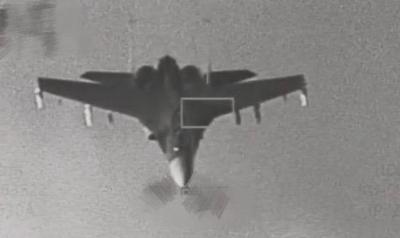
The Ministry of National Defense (MND) today released images of the military tracking China’s People's Liberation Army (PLA) movements during the latest round of Chinese drills around Taiwan. The PLA began "Justice Mission 2025" drills today, carrying out live-fire drills, simulated strikes on land and maritime targets, and exercises to blockade the nation's main ports. The exercises are to continue tomorrow, with the PLA announcing sea and air space restrictions for five zones around Taiwan for 10 hours starting from 8:30am. The ministry today released images showing a Chinese J-16 fighter jet tracked by a F-16V Block 20 jet and the

Snow fell on Yushan (Jade Mountain, 玉山) yesterday morning as a continental cold air mass sent temperatures below freezing on Taiwan’s tallest peak, the Central Weather Administration (CWA) said. Snowflakes were seen on Yushan’s north peak from 6:28am to 6:38am, but they did not fully cover the ground and no accumulation was recorded, the CWA said. As of 7:42am, the lowest temperature recorded across Taiwan was minus-5.5°C at Yushan’s Fengkou observatory and minus-4.7°C at the Yushan observatory, CWA data showed. On Hehuanshan (合歡山) in Nantou County, a low of 1.3°C was recorded at 6:39pm, when ice pellets fell at Songsyue Lodge (松雪樓), a
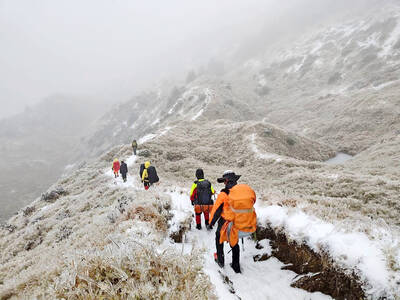
NO SHAME IN RETREAT: Hikers should consider turning back if the weather turns bad or if they do not have sufficient equipment, the Taroko park headquarters said Two people died of hypothermia over the weekend while hiking on Hsuehshan (雪山), prompting park authorities to remind hikers to bring proper equipment and consider their physical condition before setting out in the cold weather. Temperatures dropped over the weekend, bringing snow to high altitudes in Shei-pa National Park. One hiker, surnamed Lin (林), who on Friday was traveling with a group of six along the Hsuehshan west ridge trail, lost consciousness due to hypothermia and died, the Shei-pa National Park Headquarters said. On Saturday, another hiker, surnamed Tien (田), in a group of five on the southeast of the west


 RSS
RSS