


The Chinese Nationalist Party’s (KMT) female nominees for the city mayor and county commissioner elections yesterday marked International Women’s Day by declaring their support for women and gender equality, claiming that the party has accomplished more than the Democratic Progressive Party (DPP) in terms of achieving gender equality in politics.
Yesterday’s news conference was attended by six of the KMT’s seven female candidates for the nine-in-one local elections scheduled for Nov. 24, including KMT Legislator Lu Shiow-yen (盧秀燕) for Taichung, KMT Legislator Wang Hui-mei (王惠美) for Changhua County, KMT Legislator Chang Li-shan (張麗善) for Yunlin County, former Chiayi mayor Huang Min-hui (黃敏惠) for Chiayi, KMT Legislator Hsu Chen-wei (徐榛蔚) for Hualien County and Luodong Township (羅東) Mayor Lin Zi-miao (林姿妙) for Yilan County.
Taitung County Council Speaker Rao Ching-ling (饒慶鈴), the candidate for Taitung County commissioner, could not attend due to a prior engagement.
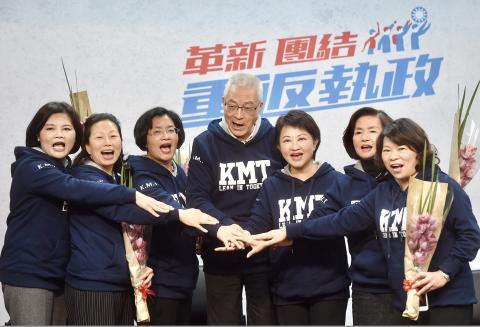
Photo: Chien Jung-fong, Taipei Times
Seven of the 12 candidates nominated for the city mayor and county commissioner races by the KMT so far are women, while the DPP has nominated zero, Huang said.
Women should be the masters of their own lives, Lu said, calling for legislation that would extend women’s maternity leave from eight weeks to 12 weeks.
Wang and Chang said that they propose fairer treatment of women and encourage younger women to have more children.
KMT Chairman Wu Den-yih (吳敦義) attended the news conference to wish the nominees success in their campaigns.
When he was Taiwan’s premier, he established the Executive Yuan’s Gender Equality Committee and the Presidential Office’s Human Rights Consultative Committee, said Wu, who served as premier from 2009 to 2012 and then was vice president from 2012 to 2016.
During his eight-year presidency, former president Ma Ying-jeou (馬英九) also worked hard to push for gender equality, Wu said.
The KMT has already nominated 12 candidates — five men and seven women, Wu said, adding that “women can hold up half the sky.”

The Ministry of Finance this afternoon announced the winning numbers for the March-April uniform invoice lottery. The winning number for the NT$10 million (US$318,060) special prize is 19531471, and the winning number for the NT$2 million grand prize is 85941329. Three numbers were drawn for the NT$200,000 first prize: 07225810, 20231230 and 83518781. Those with receipts matching the last seven digits of any of the first-prize numbers will win the NT$40,000 second prize, while those matching the last six digits will win the NT$10,000 third prize. Those whose receipts match the last five digits of the first-prize numbers can claim the NT$4,000 fourth prize,

SIX SUBSIDIES: The monthly allowance for older farmers is to increase to NT$10,000, and NT$5,000 is to be given to homemakers under the national pension system, Lai said The government is to implement major welfare policies for disadvantaged groups, including raising the monthly allowance for older farmers to NT$10,000 and providing homemakers with NT$5,000 per month, President William Lai (賴清德) said yesterday. Lai made the remarks during a visit to Wangling Temple in Chiayi County, saying that the planned increases were being introduced amid economic growth and an increase in tax revenue. Touting a policy, in which the government plans to provide a monthly allowance of NT$5,000 for every child under the age of 18 in a bid to address Taiwan’s low birthrate, Lai said that if received for the

NATIONAL SECURITY: Authorities are working to confirm the identities of the military personnel involved and investigating possible illegal conduct and regulatory violations Authorities are probing possible national security implications after Kinmen police and immigration officers on Sunday found a Chinese woman allegedly posing as a tourist while engaging in prostitution involving more than 10 military personnel. The woman, surnamed Chen (陳), has since been deported, authorities said, adding that investigators are still working to confirm the identities of those implicated, as the records only listed code names and aliases. The case stemmed from a report received by the Kinmen District Prosecutors’ Office on Friday last week from the Jinhu Precinct of the Kinmen County Police Bureau. On Sunday, police, along with the National Immigration
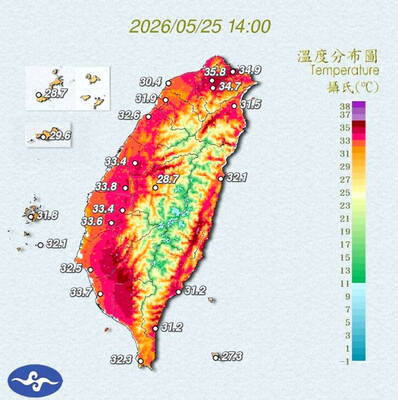
STAY COOL: The HPA recommended that people stay hydrated, use air-conditioning or fans while indoors, wear loose-fitting clothes and walk in the shade while outdoors Employers must implement measures such as installing cooling equipment, and providing drinking water and rest breaks for outdoor workers starting from Monday next week, the Taipei Department of Labor said on Sunday. Employers who fail to comply could face fines of NT$30,000 to NT$300,000 under the Occupational Safety and Health Act (職業安全衛生法), the department said. Businesses in Taipei employing fewer than 100 workers, as well as registered self-employed workers with labor insurance coverage, could receive on-site assessments and guidance from occupational safety consultants to help them apply for central government subsidies to implement or improve heat-protection measures, it said. Under the Ministry of


 RSS
RSS