


Lawmakers yesterday urged President Tsai Ing-wen’s (蔡英文) administration to adopt a proactive approach following the US government’s removal of the Republic of China (ROC) flag from some of its Web sites.
Taiwan’s interests could be sacrificed in US-China negotiations if its diplomatic and national security organs fail to see through US President Donald Trump’s foreign policy, with its profit mindset, Chinese Nationalist Party (KMT) secretary-general Lee Yen-hsiu (李彥秀) told a news conference at the Legislative Yuan in Taipei.
“If the Democratic Progressive Party [DPP] administration, with its unrequited affections, continues to adopt a foreign policy that is disproportionately tilted toward the US, it could end up gaining nothing from both sides [the US and China],” she said.
Local media reports earlier this week said that the ROC flag has disappeared from the Web sites of the US Department of State’s Bureau of Consular Affairs and the Office of the US Trade Representative.
That followed the US Department of State’s removal of the ROC flag from its official Web site in September last year.
Lee said she believed the response by the American Institute in Taiwan (AIT) on Wednesday was an attempt to downplay the issue.
The government should summon Representative to the US Stanley Kao (高碩泰) and ask him to give a briefing on the matter, Lee said.
The DPP talks eloquently about upholding the nation’s dignity and sovereignty, and it should adopt the same attitude rather than remaining silent on the issue, she said.
The disappearance of the ROC flag from three US agencies could profoundly impact Taiwan on several fronts, said KMT Legislator Jason Hsu (許毓仁), a member of the legislature’s Foreign and National Defense Committee.
From a diplomatic perspective, the Department of State removing the flag from its Web site “clearly” shows that some kind of deal had been made between China and the US, Hsu said.
Tsai, the Ministry of Foreign Affairs and national security agencies should explain to the public Taiwan’s place in negotiations between China and the US, he said.
The Office of the US Trade Representative’s removal of the ROC flag from its Web site has dealt a heavy blow to the nation’s economy, and suggests that Trump, with his business-oriented mentality, puts economic gains ahead of anything else, and would readily involve Taiwan in US-China negotiations, he said.
The removal of the ROC flag from the Bureau of Consular Affairs Web site is likely to have repercussions for Taiwanese traveling to the US, causing them inconvenience when passing through immigration, he said.
The US’ removal of the ROC flag represents a major setback for Tsai’s pandering to the US policy, which could have negative implications for all Taiwanese, he said.
The disappearance of the flag followed a similar incident last year, but since it now involves three US agencies, Kao can no longer shrug off the first incident as an “isolated case,” he said.
Hsu added that if reports that the Vatican and China are in talks over the right to appoint bishops are true, there was little that could be done to stop the two from establishing formal diplomatic ties, which could create a domino effect, prompting Taiwan’s predominantly Catholic diplomatic allies in Central and Southern America to switch diplomatic recognition to China.
Tsai has an annual budget of more than NT$70 million (US$2.41 million) for her diplomatic trips, and instead of visiting the nation’s Central and South American allies, she should seek a meeting with the Pope in the Vatican to consolidate bilateral ties, he said.
DPP caucus deputy director-general Tsai Shih-ying (蔡適應) said there has been no change in US-Taiwan relations in the wake of the incident.
“However, the Ministry of Foreign Affairs should toughen up against the Department of State’s and Office of the US Trade Representative’s removal of the nation’s flag from the introductory pages of countries around the world,” he said.
This is an issue that calls for all political parties to make their stance clear, he said.
Additional reporting by CNA

The manufacture of the remaining 28 M1A2T Abrams tanks Taiwan purchased from the US has recently been completed, and they are expected to be delivered within the next one to two months, a source said yesterday. The Ministry of National Defense is arranging cargo ships to transport the tanks to Taiwan as soon as possible, said the source, who is familiar with the matter. The estimated arrival time ranges from late this month to early next month, the source said. The 28 Abrams tanks make up the third and final batch of a total of 108 tanks, valued at about NT$40.5 billion

A group from the Taiwanese Designers in Australia association yesterday represented Taiwan at the Midsumma Pride March in Melbourne. The march, held in the St. Kilda suburb, is the city’s largest LGBTQIA+ parade and the flagship event of the annual Midsumma Festival. It attracted more than 45,000 spectators who supported the 400 groups and 10,000 marchers that participated this year, the association said. Taiwanese Designers said they organized a team to march for Taiwan this year, joining politicians, government agencies, professionals and community organizations in showing support for LGBTQIA+ people and diverse communities. As the first country in Asia to legalize same-sex
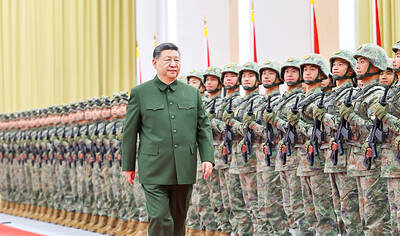
MOTIVES QUESTIONED The PLA considers Xi’s policies toward Taiwan to be driven by personal considerations rather than military assessment, the Epoch Times reports Chinese President Xi Jinping’s (習近平) latest purge of the Chinese People’s Liberation Army (PLA) leadership might have been prompted by the military’s opposition to plans of invading Taiwan, the Epoch Times said. The Chinese military opposes waging war against Taiwan by a large consensus, putting it at odds with Xi’s vision, the Falun Gong-affiliated daily said in a report on Thursday, citing anonymous sources with insight into the PLA’s inner workings. The opposition is not the opinion of a few generals, but a widely shared view among the PLA cadre, the Epoch Times cited them as saying. “Chinese forces know full well that

Travel agencies in Taiwan are working to secure alternative flights for travelers bound for New Zealand for the Lunar New Year holiday, as Air New Zealand workers are set to strike next week. The airline said that it has confirmed that the planned industrial action by its international wide-body cabin crew would go ahead on Thursday and Friday next week. While the Auckland-based carrier pledged to take reasonable measures to mitigate the impact of the workers’ strike, an Air New Zealand flight arriving at Taipei from Auckland on Thursday and another flight departing from Taipei for Auckland on Saturday would have to


 RSS
RSS