


Judges and prosecutors who have been charged with corruption or who lack the moral disposition to practice law should not be allowed to become attorneys, the Control Yuan’s Committee on Judicial and Prison Administration Affairs said in a report published late last month.
The Tainan Bar Association on Oct. 12 appealed to the Supreme Court after the Tainan District Court and the Tainan branch of the Taiwan High Court ruled against the association in a lawsuit over whether former Nantou District Prosecutor Wang Chao-chen (王朝震), who has been convicted of corruption, should be given membership and be allowed to practice law.
According to Article 4 of the Attorney Regulation Act (律師法), “any person having been convicted of a crime and been sentenced to a term of imprisonment of greater than one year, said conviction involving a crime of moral turpitude affecting their moral fitness to practice law and for that reason having been disbarred by the Attorney Disciplinary Committee” is disqualified from practicing law, with the exception of people who have received a suspended sentence.
According to the high court and district court’s legal interpretation, although the first item of the article states that people who have been convicted of a crime and sentenced to a term of imprisonment of greater than one year cannot practice law, they do not unequivocally lose their qualification.
The Attorney Disciplinary Committee must maintain that the charges have affected people’s moral fitness to practice law and remove their qualification to meet the requirements of the act, the interpretation said.
The disciplinary committee has not removed the former prosecutor’s qualification, the interpretation said.
The association urged the government to amend the act.
If the law allows judges or prosecutors who have violated the core ethics of the law to become attorneys, this deviates from people’s expectations of the law, said Control Yuan member Lin Ya-feng (林雅鋒), who filed the case for investigation.
The loophole in the law should be reviewed and closed, Lin said, adding that the judiciary should complete the amendment as soon as possible.
The judicial committee also requested that the judiciary make amendments to the act in accordance with the Constitution, the International Covenant on Civil and Political Rights and the International Covenant on Economic Social and Cultural Rights.
According to Article 5 of the Constitution, people’s right of existence and right to work should be guaranteed, Lin said.
However, if the work is closely related to the public interest, within the limits of the principle of proportionality in Article 23 of the Constitution, Article 15 can be restricted by law, Lin said.
The legal profession has distinctive characteristics, Lin said.
The guarantee of lawyers’ right to work should not be in conflict with the right to a fair trial, which constitutes the public interest; that is, the members of the courtroom should at a minimum be in accordance with formal justice, Lin said.
From the standpoint of the public’s relationship with the law, if people doubt the fairness of the attorney, judge or prosecutor upon first sight, this will erode the core of legal logic, Lin added.

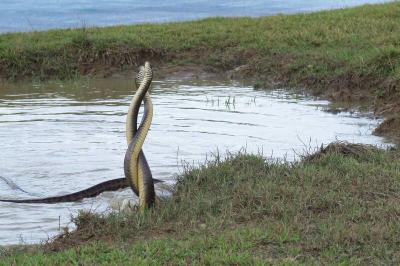
Kenting National Park service technician Yang Jien-fon (楊政峰) won a silver award in World Grand Prix Photography Awards Spring Season for his photograph of two male rat snakes intertwined in combat. Yang’s colleagues at Kenting National Park said he is a master of nature photography who has been held back by his job in civil service. The awards accept entries in all four seasons across six categories: architectural and urban photography, black-and-white and fine art photography, commercial and fashion photography, documentary and people photography, nature and experimental photography, and mobile photography. Awards are ranked according to scores and divided into platinum, gold and

More than half of the bamboo vipers captured in Tainan in the past few years were found in the city’s Sinhua District (新化), while other districts had smaller catches or none at all. Every year, Tainan captures about 6,000 snakes which have made their way into people’s homes. Of the six major venomous snakes in Taiwan, the cobra, the many-banded krait, the brown-spotted pit viper and the bamboo viper are the most frequently captured. The high concentration of bamboo vipers captured in Sinhua District is puzzling. Tainan Agriculture Bureau Forestry and Nature Conservation Division head Chu Chien-ming (朱健明) earlier this week said that the
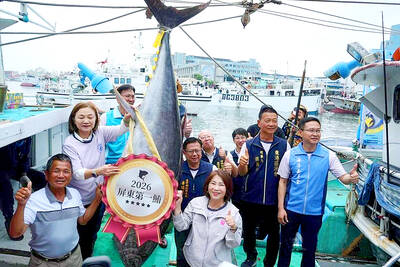
The first bluefin tuna of the season, brought to shore in Pingtung County and weighing 190kg, was yesterday auctioned for NT$10,600 (US$333.5) per kilogram, setting a record high for the local market. The auction was held at the fish market in Donggang Fishing Harbor, where the Siaoliouciou Island-registered fishing vessel Fu Yu Ching No. 2 delivered the “Pingtung First Tuna” it had caught for bidding. Bidding was intense, and the tuna was ultimately jointly purchased by a local restaurant and a local company for NT$10,600 per kilogram — NT$300 ,more than last year — for a total of NT$2.014 million. The 67-year-old skipper
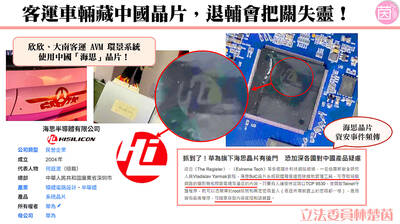
BREACH OF CONTRACT: The bus operators would seek compensation and have demanded that the manufacturer replace the chips with ones that meet regulations Two bus operators found to be using buses with China-made chips are to demand that the original manufacturers replace the systems and provide compensation for breach of contract, the Veterans Affairs Council said yesterday. Democratic Progressive Party Legislator Michelle Lin (林楚茵) yesterday said that Da Nan Bus Co and Shin-Shin Bus Co Ltd have fielded a total of 82 buses that are using Chinese chips. The bus models were made by Tron-E, while the systems provider was CYE Electronics, Lin said. Lin alleged that the buses were using chips manufactured by Huawei subsidiary HiSilicon Co, which presents a national security risk if the


 RSS
RSS