


National Security Bureau Third Department Director Wang Shao-pai (王少白) has accepted responsibility for alleged mistakes in the daily national security briefing and tendered his resignation, a high-level source said on Saturday.
The “National Security Daily” (國安日報) is a generic term for the bureau’s daily compilation of important international, cross-strait and domestic intelligence, which contains time-sensitive and highly sensitive information and is only distributed to the president, vice president, premier and a select number of high-level government officials.
In a recent National Security Daily, a member of the bureau’s third department mistakenly attributed a politician’s criticism of President Tsai Ing-wen (蔡英文) to a legislator who accompanied Tsai on last year’s visit to the nation’s diplomatic allies in the South Pacific, said the high-level source, speaking on condition of anonymity
A summary of the criticism was included in the written daily national security briefing, but the mistake was pointed out and corrected by the Presidential Office on the same day, the source said, adding that the office requested that the bureau look into the incident and address it.
The mistakes in the National Security Daily were caught by one of the high-level officials, the source said.
The incident makes clear that bureau’s internal control mechanisms are flawed and the problems did not develop overnight, as its internal control mechanisms have repeatedly failed, the source said.
Not only did the National Audit Office in a random check find many shortcomings in the bureau’s handling of funds allocated toward intelligence, but it even botched the daily national security briefing, which must be handled with the utmost care, the source said.
To stop the incident from leaking, bureau Director-General Peng Sheng-chu (彭勝竹) last week approved sudden personnel adjustments, the source said.
Bureau Secretariat Director Wang Chun-yi (王春益) is to take over the position of third department director, who oversees domestic intelligence gathering, the source said.
As Wang also holds the position of public relations office director, which is assigned on an ad hoc basis and whose duties cover interacting with the Legislative Yuan and the press, the bureau has already appointed a senior government official who is familiar with these fields to take over the position of secretariat director, the source added.
The behavior of the bureau over the past few years has been difficult for high-level government officials to understand, the source said.
Many important positions in the bureau have been left unfilled for as long as a year, the source said, adding that this complicated the bureau’s national security and intelligence-gathering duties.
The bureau has been unable to reassure high-level government officials about the quantity and quality of its national security intelligence, the source said.
During ad hoc meetings and budget reviews at the Legislative Yuan, lawmakers across party lines have requested that the bureau address the situation, but the results have been unsatisfactory, the source said.

More than half of the bamboo vipers captured in Tainan in the past few years were found in the city’s Sinhua District (新化), while other districts had smaller catches or none at all. Every year, Tainan captures about 6,000 snakes which have made their way into people’s homes. Of the six major venomous snakes in Taiwan, the cobra, the many-banded krait, the brown-spotted pit viper and the bamboo viper are the most frequently captured. The high concentration of bamboo vipers captured in Sinhua District is puzzling. Tainan Agriculture Bureau Forestry and Nature Conservation Division head Chu Chien-ming (朱健明) earlier this week said that the
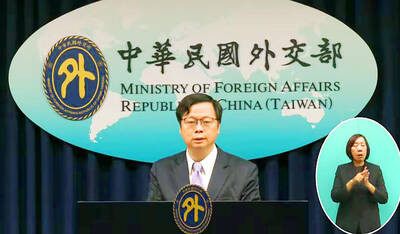
NAMING SPAT: The foreign ministry called on Denmark to propose an acceptable solution to the erroneous nationality used for Taiwanese on residence permits Taiwan has revoked some privileges for Danish diplomatic staff over a Danish permit that lists “Taiwan” as “China,” Eric Huang (黃鈞耀), head of the Ministry of Foreign Affairs’ Department of European Affairs, told a news conference in Taipei yesterday. Reporters asked Huang whether the Danish government had responded to the ministry’s request that it correct the nationality on Danish residence permits of Taiwanese, which has been listed as “China” since 2024. Taiwan’s representative office in Denmark continues to communicate with the Danish government, and the ministry has revoked some privileges previously granted to Danish representatives in Taiwan and would continue to review
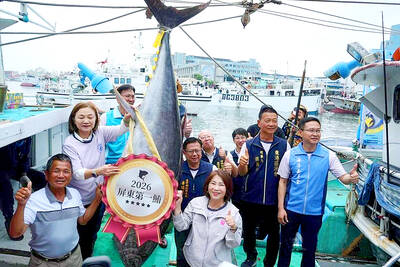
The first bluefin tuna of the season, brought to shore in Pingtung County and weighing 190kg, was yesterday auctioned for NT$10,600 (US$333.5) per kilogram, setting a record high for the local market. The auction was held at the fish market in Donggang Fishing Harbor, where the Siaoliouciou Island-registered fishing vessel Fu Yu Ching No. 2 delivered the “Pingtung First Tuna” it had caught for bidding. Bidding was intense, and the tuna was ultimately jointly purchased by a local restaurant and a local company for NT$10,600 per kilogram — NT$300 ,more than last year — for a total of NT$2.014 million. The 67-year-old skipper
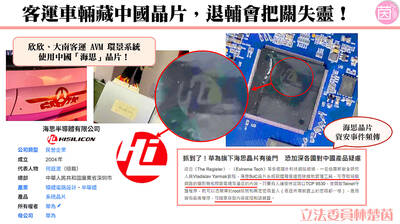
BREACH OF CONTRACT: The bus operators would seek compensation and have demanded that the manufacturer replace the chips with ones that meet regulations Two bus operators found to be using buses with China-made chips are to demand that the original manufacturers replace the systems and provide compensation for breach of contract, the Veterans Affairs Council said yesterday. Democratic Progressive Party Legislator Michelle Lin (林楚茵) yesterday said that Da Nan Bus Co and Shin-Shin Bus Co Ltd have fielded a total of 82 buses that are using Chinese chips. The bus models were made by Tron-E, while the systems provider was CYE Electronics, Lin said. Lin alleged that the buses were using chips manufactured by Huawei subsidiary HiSilicon Co, which presents a national security risk if the


 RSS
RSS