


The Democratic Progressive Party’s (DPP) citation of the National Security Act (國家安全法) as grounds for arresting four New Party Youth Corps members on Tuesday has had a chilling effect on society and goes against its previous views on the act, which it opposed when it was in opposition, the Chinese Nationalist Party (KMT) caucus said yesterday.
“When the DPP was an opposition party, it opposed the introduction of the act, saying it would grant prosecutors and investigators excessive power and abet White Terror,” KMT caucus deputy secretary-general Lee Yen-hsiu (李彥秀) told a news conference at the legislature in Taipei.
The Taipei District Prosecutors’ Office and the Investigation Bureau citing the act when arresting the New Party members just because they hold different political views constitutes “green terror,” Lee said.
“Thirty years after martial law was lifted, the DPP wants to reintroduce martial law,” KMT Legislator Alex Fai (費鴻泰) said, referring to the Act on Promoting Transitional Justice (促進轉型正義條例) and a bill proposed by the Cabinet on improving information and communication security, which includes provisions that would grant the government more power when probing documents from the nation’s authoritarian era when safeguarding information security.
KMT Legislator Lai Shyh-bao (賴士葆) accused the DPP of applying double standards when considering people who support unification between Taiwan and China and those who advocate for Taiwanese independence.
Taipei prosecutor Lin Chun-ting (林俊廷) and bureau officers barged into the homes of the four sleeping men and arrested them like they were the Ming emperor’s royal guards tasked with quashing dissent, Lai said.
The reason behind Tuesday’s arrests was indelicate, he said, urging people to condemn the DPP over the incident lest the party infringes on their basic rights.
Chinese Nationalist Party (KMT) Chairman Wu Den-yih (吳敦義) blasted prosecutors’ arrest of the New Party members and the raids of their homes, saying that such actions run counter to the spirit of the Act on Promoting Transitional Justice, which was passed by the legislature on Dec. 5.
The purpose of pushing for transitional justice is to redress past judicial or political injustices, Wu said.
“That the prosecutors’ disproportionate treatment of the party members and blatant violations of their human rights happened shortly after the passage of the act is the bill’s greatest irony,” he said.
In response, DPP caucus whip Ker Chien-ming (柯建銘) dismissed the KMT’s criticism as “irrelevant,” as the articles opposed by the DPP were removed from the National Security Act.
Article 2, which prohibited people from forming political groups and rallying, and Article 3, which restricted people’s freedom to travel abroad, were abolished in 2011 as per constitutional interpretations No. 445 and No. 644, Ker said.
The National Security Act has been the only act that addresses Chinese spies and their collaborators since 1991, when the Temporary Provisions Effective During the Period of Communist Rebellion (動員戡亂時期臨時條款) was abolished, he said.
Following the abolition of the temporary provisions, Chinese Communist Party members were no longer defined as part of a “foreign regime” or a “rebel group,” so articles 2-1 and 5-1 of the National Security Act were introduced to ban people from spying for “China or foreign nations,” he said.
The KMT’s remarks were aimed at creating chaos, as without the National Security Act, there would be no legal channel to deal with Chinese spies, which is doubtfully what the KMT wants, Ker said.
Additional reporting by Stacy Hsu


Kenting National Park service technician Yang Jien-fon (楊政峰) won a silver award in World Grand Prix Photography Awards Spring Season for his photograph of two male rat snakes intertwined in combat. Yang’s colleagues at Kenting National Park said he is a master of nature photography who has been held back by his job in civil service. The awards accept entries in all four seasons across six categories: architectural and urban photography, black-and-white and fine art photography, commercial and fashion photography, documentary and people photography, nature and experimental photography, and mobile photography. Awards are ranked according to scores and divided into platinum, gold and

More than half of the bamboo vipers captured in Tainan in the past few years were found in the city’s Sinhua District (新化), while other districts had smaller catches or none at all. Every year, Tainan captures about 6,000 snakes which have made their way into people’s homes. Of the six major venomous snakes in Taiwan, the cobra, the many-banded krait, the brown-spotted pit viper and the bamboo viper are the most frequently captured. The high concentration of bamboo vipers captured in Sinhua District is puzzling. Tainan Agriculture Bureau Forestry and Nature Conservation Division head Chu Chien-ming (朱健明) earlier this week said that the

The first bluefin tuna of the season, brought to shore in Pingtung County and weighing 190kg, was yesterday auctioned for NT$10,600 (US$333.5) per kilogram, setting a record high for the local market. The auction was held at the fish market in Donggang Fishing Harbor, where the Siaoliouciou Island-registered fishing vessel Fu Yu Ching No. 2 delivered the “Pingtung First Tuna” it had caught for bidding. Bidding was intense, and the tuna was ultimately jointly purchased by a local restaurant and a local company for NT$10,600 per kilogram — NT$300 ,more than last year — for a total of NT$2.014 million. The 67-year-old skipper
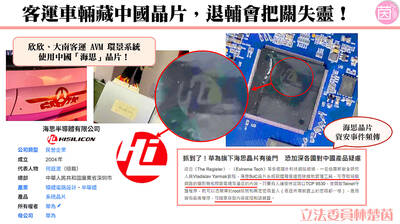
BREACH OF CONTRACT: The bus operators would seek compensation and have demanded that the manufacturer replace the chips with ones that meet regulations Two bus operators found to be using buses with China-made chips are to demand that the original manufacturers replace the systems and provide compensation for breach of contract, the Veterans Affairs Council said yesterday. Democratic Progressive Party Legislator Michelle Lin (林楚茵) yesterday said that Da Nan Bus Co and Shin-Shin Bus Co Ltd have fielded a total of 82 buses that are using Chinese chips. The bus models were made by Tron-E, while the systems provider was CYE Electronics, Lin said. Lin alleged that the buses were using chips manufactured by Huawei subsidiary HiSilicon Co, which presents a national security risk if the


 RSS
RSS