


The Act on Promoting Transitional Justice (促進轉型正義條例) is illegal and unjust, former Chinese Nationalist Party (KMT) legislators Alex Tsai (蔡正元) and Chiu Yi (邱毅) said yesterday, accusing the Democratic Progressive Party (DPP) government of attempting to wipe out an important era in the nation’s history.
The act, aimed at removing authoritarian-era symbols and redressing injustices left by the authoritarian era from Aug. 15, 1945 to Nov. 6, 1992, was passed by the Legislative Yuan on Tuesday last week. The pan-blue camp says the act unfairly targets the former KMT regime.
The KMT had proposed a version that includes a broader scope of history, applying transitional justice measures to the Japanese colonial era to demand that the Japanese government take responsibility for infringing upon the rights of Aborigines, “comfort women” and Taiwanese drafted into the Japanese army during World War II.
Their motion was defeated by the DPP-controlled legislature, whose version limits the coverage to the authoritarian era under the former KMT regime.
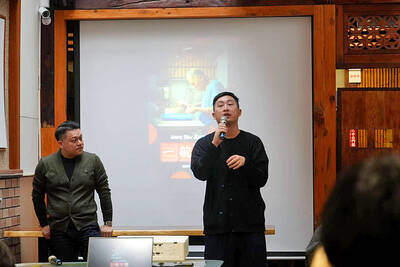
Sun Yat-sen School principal Chang Ya-chung (張亞中), who invited Tsai and Chiu to speak about the act at a news conference in Taipei, said the era of the “two Chiangs” — former presidents Chiang Kai-shek (蔣介石) and his son and successor, Chiang Ching-kuo (蔣經國) — showed rapid economic development and was the most glorious era of Taiwan.
He said that the DPP government, led by President Tsai Ing-wen (蔡英文), is trying to manipulate history by enforcing the act, which is something they cannot accept.
Many regimes have tried to wipe out history of previous regimes, but have failed, just like how the former KMT has tried to destroy many artifacts from the Japanese colonial era, and now the government led by President Tsai Ing-wen is trying to do the same, Alex Tsai said.
If it was not for former president Chiang Kai-shek, who used his last breath to resist the communists during the Korean War, Taiwan would have been ruled by Chinese leader Mao Zedong (毛澤東), he said.
“It was Chiang Kai-shek who let the pro-Taiwanese independence groups exist until today, or they would have been wiped out under Mao’s rule... but they are now trampling on him,” he said.
Taiwan had the fastest economic growth between 1961 and 1970 under Chiang Kai-shek, and so, despite the conflicting opinions on Chiang’s merits and faults, no other president has accomplished more than he did and the current government will fail in its efforts to wipe out the history of the two Chiangs, he said.
“Once the act is passed and the ad hoc commission for the promotion of transitional justice is established, an awful atmosphere with political struggles and fear will be formed, because the commission can investigate without going through judicial procedure and can deploy military police, ” Chiu said.
He said he believes the act is targeted at the KMT, and that if the government wants to enforce real transitional justice, it should start by tearing down the Presidential Office Building, which was built during the Japanese colonial period.
Additional reporting by CNA

FUKUOKA SITUATION: Japanese media reported that the pathogen is expected to be identified by the summer, while the CDC downplayed the idea that it was hMPV A “mysterious cold-like illness” reported in Japan’s Fukuoka Prefecture does not seem to be a new disease, but Japanese authorities have been asked about the situation, the Centers for Disease Control (CDC) said yesterday. The Fukuoka Prefectural Medical Association on Wednesday told a news conference that a “mystery cold” that has become a hot topic on social media is “highly likely to be caused by some kind of viral infection,” Japan’s KBC News reported. “Many people are experiencing symptoms starting with a sore throat, followed by a runny nose, phlegm and a severe cough,” KBC News reported, citing association officials. Health authorities are

Nvidia Corp CEO Jensen Huang (黃仁勳) arrived in Taiwan yesterday ahead of upcoming AI and technology events, saying he plans to meet with clients and Taiwan Semiconductor Manufacturing Co Chairman C.C. Wei (魏哲家) during his visit. After landing at Taipei Songshan Airport, Huang posed for photos with fans and handed out Yakult drinks to reporters and supporters waiting at the scene, saying he has “a lot to do” during the trip. Asked about reports that Nvidia’s planned headquarters site in Taipei’s Beitou Shilin Technology Park could break ground on May 27, Huang said that if the company holds an event, he would

The Ministry of Finance this afternoon announced the winning numbers for the March-April uniform invoice lottery. The winning number for the NT$10 million (US$318,060) special prize is 19531471, and the winning number for the NT$2 million grand prize is 85941329. Three numbers were drawn for the NT$200,000 first prize: 07225810, 20231230 and 83518781. Those with receipts matching the last seven digits of any of the first-prize numbers will win the NT$40,000 second prize, while those matching the last six digits will win the NT$10,000 third prize. Those whose receipts match the last five digits of the first-prize numbers can claim the NT$4,000 fourth prize,
Taiwan Travelogue (臺灣漫遊錄), which earlier this week became the first Taiwanese novel to win the International Booker Prize, is to be adapted into a television series through a Taiwan-Japan coproduction, producer Chang Chen-yu (張辰漁) said yesterday. Chang, a producer at World Softest Production Film Co, wrote on Facebook that the company had been searching for projects with international appeal that retain a strong Taiwanese identity after colleagues and Japanese partners strongly recommended the novel. After reading the book, Chang said he immediately decided to pursue the screen rights. “A great story has the power to transcend time and borders, and connect countless people,”


 RSS
RSS