


The examination of past authoritarian rule as part of the transitional justice program should be carried out without commemorating the achievements of former presidents Chiang Kai-shek (蔣介石) and Chiang Ching-kuo (蔣經國), because the examination is aimed at revealing state violence during their authoritarian rule, Minister of Culture Cheng Li-chiun (鄭麗君) said at a meeting of the legislature’s Education and Culture Committee yesterday.
Cheng was debating the legacy of the two former presidents with Chinese Nationalist Party (KMT) lawmakers, who asked the Ministry of Culture (MOC) to give due credit to the former presidents while examining their human rights violations.
KMT Legislator Apollo Chen (陳學聖) asked Cheng and Minister of Education Pan Wen-chung (潘文忠) to name three achievements of the two presidents, but both refused to do so, saying that enough of their achievements have been taught through state education.
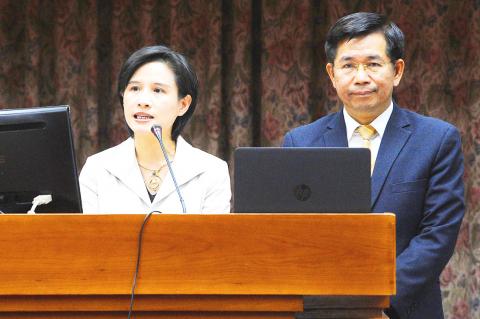
Photo: Chen Chih-chu, Taipei Times
“Examining the truth is not about comparing their achievements with wrongdoings, but to discover the truth about persecution,” Cheng said.
Chen criticized what he described as the ministry’s and the Democratic Progressive Party’s (DPP) “one-sided historical perspective,” as the Act on Promoting Transitional Justice (促進轉型正義條例), which was passed on Tuesday last week, does not address the injustices done to Aborigines and those committed during the Japanese colonial era.
The DPP has also failed to appreciate the KMT’s efforts in defending the nation and preserving National Palace Museum artifacts, Chen added.
Non-Partisan Solidarity Union Legislator May Chin (高金素梅) also questioned the act’s failure to address Aboriginal issues.
Citing DPP Legislator Rosalia Wu’s (吳思瑤) comments on Saturday that the act is part of “third wave democratization” and therefore does not include the more remote issue of Aboriginal transitional justice, Chin said the DPP is deceiving and alienating Aboriginal people.
“Screw your third wave democratization,” Chin said.
Cheng said to review the history of authoritarian rule should not involve the commemoration of the achievements of former presidents, but should instead seek to reconstruct history from the perspective of the victims of past persecutions.
“Do Europeans commemorate Hitler’s achievements when dealing with the Holocaust?” Cheng asked.
Considering the proposals to repurpose and rename the Chiang Kai-shek Memorial Hall, the MOC will not unilaterally decide its future functions, but will instead conduct a five-day forum next year to invite discussions about the proposals.
The MOC will then propose a draft bill to reinvent the memorial hall based on opinions collected from the forum, Cheng said.
“The bottom-up consensus-forming process should not be the same with the top-down authoritarian decisionmaking process that authorized the construction of the memorial hall. The rights to interpretation and decisionmaking should be returned to the public,” she said.
The MOC will also preserve 45 historic sites where political persecution took place and launch an educational program centered on those historic sites, the minister said.
Transitional justice cannot be reduced to renaming roads and schools or misinterpreted as political confrontation — it is to compensate victims and achieve reconciliation, she said.
While there are 29 schools in the nation named after Chiang Kai-shek and another five named to laud his longevity, Pan said that whether they should be renamed depends on democratic discussions among school faculties, students and alumni.
The democratic consensus-forming process will be the most meaningful achievement during the course of campus transitional justice, Pan added.

FUKUOKA SITUATION: Japanese media reported that the pathogen is expected to be identified by the summer, while the CDC downplayed the idea that it was hMPV A “mysterious cold-like illness” reported in Japan’s Fukuoka Prefecture does not seem to be a new disease, but Japanese authorities have been asked about the situation, the Centers for Disease Control (CDC) said yesterday. The Fukuoka Prefectural Medical Association on Wednesday told a news conference that a “mystery cold” that has become a hot topic on social media is “highly likely to be caused by some kind of viral infection,” Japan’s KBC News reported. “Many people are experiencing symptoms starting with a sore throat, followed by a runny nose, phlegm and a severe cough,” KBC News reported, citing association officials. Health authorities are

Nvidia Corp CEO Jensen Huang (黃仁勳) arrived in Taiwan yesterday ahead of upcoming AI and technology events, saying he plans to meet with clients and Taiwan Semiconductor Manufacturing Co Chairman C.C. Wei (魏哲家) during his visit. After landing at Taipei Songshan Airport, Huang posed for photos with fans and handed out Yakult drinks to reporters and supporters waiting at the scene, saying he has “a lot to do” during the trip. Asked about reports that Nvidia’s planned headquarters site in Taipei’s Beitou Shilin Technology Park could break ground on May 27, Huang said that if the company holds an event, he would

The Ministry of Finance this afternoon announced the winning numbers for the March-April uniform invoice lottery. The winning number for the NT$10 million (US$318,060) special prize is 19531471, and the winning number for the NT$2 million grand prize is 85941329. Three numbers were drawn for the NT$200,000 first prize: 07225810, 20231230 and 83518781. Those with receipts matching the last seven digits of any of the first-prize numbers will win the NT$40,000 second prize, while those matching the last six digits will win the NT$10,000 third prize. Those whose receipts match the last five digits of the first-prize numbers can claim the NT$4,000 fourth prize,
Taiwan Travelogue (臺灣漫遊錄), which earlier this week became the first Taiwanese novel to win the International Booker Prize, is to be adapted into a television series through a Taiwan-Japan coproduction, producer Chang Chen-yu (張辰漁) said yesterday. Chang, a producer at World Softest Production Film Co, wrote on Facebook that the company had been searching for projects with international appeal that retain a strong Taiwanese identity after colleagues and Japanese partners strongly recommended the novel. After reading the book, Chang said he immediately decided to pursue the screen rights. “A great story has the power to transcend time and borders, and connect countless people,”


 RSS
RSS