


The Chinese Nationalist Party (KMT) yesterday lashed out at prosecutors for questioning former president Ma Ying-jeou (馬英九) and other key officials over an ongoing judicial probe into alleged financial irregularities in the sale of KMT assets a decade ago, when Ma was the party chairman.
“Ma and other party officials were summoned for questioning by prosecutors for 15 hours on Wednesday in relation to their investigation into party asset sales. We suspect the judiciary is being used as a political tool to unfairly target KMT officials,” party spokesman Huang Chien-hao (黃健豪) said in a statement.
The KMT’s sale and disposal of party assets were managed through legal means, which can withstand scrutiny, Huang said, accusing the Democratic Progressive Party (DPP) of interfering in the judicial system, harassing the opposition and protecting its own interests.
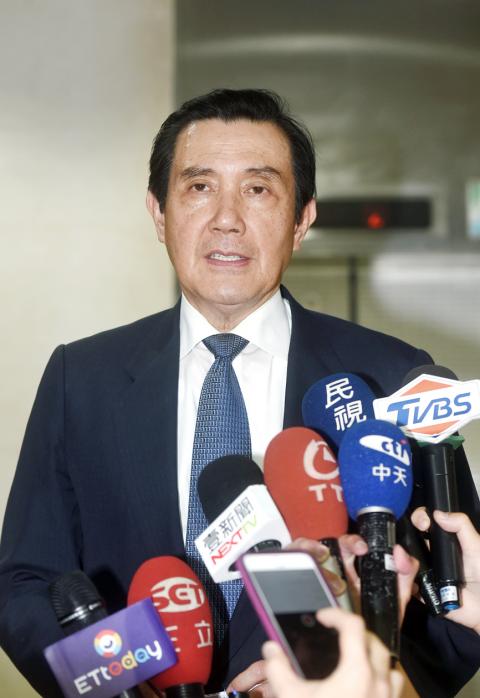
Photo: Fang Pin-chao, Taipei Times
Huang was referring to the Taipei District Prosecutors’ Office’ summoning of Ma for questioning, which went on for more than 14 hours.
It was the first time Ma was summoned for questioning in the judicial probe into a number of questionable financial transactions related to the disposal of KMT-owned businesses, real estate and other valuable party assets during the late 2000s.
According to prosecutors, Ma was questioned as a possible defendant because he was the party chairman at the time who oversaw the financial transactions and was likely the main person who approved the decisions.
Other key party officials were summoned on Wednesday, but were questioned separately to prevent collusion.
They included former KMT administration and management committee director Chang Che-chen (張哲琛), former Central Investment Co (CMPC) general manager Wang Hai-ching (汪海清), and Cheng Uei Precision Industry Co chairman Guo Tai-chiang (郭台強), who is also the chairman of Central Motion Picture Corp.
Prosecutors are investigating the KMT’s sales of three party-
affiliated media companies: CMPC, China Television Co and Broadcasting Corp of China, along with the sale of former KMT headquarters building at the intersection of Renai Road and Zhongshan S Road in Taipei, and the land that used to house the KMT’s National Research Institute.
Many of these assets were allegedly sold below their market prices or involved the transfer of wholly or partly owned state enterprises into private hands in questionable deals that benefited KMT-related figures and businesses.
The party headquarters building, for example, was sold to a nonprofit foundation belonging to Evergreen Group for NT$2.3 billion (US$76.6 million at the current exchange rate) in 2006, far below its estimated value of NT$4 billion.
Ma and the KMT sold the National Research Institute’s land for property redevelopment to Yuan Lih Group for NT$430 million in 2005, while shares in the three party-owned media businesses were sold in an initial deal in 2005 for NT$4 billion to Jungli Investment Co, a subsidiary of Want Want China Times Group registered in the British Cayman Islands.

Actor Darren Wang (王大陸) was sentenced to six months in prison, commutable to a fine, by the New Taipei District Court today for contravening the Personal Data Protection Act (個人資料保護法) in a case linked to an alleged draft-dodging scheme. Wang allegedly paid NT$3.6 million (US$114,380) to an illegal group to help him evade mandatory military service through falsified medical documents, prosecutors said. He transferred the funds to Chen Chih-ming (陳志明), the alleged mastermind of a draft-evasion ring, although he lost contact with him as he was already in detention on fraud charges, they said. Chen is accused of helping a

SECURITY: Starlink owner Elon Musk has taken pro-Beijing positions, and allowing pro-China companies to control Taiwan’s critical infrastructure is risky, a legislator said Starlink was reluctant to offer services in Taiwan because of the nation’s extremely high penetration rates in 4G and 5G services, the Ministry of Digital Affairs said yesterday. The ministry made the comments at a meeting of the legislature’s Transportation Committee, which reviewed amendments to Article 36 of the Telecommunications Management Act (電信管理法). Article 36 bans foreigners from holding more than 49 percent of shares in public telecommunications networks, while shares foreigners directly and indirectly hold are also capped at 60 percent of the total, unless specified otherwise by law. The amendments, sponsored by Chinese Nationalist Party (KMT) Legislator Ko

NON-RED SUPPLY: Boosting the nation’s drone industry is becoming increasingly urgent as China’s UAV dominance could become an issue in a crisis, an analyst said Taiwan’s drone exports to Europe grew 41.7-fold from 2024 to last year, with demand from Ukraine’s fight against Russian aggression the most likely driver of growth, a study showed. The Institute for Democracy, Society and Emerging Technology (DSET) in a statement on Wednesday said it found that many of Taiwan’s uncrewed aerial vehicle (UAV) sales were from Poland and the Czech Republic. These countries likely transferred the drones to Ukraine to aid it in its fight against the Russian invasion that started in 2022, it said. Despite the gains, Taiwan is not the dominant drone exporter to these markets, ranking second and fourth

The eastern extension of the Taipei MRT Red Line could begin operations as early as late June, the Taipei Department of Rapid Transit Systems said yesterday. Taipei Rapid Transit Corp said it is considering offering one month of free rides on the new section to mark its opening. Construction progress on the 1.4km extension, which is to run from the current terminal Xiangshan Station to a new eastern terminal, Guangci/Fengtian Temple Station, was 90.6 percent complete by the end of last month, the department said in a report to the Taipei City Council's Transportation Committee. While construction began in October 2016 with an


 RSS
RSS