


Chinese Nationalist Party (KMT) Chairman Wu Den-yih (吳敦義) yesterday urged President Tsai Ing-wen’s (蔡英文) administration to ensure mutual respect and be discreet when granting visa-waiver privileges to other countries, as he embarked on a trip to Southeast Asia that has been overshadowed by visa application difficulties.
Wu made the remarks at Taiwan Taoyuan International Airport before leaving for the Philippines on a seven-day trip that is to also take him to Thailand.
Wu was on Friday forced to cancel the Thailand leg of his trip, after failing to secure a visa that he had applied for two weeks ago.
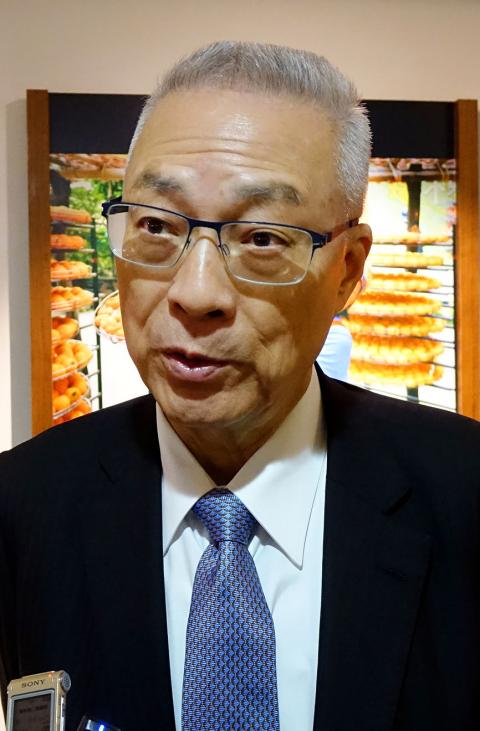
Photo: Chu Pei-hsiung, Taipei Times
However, in an unexpected turn of events, the Thai government decided to issue visa shortly after the KMT announced the cancelation.
“I am not saying that we should not grant visa-free status to nations friendly toward us, but we must be cautious and discreet and have a good grasp of the local situation first,” Wu said.
Citing the US as an example, Wu said that Taiwan had endeavored for a long time to secure visa-free privileges from Washington, but the nation was not able to fulfill all the criteria until 2011, when he was premier.
Taiwan was the 37th nation to be granted the treatment, but only one country has managed to obtain the same privilege since then, Wu said, praising the US’ high standards in granting visa-free entry to foreign nationals.
“[It is inappropriate] if Southeast Asian nations hold off on offering us visa-free treatment, but we proceed to grant it to them. There should be reciprocity,” Wu said, in an apparent reference to the Tsai administration’s granting of visa waivers to some of the nations targeted by its New Southbound Policy.
The government initiated a year-long pilot visa-free entry program for Thai and Bruneian nationals in August last year, offering them 30-day visa-free stay in Taiwan. The program was this year extended by one more year, after government statistics showed a significant increase in the number of tourists from the two countries to Taiwan.
Earlier this month, a similar program was launched for Philippine nationals, who are now granted 14-day visa-free stays in Taiwan. Conditional visa-free entry has also been granted to the citizens of Cambodia, India, Indonesia, Laos, Myanmar and Vietnam.
However, the Thai government, for example, requires that Taiwanese nationals apply for a landing visa upon arrival in Thailand, which is valid for 15 days.
There are also allegations that some Thai nationals have taken advantage of the visa waiver program to engage in prostitution in Taiwan.
In response, Ministry of Foreign Affairs spokesman Andrew Lee (李憲章) said the government has always conducted a thorough and careful evaluation of other nations’ conditions before granting their citizens visa-free entry.
Violations of the Social Order Maintenance Act (社會秩序維護法) have increased slightly since visa waivers were granted to Southeast Asian nations, but the number of tourists from the region to Taiwan has increased 33 percent between January and September compared with same period last year, Lee said.
“While the programs have benefitted tourism as expected, the ministry has instructed the responsible agencies to pay close attention to law violations to keep our nation safe,” he said.

The Centers for Disease Control (CDC) yesterday reported the first case of a new COVID-19 subvariant — BA.3.2 — in a 10-year-old Singaporean girl who had a fever upon arrival in Taiwan and tested positive for the disease. The girl left Taiwan on March 20 and the case did not have a direct impact on the local community, it said. The WHO added the BA.3.2 strain to its list of Variants Under Monitoring in December last year, but this was the first imported case of the COVID-19 variant in Taiwan, CDC Deputy Director-General Lin Ming-cheng (林明誠) said. The girl arrived in Taiwan on

South Korea is planning to revise its controversial electronic arrival card, a step Taiwanese officials said prompted them to hold off on planned retaliatory measures, a South Korean media report said yesterday. A Yonhap News Agency report said that the South Korean Ministry of Foreign Affairs is planning to remove the “previous departure place” and “next destination” fields from its e-arrival card system. The plan, reached after interagency consultations, is under review and aims to simplify entry procedures and align the electronic form with the paper version, a South Korean ministry official said. The fields — which appeared only on the electronic form

The Ministry of Foreign Affairs (MOFA) is suspending retaliation measures against South Korea that were set to take effect tomorrow, after Seoul said it is updating its e-arrival system, MOFA said today. The measures were to be a new round of retaliation after Taiwan on March 1 changed South Korea's designation on government-issued alien resident certificates held by South Korean nationals to "South Korea” from the "Republic of Korea," the country’s official name. The move came after months of protests to Seoul over its listing of Taiwan as "China (Taiwan)" in dropdown menus on its new online immigration entry system. MOFA last week
A bipartisan group of US senators has introduced a bill to enhance cooperation with Taiwan on drone development and to reduce reliance on supply chains linked to China. The proposed Blue Skies for Taiwan Act of 2026 was introduced by Republican US senators Ted Cruz and John Curtis, and Democratic US senators Jeff Merkley and Andy Kim. The legislation seeks to ease constraints on Taiwan-US cooperation in uncrewed aerial systems (UAS), including dependence on China-sourced components, limited access to capital and regulatory barriers under US export controls, a news release issued by Cruz on Wednesday said. The bill would establish a "Blue UAS


 RSS
RSS