


The Chinese Nationalist Party (KMT) yesterday said the Executive Yuan’s hasty passage of a draft amendment to the Labor Standards Act (勞動基準法) on Thursday runs counter to the Democratic Progressive Party (DPP) administration’s pledge to build an “open and transparent government.”
In an effort to ensure openness and transparency in government, the DPP administration issued a regulation in September last year stipulating that draft legislation drawn up by government agencies need to be made available to the public for at least 60 days for review and the gathering of opinions, KMT Culture and Communications Committee deputy director-general Hung Meng-kai (洪孟楷) said.
“Despite the pledge, the draft amendment to the Labor Standards Act was passed by the Executive Yuan only eight days after it was released for public review. This is clearly a violation of the 60-day rule and a black box operation,” Hung told a news conference at the KMT’s headquarters in Taipei.
The amendment is the only one of 66 bills passed this year that failed to comply with the 60-day requirement, he said.
The draft legislation would raise the ceiling for consecutive work days from six to 12 days and would also allow businesses to reduce the minimum rest time between shifts from 11 hours to eight hours with the consent of employees or their workers’ union.
It would also permit a one-year extension for any unused annual leave.
The legislation was drafted amid continued protests from businesses against an amendment passed by the DPP administration in December last year that introduced a contentious five-day workweek with “one fixed day off and one flexible rest day.”
The system ensures workers at least one day off after every six days worked and requires employers to offer better overtime pay for staff.
However, some companies and workers have said that it makes personnel scheduling less flexible, increases costs and robs staff who want to earn more money by working overtime the opportunity to do so.
“The draft amendment could affect the nation’s 9.5 million workers and is a magnet of controversy, but the Cabinet nevertheless passed it only eight days after its publication,” Hung said. “Why is the DPP administration suddenly in such a hurry?”
The government originally stipulated only a seven-day public review period for draft bills, which was extended to 14 days by former president Ma Ying-jeou’s (馬英九) administration and then to 60 days by the DPP government, he said.
Hung urged Legislative Speaker Su Jia-chyuan (蘇嘉全) to refrain from letting the legislature endorse a draft amendment that infringed upon procedural justice.

FUKUOKA SITUATION: Japanese media reported that the pathogen is expected to be identified by the summer, while the CDC downplayed the idea that it was hMPV A “mysterious cold-like illness” reported in Japan’s Fukuoka Prefecture does not seem to be a new disease, but Japanese authorities have been asked about the situation, the Centers for Disease Control (CDC) said yesterday. The Fukuoka Prefectural Medical Association on Wednesday told a news conference that a “mystery cold” that has become a hot topic on social media is “highly likely to be caused by some kind of viral infection,” Japan’s KBC News reported. “Many people are experiencing symptoms starting with a sore throat, followed by a runny nose, phlegm and a severe cough,” KBC News reported, citing association officials. Health authorities are

Nvidia Corp CEO Jensen Huang (黃仁勳) arrived in Taiwan yesterday ahead of upcoming AI and technology events, saying he plans to meet with clients and Taiwan Semiconductor Manufacturing Co Chairman C.C. Wei (魏哲家) during his visit. After landing at Taipei Songshan Airport, Huang posed for photos with fans and handed out Yakult drinks to reporters and supporters waiting at the scene, saying he has “a lot to do” during the trip. Asked about reports that Nvidia’s planned headquarters site in Taipei’s Beitou Shilin Technology Park could break ground on May 27, Huang said that if the company holds an event, he would

Carrefour Taiwan is to begin using a new name from the start of July, but it cannot divulge the name until then, the chairman of the supermarket chain's parent company said today. President Chain Store Co chairman Lo Chih-hsien (羅智先) was asked by reporters after a shareholders' meeting to confirm whether the company has settled on a new name for the supermarket brand. In March, the government-registered name of two Carrefour Taiwan branches was quietly changed to "Le Chia Kang" (樂家康) in Chinese, raising speculation that has been selected as the name. Lo said that because of local regulations and contractual obligations, the
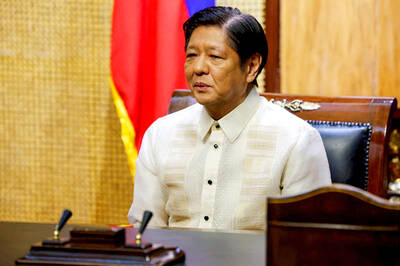
The Philippines would likely be involved in any conflict over Taiwan due to its proximity to the democracy claimed by China, President Ferdinand Marcos Jr said, reiterating a stance that risks angering Beijing. “In the Philippines, we do not have a choice because Taiwan is so close to the Philippines and we have almost 200,000 Filipino nationals living and working in Taiwan,” Marcos said in an interview with Japanese media in Manila on Monday. The Philippine leader’s comments come ahead of a state visit to Japan next week, where he is to meet with Japanese Prime Minister Sanae Takaichi to discuss security


 RSS
RSS