


The absence of any references to the so-called “1992 consensus” in China’s response to President Tsai Ing-wen’s (蔡英文) Double Ten National Day speech has led to speculation over its significance to the cross-strait narrative, a Taiwan-China relations researcher said.
In response to Tsai’s speech, China’s Taiwan Affairs Office (TAO) spokesman Ma Xiaoguang (馬曉光) on Tuesday said the peaceful development of cross-strait relations depends on the “one China” principle and expressed opposition to Taiwanese independence, but made no reference to the “1992 consensus.”
The “1992 consensus,” a term former Mainland Affairs Council chairman Su Chi (蘇起) in 2006 admitted making up in 2000, refers to a tacit understanding between the Chinese Nationalist Party (KMT) and the Chinese government that both sides of the Taiwan Strait acknowledge there is “one China,” with each side having its own interpretation of what “China” means.
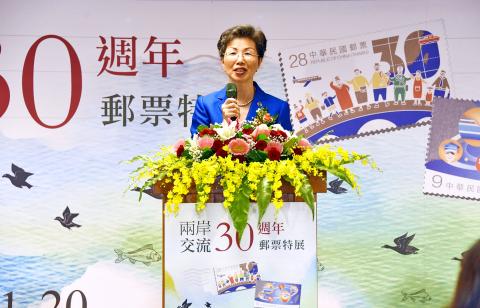
Photo courtesy of Chunghwa Post Co
The TAO’s response was “unprecedented” because it emphasized the “one China” principle instead of the “1992 consensus,” which has been mentioned in its past comments on Taiwan, Democratic Progressive Party (DPP) Legislator Huang Wei-cher (黃偉哲) said.
“Although President Tsai’s public statements have been consistent throughout her term in office and have not crossed any red lines laid out by China, Beijing has continued to escalate its hardline position with each response. This is not the way to show goodwill,” Huang said.
“Tsai has never said or done anything shocking. Such responses [from China] are rather disappointing,” he said.
China refrained from mentioning the “1992 consensus” because it has realized that the consensus is deeply unpopular in Taiwan, National Chengchi University professor Chen Fang-ming (陳芳明) said.
Moreover, the Chinese government might have conceded that the KMT’s chances of returning to power are slim, Chen said.
“If they thought the KMT would retake the government, they would have insisted the Democratic Progressive Party accept the ‘1992 consensus,’” he added.
“It is clear that the ‘1992 consensus’ is a KMT fabrication meant to deceive Taiwanese through collusion with the Chinese Communist Party [CCP],” he said.
Beijing needs to find a new narrative as its basis for future dialogue with the DPP because its under-the-table agreements with the KMT are bound to be rejected by the DPP, Chen added.
Chinese President Xi Jinping (習近平) might not officially respond to Tsai’s comments until he has secured his grip on power after the Chinese Communist Party’s National Congress, which begins on Wednesday next week, Chen said.
The Tsai administration’s “promises and goodwill remain unchanged,” Mainland Affairs Council Minister Katharine Chang (張小月) said yesterday at a Chunghwa Post Co exhibition in Taipei.
The council will not jump to any conclusions about the TAO’s comments because the CCP is expected to elaborate its official line on cross-strait policy at its congress, Chang said.
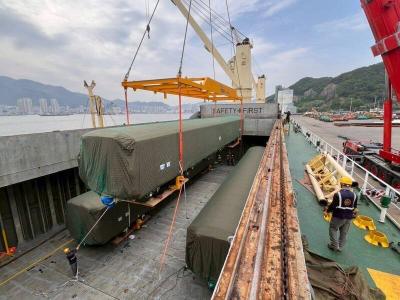
The first of 10 new high-capacity trains purchased from South Korea’s Hyundai Rotem arrived at the Port of Taipei yesterday to meet the demands of an expanding metro network, Taipei Rapid Transit Corp (TRTC) said yesterday. The train completed a three-day, 1,200km voyage from the Port of Masan in South Korea, the company said. Costing NT$590 million (US$18.79 million) each, the new six-carriage trains feature a redesigned interior based on "human-centric" transportation concepts, TRTC said. The design utilizes continuous longitudinal seating to widen the aisles and optimize passenger flow, while also upgrading passenger information displays and driving control systems for a more comfortable
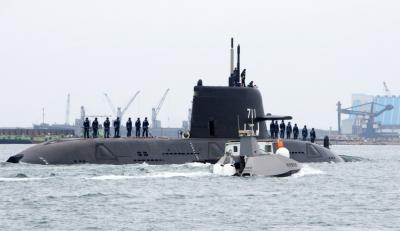
Taiwan's first indigenous defense submarine, the SS-711 Hai Kun (海鯤, or Narwhal), departed for its 13th sea trial at 7am today, marking its seventh submerged test, with delivery to the navy scheduled for July. The outing also marked its first sea deployment since President William Lai (賴清德) boarded the submarine for an inspection on March 19, drawing a crowd of military enthusiasts who gathered to show support. The submarine this morning departed port accompanied by CSBC Corp’s Endeavor Manta (奮進魔鬼魚號) uncrewed surface vessel and a navy M109 assault boat. Amid public interest in key milestones such as torpedo-launching operations and overnight submerged trials,
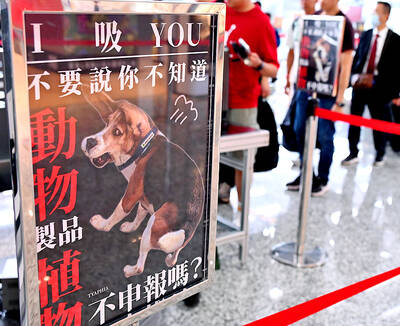
Quarantine awareness posters at Taiwan Taoyuan International Airport have gone viral for their use of wordplay. Issued by the airport branch of the Animal and Plant Health Inspection Agency, the posters feature sniffer dogs making a range of facial expressions, paired with advisory messages built around homophones. “We update the messages for holidays and campaign needs, periodically refreshing materials to attract people’s attention,” quarantine officials said. “The aim is to use the dogs’ appeal to draw focus to quarantine regulations.” A Japanese traveler visiting Taiwan has posted a photo on X of a poster showing a quarantine dog with a

Taiwan’s coffee community has launched a “one-person-one-e-mail” campaign, calling for people to send a protest-e-mail to the World Coffee Championships (WCC) urging it to redesignate Taiwanese competitors as from “Taiwan,” rather than “Chinese Taipei.” The call followed sudden action last week after the WCC changed all references to Taiwanese competitors from “Taiwan” to “Chinese Taipei,” including recent World Latte Art champion Bala (林紹興), who won the World Latte Art Championship in San Diego earlier this month. When Bala received the trophy, he was referred to as representing Taiwan, as well as in the announcement on the WCC’s Web site, until it


 RSS
RSS