


The Taiwan-based Bamboo Union and Hong Kong-based 14K triad are behind the proliferation of drugs in the Philippines, Philippine President Rodrigo Duterte said yesterday, after barrels of drugs fitted with satellite positioning equipment and covered with Chinese writing washed up in the Philippines on Wednesday last week.
He first made the allegation that the drugs were from Taiwan while speaking at a police academy alumni event on Thursday last week.
Duterte, speaking on Tuesday at an event marking the 120th anniversary of the establishment of the Philippine Department of Justice, named the Bamboo Union and 14K as running the drug trade in the country.
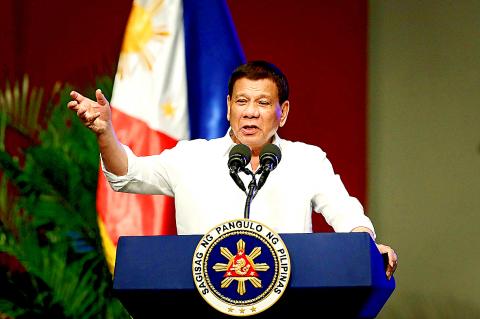
Photo: EPA
At an event celebrating the 56th anniversary of the Philippine Constitution Association, he said that the Philippines is a client state of the Bamboo Union.
“The Philippines is a transshipment [point] of shabu to America. It behooves upon America to work closely with the Republic of the Philippines, especially in this serious matter,” he said.
Shabu is a slang term for methamphetamine that is widely used in the Philippines, Japan, Hong Kong, Malaysia and Indonesia.
Illegal drugs have penetrated 40 percent of the villages in the country, Duterte said.
He has been pushing to postpone village elections scheduled for next month, citing the alleged presence of narcotics in politics at the village level.
Duterte, who is known for his controversial policy of cracking down on drugs by sanctioning extrajudicial killings of suspected drug dealers, on Thursday last week reportedly gave police orders to kill his eldest son if they discover that he is involved in the drug trade.
That remark came after Philippine Senator Antonio Trillanes claimed that Duterte’s eldest son is a member of a Chinese drug triad.
Meanwhile, a Ministry of Foreign Affairs spokeswoman yesterday reiterated Taiwan’s support of the Philippine government’s “war on drugs.”
Regarding Duterte’s claim that the Bamboo Union, a known organized crime group, is one of the primary sources of drugs in the Philippines, ministry spokeswoman Eleanor Wang (王珮玲) said in a statement that the government would work with relevant Philippine agencies to eliminate cross-border drug-related crime.
A critical component of the administration’s New Southbound Policy is to strengthen Taiwan’s collaboration with other nations to crack down on international crime, which in the case of the Philippines means a shared effort to combat drug-related crime, Wang said.
The statement did not dispute Duterte’s allegations, but voiced support for his increasingly tough policies on drug-related activities.
The Taipei Economic and Cultural Office in the Philippines yesterday rejected Duterte’s claims.
Representative to the Philippines Gary Lin (林松煥) said that what is known at the moment is that illegal drugs in the Philippines are not coming from Taiwan.
Taiwan does not ship drugs to the Philippines, Lin said, but added that his office was looking into the situation.
Regarding an allegation that drugs were being produced in labs in international waters, Lin said that Taiwanese fishing boats were not involved and that the transportation routes were most likely in international waters.
Raw materials for the production of illegal drugs have been mainly obtained from China, while Taiwanese have provided expertise, said a Philippine source, who claimed to be an expert on the Philippine drug trade.

Considering that most countries issue more than five denominations of banknotes, the central bank has decided to redesign all five denominations, the bank said as it prepares for the first major overhaul of the banknotes in more than 24 years. Central bank Governor Yang Chin-lung (楊金龍) is expected to report to the Legislative Yuan today on the bank’s operations and the redesign’s progress. The bank in a report sent to the legislature ahead of today’s meeting said it had commissioned a survey on the public’s preferences. Survey results showed that NT$100 and NT$1,000 banknotes are the most commonly used, while NT$200 and NT$2,000

The Centers for Disease Control (CDC) yesterday reported the first case of a new COVID-19 subvariant — BA.3.2 — in a 10-year-old Singaporean girl who had a fever upon arrival in Taiwan and tested positive for the disease. The girl left Taiwan on March 20 and the case did not have a direct impact on the local community, it said. The WHO added the BA.3.2 strain to its list of Variants Under Monitoring in December last year, but this was the first imported case of the COVID-19 variant in Taiwan, CDC Deputy Director-General Lin Ming-cheng (林明誠) said. The girl arrived in Taiwan on

ANNUAL EVENT: Two massive Pokemon balloons are to be set up in Daan Park, with an event zone operating from 10am to 6pm This year’s Taipei Floral Picnic is to be held at Daan Park today and tomorrow, featuring an exclusive Pokemon Go event, a themed food market, a coffee rave picnic area and stage performances, the Taipei Department of Information and Tourism said yesterday. Two massive Pokemon balloons are to be set up in the park as attractions, with an exclusive event zone operating from 10am to 6pm, it said. Participants who complete designated tasks on-site would have a chance to receive limited-edition souvenirs, it added. People could also try the newly launched game Pokemon Pokopia in the trial area, the department said. Three PokeStops are

South Korea is planning to revise its controversial electronic arrival card, a step Taiwanese officials said prompted them to hold off on planned retaliatory measures, a South Korean media report said yesterday. A Yonhap News Agency report said that the South Korean Ministry of Foreign Affairs is planning to remove the “previous departure place” and “next destination” fields from its e-arrival card system. The plan, reached after interagency consultations, is under review and aims to simplify entry procedures and align the electronic form with the paper version, a South Korean ministry official said. The fields — which appeared only on the electronic form


 RSS
RSS