


State-run oil refiner CPC Corp, Taiwan (CPC) last year sold half of its stake in an oil exploration project in Chad to CEFC China Energy Co, potentially giving the venture to the Chinese conglomerate, which allegedly has Chinese People’s Liberation Army (PLA) connections, a Democratic Progressive Party (DPP) lawmaker said yesterday.
CPC has cooperated with the Chadian government in developing an oil field since 2006, with CPC holding a 70 percent stake in the project and the government holding the remaining 30 percent.
CPC in 2011 announced that it had made a crude oil discovery and would begin drilling, a milestone for Taiwan’s oil supply industry, but in 2015 the company announced that it would sell half of its share to CEFC, a deal that was completed last year.
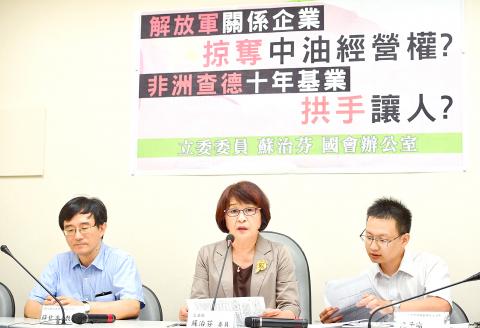
Photo: Peter Lo, Taipei Times
During a news conference at Legislative Yuan, DPP Legislator Su Chih-feng (蘇治芬) questioned if the CPC has authority over the now-joint venture, especially when CEFC is allegedly connected with PLA officials.
Former CPC Chad mining office director Chen Tzu-yu (陳子瑜) said although CEFC had promised that it would not challenge the CPC’s managing authority, it nevertheless put six employees in the CPC office, which was staffed by fewer than 20 Taiwanese.
A CEFC employee also holds the critical position of production vice president, which would allow the Chinese company to plan and direct the production process when the oil field begins production, Chen said, warning against the CEFC’s potential to monopolize the venture.
CEFC’s top management allegedly has a background in the PLA, casting a shadow over its partnership with CPC, Chen said.
CEFC chairman Ye Jianming (葉簡明) and executive director Chan Chauto (陳秋途) were high-ranking Chinese Association for International Friendly Contact officials, Chen said.
Notable association member Xin Qi (辛旗), a PLA major general involved in China’s Taiwan affairs, is rumored to be behind Taiwan’s high-school curriculum guidelines controversy, Chen said.
The China Academy of Culture Ltd, a cultural organization established by CEFC, has organized several cross-strait exchange events with a “united front” aim, Chen said.
National Chengchi University professor Hsueh Hua-yuan (薛化元) warned against a possible hostile takeover by CEFC.
“Market economy is only applicable to nations where rules of the market economy are observed, but [CPC] has to change its mindset when dealing with people who do not observe the rules,” Hsueh said.
However, CPC Exploration and Production Business Division chief executive officer Michael Chang (張敏) said that CPC is in control of the Chadian project.
CPC holds the positions of general manager, operational vice president and technical vice president, while the Chadian government has promised to stay neutral in a potential management dispute, Chang said.
CPC has invested more than US$200 million in the project and CEFC has spent US$114 million purchasing CPC shares, the company said.
The shares were sold because CEFC offered the best terms against five Canadian and Malaysian bidders, and because the company decided to hedge the risk of development failure due to concerns about technical problems, local politics and oil price fluctuations, Chang said.
The oil field has a reserve of about 34.74 million barrels and could begin production by 2020.
CPC is to invest another US$473 million in developing the oilfield, with an estimated return of 15 percent.

Taiwanese can file complaints with the Tourism Administration to report travel agencies if their activities caused termination of a person’s citizenship, Mainland Affairs Council Minister Chiu Chui-cheng (邱垂正) said yesterday, after a podcaster highlighted a case in which a person’s citizenship was canceled for receiving a single-use Chinese passport to enter Russia. The council is aware of incidents in which people who signed up through Chinese travel agencies for tours of Russia were told they could obtain Russian visas and fast-track border clearance, Chiu told reporters on the sidelines of an event in Taipei. However, the travel agencies actually applied
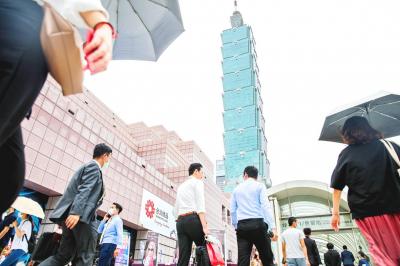
Japanese footwear brand Onitsuka Tiger today issued a public apology and said it has suspended an employee amid allegations that the staff member discriminated against a Vietnamese customer at its Taipei 101 store. Posting on the social media platform Threads yesterday, a user said that an employee at the store said that “those shoes are very expensive” when her friend, who is a migrant worker from Vietnam, asked for assistance. The employee then ignored her until she asked again, to which she replied: "We don't have a size 37." The post had amassed nearly 26,000 likes and 916 comments as of this

New measures aimed at making Taiwan more attractive to foreign professionals came into effect this month, the National Development Council said yesterday. Among the changes, international students at Taiwanese universities would be able to work in Taiwan without a work permit in the two years after they graduate, explainer materials provided by the council said. In addition, foreign nationals who graduated from one of the world’s top 200 universities within the past five years can also apply for a two-year open work permit. Previously, those graduates would have needed to apply for a work permit using point-based criteria or have a Taiwanese company
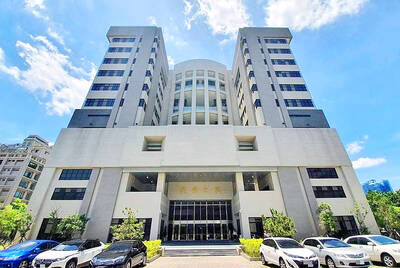
The Shilin District Prosecutors’ Office yesterday indicted two Taiwanese and issued a wanted notice for Pete Liu (劉作虎), founder of Shenzhen-based smartphone manufacturer OnePlus Technology Co (萬普拉斯科技), for allegedly contravening the Act Governing Relations Between the People of the Taiwan Area and the Mainland Area (臺灣地區與大陸地區人民關係條例) by poaching 70 engineers in Taiwan. Liu allegedly traveled to Taiwan at the end of 2014 and met with a Taiwanese man surnamed Lin (林) to discuss establishing a mobile software research and development (R&D) team in Taiwan, prosecutors said. Without approval from the government, Lin, following Liu’s instructions, recruited more than 70 software


 RSS
RSS