


The Chinese Nationalist Party’s (KMT) National Policy Foundation think tank yesterday raised questions over revised budget proposals for the current fiscal year, saying that the government might be reinstating “dollar diplomacy” through a drastically inflated “black budget,” while the national defense budget has slumped to a record low of NT$327.8 billion (US$10.88 billion).
At NT$1.72 billion, the black budget for diplomacy has nearly quadrupled from last year’s NT$464 million, foundation Department of National Security convener Lin Yu-fang (林郁方) told a news conference in Taipei.
The budget would make up 6.47 percent of the nation’s overall spending over the next 12 months, compared with 1.89 percent over the past 12 months, Lin said, adding that it has received a larger allocation than the Ministry of Foreign Affairs’ black budget.
He questioned the intent behind the increase, saying that due to the nation’s diplomatic plight, it could involve a “secretive dollar diplomacy” agenda similar to those of past administrations, which drew significant public criticism.
The defense budget accounts for a record low 1.84 percent of the nation’s projected GDP of NT$17.78 trillion for next year, meaning President Tsai Ing-wen (蔡英文) has failed to honor her campaign promise to boost defense spending to 3 percent of GDP, which, based on the forecast, should be NT$533.6 billion, Lin said.
There is an uneven distribution of funds in the defense budget, with personnel costs taking up 46 percent, meaning the quota for purchasing, researching and developing weapons has been reduced, he said.
Since Tsai took office, the budget for procuring arms has continued to decline to about NT$86 billion, compared with NT$97.7 billion allocated in 2015 during former president Ma Ying-jeou’s (馬英九) second term, he added.
Concern over the nation’s ability to defend itself has been aggravated by the slowing progress on Tsai’s initiative to locally build warships, Lin said.
Meanwhile, in an unprecedented move, the ministry has earmarked NT$116 million for the Overseas Community Affairs Council, he said.
It is inappropriate to allocate funds from a black budget for the council, as subsidizing overseas Taiwanese groups could strike a sensitive nerve for foreign governments and the Democratic Progressive Party should avoid giving the impression that it is trying to interfere with other nations’ domestic affairs, he added.
Lin also questioned the government’s estimate of low-ranking military officers it expects to recruit over the next 12 months — 8,523, 1.8 times the number recorded in the past 12 months, 4,762 — saying that the figure might have been overblown.
The increase was forecast, despite a Ministry of National Defense plan to reduce the number of volunteer officers and soldiers from 175,000 to about 160,000, which makes it seem improbable, he said.
He raised concerns over the downsizing of the military, saying that it could impact the nation’s ability to defend itself.

The military has spotted two Chinese warships operating in waters near Penghu County in the Taiwan Strait and sent its own naval and air forces to monitor the vessels, the Ministry of National Defense (MND) said. Beijing sends warships and warplanes into the waters and skies around Taiwan on an almost daily basis, drawing condemnation from Taipei. While the ministry offers daily updates on the locations of Chinese military aircraft, it only rarely gives details of where Chinese warships are operating, generally only when it detects aircraft carriers, as happened last week. A Chinese destroyer and a frigate entered waters to the southwest
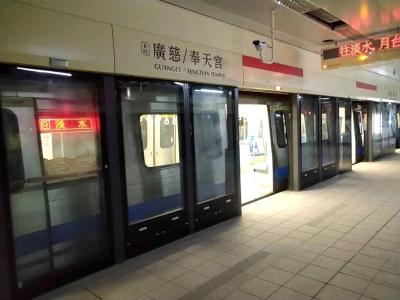
The eastern extension of the Taipei MRT Red Line could begin operations as early as late June, the Taipei Department of Rapid Transit Systems said yesterday. Taipei Rapid Transit Corp said it is considering offering one month of free rides on the new section to mark its opening. Construction progress on the 1.4km extension, which is to run from the current terminal Xiangshan Station to a new eastern terminal, Guangci/Fengtian Temple Station, was 90.6 percent complete by the end of last month, the department said in a report to the Taipei City Council's Transportation Committee. While construction began in October 2016 with an
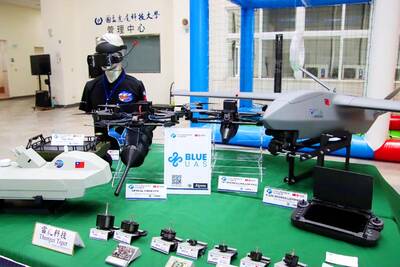
NON-RED SUPPLY: Boosting the nation’s drone industry is becoming increasingly urgent as China’s UAV dominance could become an issue in a crisis, an analyst said Taiwan’s drone exports to Europe grew 41.7-fold from 2024 to last year, with demand from Ukraine’s fight against Russian aggression the most likely driver of growth, a study showed. The Institute for Democracy, Society and Emerging Technology (DSET) in a statement on Wednesday said it found that many of Taiwan’s uncrewed aerial vehicle (UAV) sales were from Poland and the Czech Republic. These countries likely transferred the drones to Ukraine to aid it in its fight against the Russian invasion that started in 2022, it said. Despite the gains, Taiwan is not the dominant drone exporter to these markets, ranking second and fourth
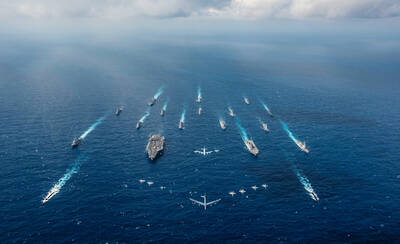
Japanese Prime Minister Sanae Takaichi’s comment last year on Tokyo’s potential reaction to a Taiwan-China conflict has forced Beijing to rewrite its invasion plans, a retired Japanese general said. Takaichi told the Diet on Nov. 7 last year that a Chinese naval blockade or military attack on Taiwan could constitute a “survival-threatening situation” for Japan, potentially allowing Tokyo to exercise its right to collective self-defense. Former Japan Ground Self-Defense Force general Kiyofumi Ogawa said in a recent speech that the remark has been interpreted as meaning Japan could intervene in the early stages of a Taiwan Strait conflict, undermining China’s previous assumptions


 RSS
RSS