


Premier William Lai (賴清德) should hold President Tsai Ing-wen’s (蔡英文) administration and the fipronil-tainted eggs scandal to the same strict standards he demanded of then-president Ma Ying-jeou (馬英九) during the 2014 tainted cooking oil scandals, the Chinese Nationalist Party (KMT) said yesterday.
The Taipei Department of Health on Monday announced that it has sent a large batch of eggs discovered last week to have been contaminated by the insecticide back to Tainan, where they originated, to be destroyed, KMT Culture and Communications Committee deputy director-general Hung Meng-kai (洪孟楷) told a Taipei news conference.
The discovery of more tainted eggs came after the central government told the public on Aug. 18 that all fipronil-tainted eggs had been accounted for and that eggs on the market were safe for consumption, which showed that Council of Agriculture and Ministry of Health of Welfare efforts to curb the distribution of tainted eggs had failed, Hung said.
As Tainan mayor, Lai had criticized Ma for “shifting the responsibility” of preventing substandard cooking oils being produced from his administration to local governments, Hung said.
Lai had called on Ma to convene a meeting of the premier, central and local government officials and lawmakers to tackle the issue of eliminating the tainted oils, adding that it was “unpresidential” of Ma to try to shift responsibility to local governments.
“Tsai has not said a word about the tainted eggs in these two months, and no ministerial-level official has offered a word of apology,” Hung said, adding that the president and her officials were “hiding.”
“We urge Lai to hold Tsai to the same standards. He must not make an about-face by only talking the talk and not walking the walk,” Hung said.
National Taiwan Normal University chemistry professor Wu Chia-cheng (吳家誠) told the news conference that fipronil-tainted eggs had been a major food safety issue earlier this year in Hong Kong and South Korea, but the government had not taken notice.
The government had acted irresponsibly, Wu said.
Fipronil is an insecticide, for which the EU has set a permissible residue level in food products of just 5 parts per billion, indicating that it is highly toxic, Wu said.
Though not considered carcinogenic, if consumed by humans, it could damage their kidneys, liver and endocrine system, he said.
Separately, KMT caucus secretary-general Lin Wei-chou (林為洲) told a news conference at the legislature that the continuing discoveries of more eggs tainted with fipronil could mean the inspections carried out by local agricultural authorities had been lenient.
That means graft could have been involved, Lin said.
The lawmaker said that he was perplexed as to why tainted agricultural products are rarely detected on farms, and violations are almost always discovered after the products have been distributed to retailers.
Local agricultural and animal health inspection agencies are responsible of ensuring the safety of agricultural products, but they are also known to have reciprocal relationships with farmers and producers, which could lead to collusion and in turn lead to inaccuracies when screening for hazardous chemicals or additives, he said.
Possible collusion could also explain why data on local government’s inspections of agricultural products often conflict with the results of screening tests conducted after a food scandal breaks out, he said.
The government should address this issue, he said, adding that it should also provide the public with a systematic account of the tainted eggs scandal.

The military has spotted two Chinese warships operating in waters near Penghu County in the Taiwan Strait and sent its own naval and air forces to monitor the vessels, the Ministry of National Defense (MND) said. Beijing sends warships and warplanes into the waters and skies around Taiwan on an almost daily basis, drawing condemnation from Taipei. While the ministry offers daily updates on the locations of Chinese military aircraft, it only rarely gives details of where Chinese warships are operating, generally only when it detects aircraft carriers, as happened last week. A Chinese destroyer and a frigate entered waters to the southwest

The eastern extension of the Taipei MRT Red Line could begin operations as early as late June, the Taipei Department of Rapid Transit Systems said yesterday. Taipei Rapid Transit Corp said it is considering offering one month of free rides on the new section to mark its opening. Construction progress on the 1.4km extension, which is to run from the current terminal Xiangshan Station to a new eastern terminal, Guangci/Fengtian Temple Station, was 90.6 percent complete by the end of last month, the department said in a report to the Taipei City Council's Transportation Committee. While construction began in October 2016 with an
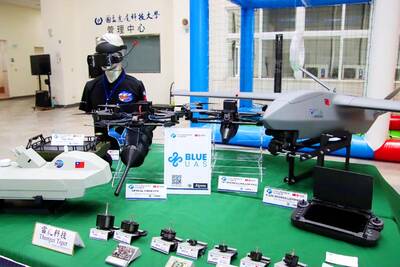
NON-RED SUPPLY: Boosting the nation’s drone industry is becoming increasingly urgent as China’s UAV dominance could become an issue in a crisis, an analyst said Taiwan’s drone exports to Europe grew 41.7-fold from 2024 to last year, with demand from Ukraine’s fight against Russian aggression the most likely driver of growth, a study showed. The Institute for Democracy, Society and Emerging Technology (DSET) in a statement on Wednesday said it found that many of Taiwan’s uncrewed aerial vehicle (UAV) sales were from Poland and the Czech Republic. These countries likely transferred the drones to Ukraine to aid it in its fight against the Russian invasion that started in 2022, it said. Despite the gains, Taiwan is not the dominant drone exporter to these markets, ranking second and fourth

Japanese Prime Minister Sanae Takaichi’s comment last year on Tokyo’s potential reaction to a Taiwan-China conflict has forced Beijing to rewrite its invasion plans, a retired Japanese general said. Takaichi told the Diet on Nov. 7 last year that a Chinese naval blockade or military attack on Taiwan could constitute a “survival-threatening situation” for Japan, potentially allowing Tokyo to exercise its right to collective self-defense. Former Japan Ground Self-Defense Force general Kiyofumi Ogawa said in a recent speech that the remark has been interpreted as meaning Japan could intervene in the early stages of a Taiwan Strait conflict, undermining China’s previous assumptions


 RSS
RSS