


CRIME
Cannabis seized in Taoyuan
A shipment of about 6kg of smuggled cannabis was seized by customs officials at a cargo services center near Taiwan Taoyuan International Airport, the Aviation Police Bureau said on Thursday. The 6,225g of drugs were found stashed in two large boxes during a clearing inspection at Taiwan Air Cargo Terminal’s facility, one of the largest air cargo centers at the airport, the bureau said. The shipment was destined for Hualien County, it said. With the assistance of Hualien police, the find was later connected to a suspect surnamed Wu (吳), who said that he was only receiving the package on behalf of a friend in prison. The man was taken to the Taoyuan District Prosecutors’ Office for further questioning, the bureau said, adding that authorities would expand their search to see whether there are possible suspects in the case.
GOVERNANCE
Cultural center opened
The Ministry of Culture yesterday inaugurated the Mongolian and Tibetan Cultural Center, which is to take over the promotion and preservation of Mongolian and Tibetan culture from the now-disbanded Mongolian and Tibetan Affairs Commission. The commission was disbanded last month as part of a government restructuring plan, and its tasks and budgets were distributed among the Ministry of Culture, Ministry of Foreign Affairs and the Mainland Affairs Council. The Mongolian and Tibetan Cultural Center, housed on the former premises of the commission, is headed by Hsu Kuei-hsiang (徐桂香), who served as chief secretary of the commission. The center is also to supervise Mongolian and Tibetan cultural foundations, organize exhibitions, preserve historical documents and artifacts, and train talent in the field, the Ministry of Culture said.
MEDIA
MOJ accused of power abuse
The Control Yuan on Wednesday issued a reprimand to the Ministry of Justice (MOJ), saying officials have been abusing their power and infringing on press freedom by investigating members of the media. According to the Control Yuan, its investigations have revealed that some ministry officials have been using lie detectors and accessing journalists’ phone records to investigate members of the media. In response, the ministry’s Agency Against Corruption issued a statement defending agency officials saying they were performing their official duties without the purview of a clear law. The agency said it would draft a law to define its duties and how its officials should carry them out independently while also protecting human rights.
IMMIGRATION
Tsai welcomes exchanges
President Tsai Ing-wen (蔡英文) yesterday stated her administration’s commitment to allow more foreign nationals to study in Taiwan at a reception for a delegation of Malaysian alumni of local universities. Tsai hosted the delegation of officers from the Federation of Alumni Associations of Taiwan Universities, Malaysia, reiterating her administration’s desire to promote more academic and cultural exchanges between both countries’ students, as part of the New Southbound Policy. The growing numbers of Malaysian students attending Taiwan’s universities have made campuses more diverse, she said. Tsai’s goal is to create a cross-national talent base in Asia that will benefit the whole region’s development, the Presidential Office said in a statement on the event. The government is working on policies to make sure that foreign nationals who want to stay and work could do so, Tsai added.

NATIONAL SECURITY: Authorities are working to confirm the identities of the military personnel involved and investigating possible illegal conduct and regulatory violations Authorities are probing possible national security implications after Kinmen police and immigration officers on Sunday found a Chinese woman allegedly posing as a tourist while engaging in prostitution involving more than 10 military personnel. The woman, surnamed Chen (陳), has since been deported, authorities said, adding that investigators are still working to confirm the identities of those implicated, as the records only listed code names and aliases. The case stemmed from a report received by the Kinmen District Prosecutors’ Office on Friday last week from the Jinhu Precinct of the Kinmen County Police Bureau. On Sunday, police, along with the National Immigration

GLOBALGIVING: ‘ Caving to external pressure is not acceptable for an organization that has cultivated justice reform and human rights for 30 years,’ one NGO said A slew of non-government organizations (NGOs) have withdrawn from the GlobalGiving fundraising platform after it announced it would use “Chinese Taipei” instead of “Taiwan” from next month. The Taiwan Good Rice Association wrote on Facebook on Friday that it was informed on April 28 via a teleconference call of the change, which was made because the platform wanted to operate in China. Taiwan Good Rice is to terminate all cooperative relationships with GlobalGiving in response to the platform’s “unilateral and non-negotiable” decision to remove references to Taiwan, the NGO said. “Taiwan is in the official name of Taiwan Good Rice Association and the
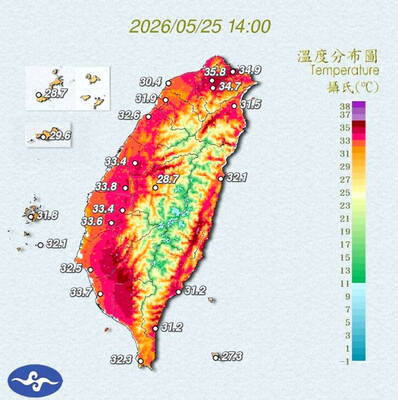
STAY COOL: The HPA recommended that people stay hydrated, use air-conditioning or fans while indoors, wear loose-fitting clothes and walk in the shade while outdoors Employers must implement measures such as installing cooling equipment, and providing drinking water and rest breaks for outdoor workers starting from Monday next week, the Taipei Department of Labor said on Sunday. Employers who fail to comply could face fines of NT$30,000 to NT$300,000 under the Occupational Safety and Health Act (職業安全衛生法), the department said. Businesses in Taipei employing fewer than 100 workers, as well as registered self-employed workers with labor insurance coverage, could receive on-site assessments and guidance from occupational safety consultants to help them apply for central government subsidies to implement or improve heat-protection measures, it said. Under the Ministry of

Chinese Nationalist Party (KMT) Chairwoman Cheng Li-wun (鄭麗文) yesterday briefed her party’s Central Standing Committee regarding her scheduled visit to the US between Monday next week and June 16, saying that her purpose would be to persuade the US that the Republic of China (ROC) Constitution was a “one China” constitution that would foster stable and peaceful cross-strait relations. The ROC Constitution is the most important defense for all Taiwanese citizens, as it upholds our democracy and has contributed to our robust economy, which aligns with international and US interests, she said. “We would not be troublemakers and drag the US under,”


 RSS
RSS