


Premier-designate William Lai (賴清德) yesterday finalized the Cabinet reshuffle, adding only a handful of new faces while retaining the majority of ministers.
Only two ministers are being replaced: National Development Council Minister Chen Tain-jy (陳添枝) will today be replaced by Cabinet Secretary-General Chen Mei-ling (陳美伶) and Ill-gotten Party Assets Settlement Committee Chairman Wellington Koo (顧立雄) is to become the new Financial Supervisory Commission chairman, Executive Yuan spokesman Hsu Kuo-yung (徐國勇) said.
Koo’s vacancy is to be filled by National Security Council adviser Lin Feng-jeng (林?正), Hsu said.
Acting Minister of Economic Affairs Sheng Jong-chin (沈榮津) is to be promoted to minister and National Development Council Deputy Minister Kung Ming-hsin (龔明鑫) is to be named Shen’s deputy.
Lai has named Taiwan Stock Exchange Corp (台灣證交所) chairman Shih Jun-ji (施俊吉) as the next vice premier and Democratic Progressive Party Deputy Secretary-General Cho Jung-tai (卓榮泰) as the next Cabinet secretary-general.
All other ministers are to remain at their posts, including Minister of the Interior Yeh Jiunn-rong (葉俊榮), Minister of Foreign Affairs David Lee (李大維), Minister of National Defense Feng Shih-kuan (馮世寬), Minister of Finance Sheu Yu-jer (許虞哲), Minister of Education Pan Wen-chung (潘文忠), Minister of Justice Chiu Tai-san (邱太三), Minister of Transportation and Communications Hochen Tan (賀陳旦), Minister of Labor Lin Mei-chu (林美珠), Minister of Health and Welfare Chen Shih-chung (陳時中), Minister of Culture Cheng Li-chiun (鄭麗君), Minister of Science and Technology Chen Liang-gee (陳良基) Environmental Protection Administration Minister Lee Ying-yuan (李應元), Council of Agriculture Minister Lin Tsung-hsien (林聰賢), Mainland Affairs Council Minister Katharine Chang (張小月), Overseas Community Affairs Council Minister Wu Hsin-hsing (吳新興), Council of Indigenous Peoples Minister Icyang Parod and Hakka Affairs Council Minister Lee Yong-te (李永得).
The ministers without portfolio are Lin Wan-i (林萬億), Chang Ching-sen (張景森), Chen Mei-ling, Hsu Chang-yao (許璋瑤), John Deng (鄧振中), Audrey Tang (唐鳳), Wu Tsung-tsong (吳政忠) and Wu Hong-mo (吳宏謀). All are incumbents, except for Chen Mei-ling.
CGA Director-General Lee Chung-wei (李仲威), Veterans Affairs Council Director Lee Shying-jow (李翔宙), Directorate-General of Budget, Accounting and Statistics Minister Chu Tzer-ming (朱澤民), Directorate-General of Personnel Administration Minister Jay Shih (施能傑), Public Construction Commission Minister Wu Hong-mo (吳宏謀) and Atomic Energy Council Minister Hsieh Shou-shing (謝曉星) are also to remain.
However, Deputy Minister of Labor Kuo Kuo-wen (郭國文) is to leave for personal reasons.

The military has spotted two Chinese warships operating in waters near Penghu County in the Taiwan Strait and sent its own naval and air forces to monitor the vessels, the Ministry of National Defense (MND) said. Beijing sends warships and warplanes into the waters and skies around Taiwan on an almost daily basis, drawing condemnation from Taipei. While the ministry offers daily updates on the locations of Chinese military aircraft, it only rarely gives details of where Chinese warships are operating, generally only when it detects aircraft carriers, as happened last week. A Chinese destroyer and a frigate entered waters to the southwest

A magnitude 6.1 earthquake struck off the coast of Yilan County at 8:39pm tonight, the Central Weather Administration (CWA) said, with no immediate reports of damage or injuries. The epicenter was 38.7km east-northeast of Yilan County Hall at a focal depth of 98.3km, the CWA’s Seismological Center said. The quake’s maximum intensity, which gauges the actual physical effect of a seismic event, was a level 4 on Taiwan’s 7-tier intensity scale, the center said. That intensity level was recorded in Yilan County’s Nanao Township (南澳), Hsinchu County’s Guansi Township (關西), Nantou County’s Hehuanshan (合歡山) and Hualien County’s Yanliao (鹽寮). An intensity of 3 was
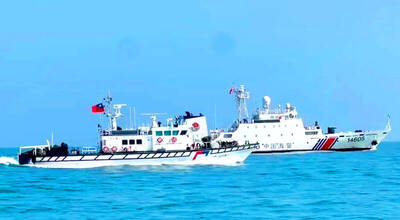
Instead of focusing solely on the threat of a full-scale military invasion, the US and its allies must prepare for a potential Chinese “quarantine” of Taiwan enforced through customs inspections, Stanford University Hoover fellow Eyck Freymann said in a Foreign Affairs article published on Wednesday. China could use various “gray zone” tactics in “reconfiguring the regional and ultimately the global economic order without a war,” said Freymann, who is also a nonresident research fellow at the US Naval War College. China might seize control of Taiwan’s links to the outside world by requiring all flights and ships entering or leaving Taiwan
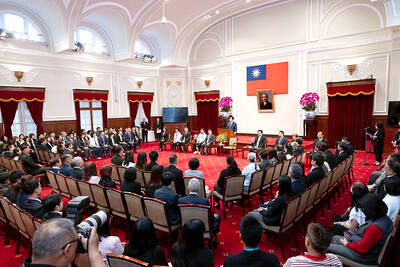
The next minimum wage hike is expected to exceed NT$30,000, President William Lai (賴清德) said yesterday during an award ceremony honoring “model workers,” including migrant workers, at the Presidential Office ahead of Workers’ Day today. Lai said he wished to thank the awardees on behalf of the nation and extend his most sincere respect for their hard work, on which Taiwan’s prosperity has been built. Lai specifically thanked 10 migrant workers selected for the award, saying that although they left their home countries to further their own goals, their efforts have benefited Taiwan as well. The nation’s industrial sector and small businesses lay


 RSS
RSS